Cincuenta años de cambios en el sector de los cimientos de concreto: Cómo la colaboración y la innovación siguen marcando el trabajo de los contratistas de cimientos
De MPW Construction Services
E n los últimos cincuenta años, el sector de los cimientos de concreto ha experimentado una transformación radical. Los avances tecnológicos, las mejoras en la seguridad en las obras, la mayor especialización y la capacidad de los contratistas para aprender unos de otros han redefinido la forma en que se realizan los trabajos de cimentación en toda América del Norte. Desde entonces, organizaciones como la Concrete Foundations Association (CFA) han desempeñado un papel significativo en esta evolución al proporcionar a los contratistas un foro para compartir ideas, perfeccionar las prácticas recomendadas y adoptar nuevas tecnologías. Para muchos contratistas, las lecciones aprendidas a través de la CFA han ayudado a orientar las decisiones sobre inversión en equipos, prácticas de seguridad y estrategia comercial tanto durante los ciclos económicos prósperos como durante los difíciles.
El sector hace cincuenta años
A mediados de la década de 1970, muchos contratistas de cimientos de concreto operaban con una mecanización limitada. Los encofrados se manejaban a menudo de forma manual, la colocación del concreto dependía en gran medida de la descarga directa de los camiones de concreto preparado, y la piedra de drenaje y el relleno de los cimientos se colocaban comúnmente con palas y cubetas. El equipo que hoy es estándar —como camiones de carga, equipo de bombeo especializado, sistemas de trazado robótico y transporte avanzado de encofrados— no estaba disponible o aún no se había adoptado ampliamente. Los contratistas dependían principalmente de la destreza artesanal, la experiencia en el campo y el aprendizaje por ensayo y error. Si bien estas empresas se forjaron una reputación sólida en los mercados locales, las oportunidades para aprender de sus pares en otras regiones eran limitadas. A medida que la industria maduró, los contratistas comenzaron a buscar oportunidades para colaborar y aprender unos de otros. Esta necesidad ayudó a impulsar el crecimiento de organizaciones como la CFA.
A través de conferencias, publicaciones técnicas y redes de contacto entre contratistas, la CFA creó un entorno en el que las empresas podían intercambiar conocimientos prácticos sobre métodos de construcción, equipos y prácticas de gestión. Para muchos contratistas, este intercambio de ideas aceleró la adopción de nuevas tecnologías y mejoró las prácticas comerciales. La participación en la asociación también ayudó a los contratistas a comprender mejor los temas emergentes que afectaban al sector, incluidos los sistemas de impermeabilización, las normas de seguridad, las innovaciones en los equipos y los cambios en los códigos de edificación.
Tecnología e innovación
En las últimas décadas, la innovación tecnológica ha transformado significativamente la construcción de cimientos. Los sistemas de transporte mecanizados han reducido la manipulación manual de materiales. Los sistemas de encofrado con grúa han mejorado la eficiencia y la seguridad. La tecnología de trazado ha evolucionado desde las cintas métricas y las cuerdas de alineación hasta instrumentos robóticos integrados con archivos de diseño basados en CAD. Estos avances han permitido a los contratistas finalizar proyectos de manera más eficiente y mantener niveles más altos de precisión. También han ampliado la capacidad del sector para construir sistemas de cimientos cada vez más complejos.
Muchas de estas innovaciones se extendieron por todo el sector gracias a la colaboración entre contratistas y al intercambio de experiencias a través de organizaciones como la CFA.
Otro avance importante dentro de la industria ha sido el creciente énfasis en la seguridad en las obras. Durante las últimas décadas, los contratistas han adoptado programas formales de seguridad, han exigido el uso de equipo de protección personal y han implementado capacitación estructurada para el personal de campo. Estos cambios han mejorado significativamente las condiciones de trabajo de los equipos que realizan labores físicamente exigentes. Las organizaciones del sector han desempeñado un papel importante en el intercambio de conocimientos sobre seguridad y en alentar a los contratistas a adoptar las prácticas recomendadas que protejan a los trabajadores al tiempo que mantienen la productividad.
Al igual que gran parte del sector de la construcción, los contratistas de cimentación también han tenido que lidiar con ciclos económicos significativos. Los períodos de fuerte demanda de vivienda a menudo han dado paso a recesiones que obligaron a las empresas a adaptarse rápidamente. El colapso del mercado inmobiliario que comenzó en 2007 demostró la vulnerabilidad de los contratistas que dependían casi exclusivamente de la construcción residencial. Muchas empresas respondieron diversificando sus servicios para incluir cimentaciones comerciales, excavación y otras actividades de construcción relacionadas.
La capacidad de compartir experiencias y estrategias con otros contratistas ha demostrado ser muy valiosa durante estos tiempos difíciles. Las asociaciones del sector ofrecen una red en la que las empresas pueden aprender cómo otras se adaptan a las condiciones cambiantes del mercado. Los contratistas de cimentación actuales operan en un entorno mucho más avanzado tecnológicamente y mejor conectado profesionalmente que hace varias décadas. Los equipos modernos, los sistemas de trazado digital y los métodos de construcción mejorados han aumentado la productividad y la precisión. Al mismo tiempo, la colaboración sectorial ha permitido a los contratistas elevar los estándares de seguridad, calidad y profesionalismo.
Organizaciones como la CFA continúan desempeñando un papel clave al reunir a los contratistas para compartir conocimientos, abordar los retos de la industria y fomentar la innovación. A medida que la industria de los cimientos de concreto avanza, la capacidad de adaptarse a las nuevas tecnologías, a los mercados cambiantes y a las prácticas de construcción en evolución seguirá siendo esencial. Igualmente importante será la colaboración continua entre los contratistas que reconocen que compartir conocimientos fortalece a todo el sector.
Los últimos cincuenta años han demostrado que cuando los contratistas trabajan juntos —a través de organizaciones como la CFA— están mejor equipados para mejorar las prácticas de construcción, apoyar a su fuerza laboral y brindar un valor duradero a las comunidades a las que sirven.
El propósito y el impacto del nuevo Comité técnico de la CFA

La construcción de cimientos de concreto requiere un conocimiento profundo de los códigos de edificación en constante evolución, los materiales emergentes y las prácticas de construcción seguras. Los contratistas se enfrentan a nuevos retos en las obras cada día. Para ayudar a nuestros miembros a lidiar con estas complejidades, la Concrete Foundations Association (CFA) ha renovado su Comité técnico.
Este grupo dedicado de profesionales se creó para respaldar la misión más amplia de la CFA. Su enfoque principal es ayudar al personal a revisar y desarrollar recursos y documentos técnicos. El grupo también ayudará a supervisar comités importantes de la industria y a garantizar la precisión de los materiales educativos proporcionados por la CFA.
Es importante que todos los miembros comprendan la función de este nuevo comité. Este artículo explora el propósito principal del grupo, sus actividades clave y cómo su trabajo detrás de escena apoya directamente a la industria de los cimientos de concreto.
Estructura del comité técnico
El comité opera bajo la dirección de la Junta Directiva de la CFA. Está compuesto por profesionales de la industria con diversos antecedentes en la construcción con concreto. Para garantizar un proceso de revisión exhaustivo y evitar que la carga de trabajo recaiga en solo una o dos personas, el comité mantiene una lista de al menos cinco miembros.
El comité celebró recientemente su primera reunión y tiene previsto reunirse al menos cuatro veces al año para debatir los proyectos en curso, elaborar recursos y planificar iniciativas futuras. Al centralizar este proceso de revisión, el comité ayuda a la CFA a mantener un alto nivel de aseguramiento de calidad en todos los materiales publicados.
Queremos agradecer a los siguientes miembros dedicados que han dado un paso al frente para ayudar a poner en marcha este comité y allanar el camino para garantizar que sirva como un recurso eficiente y útil:
- Kirby Justesen
- Amanda Kurt
- Bruce Neal
- Evan Resetar
- Scott Smith
- Sean Smith
- Russ Talpey
Un enfoque por niveles para las consultas técnicas
Uno de los servicios más valiosos que ofrece la CFA es la atención de las consultas técnicas de nuestros miembros. Dado que la CFA recibe preguntas sobre códigos y prácticas, es necesario contar con un proceso optimizado. El Comité técnico desempeña un papel específico en un sistema de respuesta de tres niveles recientemente definido.
En primer lugar, el personal de la CFA se encarga de las respuestas iniciales en un plazo de seis horas. El personal remite las consultas a los recursos existentes de la CFA, proporciona la información disponible y sugiere consultores externos cuando es necesario.
La segunda línea de respuesta involucra a ACI Engineering. Las consultas que requieren más información técnica relacionada con los códigos se envían a este grupo con un plazo de respuesta objetivo de 48 horas hábiles. Esta opción brinda contexto técnico, pero no ofrece orientación específica de diseño. Si un miembro requiere ayuda específica en materia de diseño, el equipo de la CFA puede ayudarlo a ponerse en contacto con consultores de ingeniería externos.
El Comité técnico de la CFA actúa como la tercera línea de asistencia. Pueden revisar las consultas en el plazo de un mes para aquellas personas que necesiten un nivel adicional de información más allá de lo que pueden proporcionar el personal de la CFA y el ACI. Este sistema por niveles garantiza que los miembros obtengan respuestas rápidamente, al tiempo que preserva la capacidad del comité para el desarrollo de recursos más amplios.
Recursos, herramientas y directrices de redacción
La mayor parte del trabajo del comité se centra en colaborar con el equipo de la CFA para desarrollar, revisar y mantener recursos valiosos como nuestros Boletines técnicos. Estos documentos abordan desafíos específicos y prácticas estándar dentro de la construcción de concreto residencial. El comité revisa y finaliza activamente varios Boletines técnicos importantes para los miembros. Los boletines finalizados incluyen orientación sobre el uso de la norma ACI 332 con el Código Residencial Internacional, el relleno de muros de cimentación, el colado de muros de cimentación residenciales en clima frío y, más recientemente, la interpretación del espesor nominal de los muros de concreto.
Supervisión de los comités y normas de la industria
Para mantener a la CFA y a sus miembros a la vanguardia, el Comité técnico supervisa activamente otras actualizaciones y actividades de la industria. Esta supervisión es fundamental para defender el sector del concreto residencial y garantizar que los nuevos códigos no afecten negativamente a los contratistas.
Los miembros del comité siguen de cerca al American Concrete Institute (ACI) y a los subcomités específicos. Esto incluye la monitorización de la norma ACI 380 para trabajos de concreto residencial y la ACI 332. El equipo también realiza un seguimiento de la norma ACI C655 para mantenerse informado sobre los criterios y normas más recientes de pruebas y certificación para la Certificación de cimentaciones residenciales de concreto. Al estar al tanto de estos comités externos, el Comité técnico de la CFA puede asesorar a la asociación sobre los próximos cambios y ayudar a preparar a los miembros para los cambios en el panorama normativo.
El Comité técnico también respalda la meta de formación de la CFA al solicitar y aportar contenido para diversas plataformas educativas. Desempeñan un papel activo en la configuración de los temas técnicos que se tratan en la CFA Magazine e incluso están planeando un panel de debate técnico en la próxima CFACON.
La creación del Comité técnico de la CFA marca un avance significativo para la asociación. Al dedicar un grupo específico a revisar documentos, elaborar recursos y supervisar los estándares de la industria, la CFA está mejor equipada para apoyar a sus miembros y ayudar al personal a mantener la excelencia dentro de nuestra organización.
A través de sus reuniones virtuales y su profundo conocimiento de la industria, el comité garantiza que los contratistas tengan acceso a herramientas verificadas e información precisa. A medida que la industria de los cimientos de concreto continúa evolucionando, este comité seguirá siendo un recurso firme para promover la seguridad, la precisión y la excelencia profesional en todos los proyectos.
Cómo proteger sus activos

De Larry Oxenham, asesor sénior de la Sociedad estadounidense para la protección de activos
L os contratistas de concreto operan en uno de los segmentos de mayor riesgo del sector de la construcción. Entre la maquinaria pesada, los peligros en las obras, los empleados, los vehículos y el público, la posibilidad de enfrentarse a demandas judiciales es constante. Un solo accidente, un reclamo por defectos o un conflicto laboral pueden derivar rápidamente en una batalla legal que amenace no solo a su empresa, sino también a su patrimonio personal.
Comprender cómo funcionan las demandas y cómo reducir su exposición es el primer paso para proteger todo lo que ha construido. Si bien el seguro es esencial, no es suficiente por sí solo. Una estrategia sólida de protección de activos, que incluya sociedades de responsabilidad limitada (LLC, por sus siglas en inglés) debidamente estructuradas, puede marcar la diferencia entre una situación manejable y la ruina financiera.
Paso 1. Lesión o pérdida
Toda demanda comienza con algún tipo de lesión o pérdida financiera. Para los contratistas de concreto, esto puede originarse de una amplia gama de situaciones. Un trabajador puede lesionarse en una obra, un peatón podría tropezar con concreto recién vertido o irregular, o un fallo estructural podría causar daños a la propiedad. Los accidentes de tráfico en los que se ven involucrados camiones o equipos de la empresa son otra fuente común de reclamaciones. Además, los contratistas pueden enfrentarse a demandas relacionadas con el empleo, como despido improcedente, discriminación o acoso. Dado que los trabajos con concreto suelen implicar exposición pública y un rendimiento estructural a largo plazo, incluso un pequeño problema puede convertirse en una reclamación significativa.
Paso 2. Encuentre uno o varios demandados que puedan pagar
La mayoría de las demandas se manejan en base a honorarios contingentes, lo que significa que el abogado solo cobra si recupera dinero. Por ello, uno de los primeros pasos que da un abogado es determinar si un posible demandado tiene activos que valga la pena perseguir. En muchos casos, se apunta a personas y empresas no porque sean claramente culpables, sino porque tienen la capacidad de pagar.
Para asegurarse de que sus activos empresariales y personales no sean objeto de embargo, es recomendable mantenerlos en varias LLC. Cuando sus activos están protegidos en LLC correctamente constituidas y capitalizadas, ya no son de su propiedad ni de la empresa, sino de una entidad legal independiente, por lo que una búsqueda de activos realizada por un abogado no encontrará bienes que puedan ser embargados mediante una demanda.
Paso 3. Construir una teoría de responsabilidad
Si la persona directamente responsable de la pérdida o lesión no tiene capacidad de pago, es probable que el abogado busque a un demandado con recursos económicos y una teoría de responsabilidad que pueda desarrollarse en su contra, demostrando por qué ese demandado debe ser considerado responsable. El éxito del abogado litigante depende de esto. Los abogados litigantes constituyen uno de los grupos de presión más grandes del país y han creado leyes para aumentar el nivel de responsabilidad subsidiaria. La responsabilidad subsidiaria significa que usted puede ser considerado responsable de las acciones de otros. Los abogados litigantes han trabajado arduamente para garantizar que quien tenga el dinero pueda ser considerado responsable de los resultados negativos a través de la responsabilidad subsidiaria, incluso si no cometió ninguna falta.
Un ejemplo de esto es la responsabilidad de las instalaciones. La responsabilidad de las instalaciones es una ley por la que presionaron los abogados litigantes. Esta ley establece que el propietario de un inmueble es responsable de cualquier lesión o pérdida que ocurra en ese inmueble. Por eso se ven demandas en las que se responsabiliza al propietario de una vivienda cuando un ladrón resulta herido mientras roba en ella. El propietario no hizo nada malo. El ladrón estaba entrando sin permiso y robando, pero por ley el propietario sigue siendo responsable si el ladrón se lesiona mientras se encuentra en la propiedad.
Paso 4. El juicio
Todos los días vemos a abogados litigantes ganar casos que parecen irracionales, absurdos y sin fundamento. Muchos abogados incluso aceptan casos poco prometedores si encuentran un demandado con capacidad de pago. Esperan poder llegar a un acuerdo o convencer al jurado de que conceda una indemnización en efectivo al demandante lesionado por parte del demandado, que es comparativamente más adinerado. Muchos miembros del jurado han admitido abiertamente que han pasado por alto si el demandado tenía la culpa si sentían lástima por el demandante.
Paso 5. Sentencia
Si el demandante (la persona que presenta la demanda) gana el juicio y se determina que el demandado (la persona a quien demandan) es responsable de la lesión o pérdida, el tribunal dicta una sentencia para indemnizar al demandante por su lesión o pérdida. Ahora es habitual que las sentencias asciendan a millones de dólares.
Paso 6. Cobro de la sentencia
Una sentencia solo tiene valor si se puede cobrar. Por eso los abogados se centran tanto en identificar a los demandados con activos accesibles. Si sus activos están a su nombre personal o directamente dentro de su negocio operativo, pueden ser embargados para satisfacer la sentencia.
Sin embargo, cuando los activos están debidamente estructurados dentro de sociedades de responsabilidad limitada separadas, es mucho más difícil acceder a ellos. En muchos casos, si no hay activos accesibles más allá de la cobertura del seguro, el incentivo para iniciar o continuar una demanda se reduce considerablemente.
Acuerdo extrajudicial
En cualquier momento durante el proceso judicial, puede llegar a un acuerdo extrajudicial para poner fin a la demanda. Si una demanda está incluida en los conceptos cubiertos por su compañía de seguros, esta cubrirá el costo de su defensa. La compañía de seguros a menudo llegará a un acuerdo para evitar el alto costo de que el caso llegue a juicio. Si sus activos comerciales o personales están protegidos contra el embargo para satisfacer una sentencia, es más probable que la persona que lo demanda llegue a un acuerdo con la compañía de seguros en lugar de buscar una sentencia elevada que podría exceder su cobertura de seguro, ya que no hay activos que embargar para satisfacer una sentencia que supere su cobertura de seguro.
Si bien le recomendamos que cuente con una cobertura de seguro razonable, es imposible tener un seguro que cubra todas las posibles demandas y sentencias. Las compañías de seguros son expertas en redactar exclusiones en sus pólizas para minimizar su riesgo. Si lo demandan por algo que no está cubierto por su seguro, como acoso sexual, discriminación o violaciones de la Ley de Estadounidenses con Discapacidades, tendrá que defenderse por su cuenta. Además, sus activos comerciales o personales podrían ser embargados para satisfacer una sentencia que exceda su cobertura de seguro si no se encuentran debidamente en sociedades de responsabilidad limitada.
Prevención de demandas y protección de activos
Si se le nombra personalmente en la demanda, todos los activos a su nombre o en copropiedad pueden ser embargados para satisfacer la sentencia. Si se demanda a su empresa, todos los activos que posea la empresa pueden ser embargados para satisfacer la sentencia. Para resolver este problema, es recomendable mantener sus activos empresariales y personales en sociedades de responsabilidad limitada cuidadosamente constituidas y redactadas de manera adecuada.
La mejor manera de defenderse contra una demanda es eliminar el incentivo financiero de los abogados para evitar que la demanda llegue a producirse. Si no tiene activos accesibles y embargables, las estrategias de extorsión legal del abogado litigante no serán efectivas contra usted. Con una protección de activos adecuada, los abogados no querrán iniciar una demanda en su contra. Larry Oxenham imparte seminarios sobre protección de activos para propietarios de empresas en todo Estados Unidos. Para obtener más información, visite www.americansocietyforassetprotection.com.
Cemento adicionado y cimientos de concreto
Por James A. Farny, director de Medición y Métricas Ambientales, American Cement Association
L as aplicaciones de los cimientos de concreto abarcan desde viviendas unifamiliares hasta edificios de apartamentos, pasando por todo tipo de desarrollos privados e infraestructura pública. Gracias a su facilidad de colocación y su rendimiento resistente, el concreto es adecuado para proyectos de cualquier envergadura. Dado que la industria del concreto ha optado por elevar la sostenibilidad en sus prácticas, todas las partes interesadas deben mantenerse informadas sobre las prácticas y los materiales en evolución que pueden respaldar la construcción sostenible.1
La American Cement Association (ACA) presentó su Hoja de ruta hacia la neutralidad de carbono en 2021, con el objetivo de alcanzar la neutralidad de carbono en toda la cadena de valor del cemento (clinker, cemento, concreto, construcción y absorción de carbono) para 2050.2 La Hoja de ruta promueve la optimización de cada eslabón de la cadena. En el caso del cemento y el concreto, el avance hacia la reducción de las emisiones de carbono se traduce en un uso más eficiente de los materiales, favorece una mayor producción de cemento nacional y mejora la seguridad energética de los Estados Unidos.
Los miembros de la ACA, que son productores de cemento de los Estados Unidos, identificaron muchas oportunidades para avanzar hacia la neutralidad de carbono, centrándose inicialmente en tres áreas:
- Cemento adicionado,
- Combustibles alternativos y
- Captura, utilización y almacenamiento de carbono (CCUS).
Los cementos adicionados son el «fruto más accesible» de la Hoja de ruta, un cambio a corto plazo con impacto inmediato. Los cementos con bajas emisiones de carbono con una menor relación de clinker respecto al cemento tienen un menor impacto ambiental. Una mayor adopción y uso de cementos adicionados para reemplazar el cemento Portland tradicional da como resultado mayores reducciones de CO2. Los fabricantes de concreto y los contratistas utilizan el mismo equipo para mezclar, colocar y dar acabado al concreto fabricado con cementos adicionados. Con las pruebas adecuadas y un buen conocimiento de las propiedades del concreto, los cementos adicionados pueden reemplazar al cemento Portland con ajustes relativamente menores en las prácticas de concreto cuando sea necesario.
Para los cambios a mediano y largo plazo, los fabricantes de cemento también identificaron los combustibles alternativos para los hornos de cemento y la CCUS de las emisiones de las plantas de cemento como oportunidades para ofrecer reducciones significativas en la huella de carbono.
Evolución de las especificaciones del cemento y la aparición de los cementos adicionados
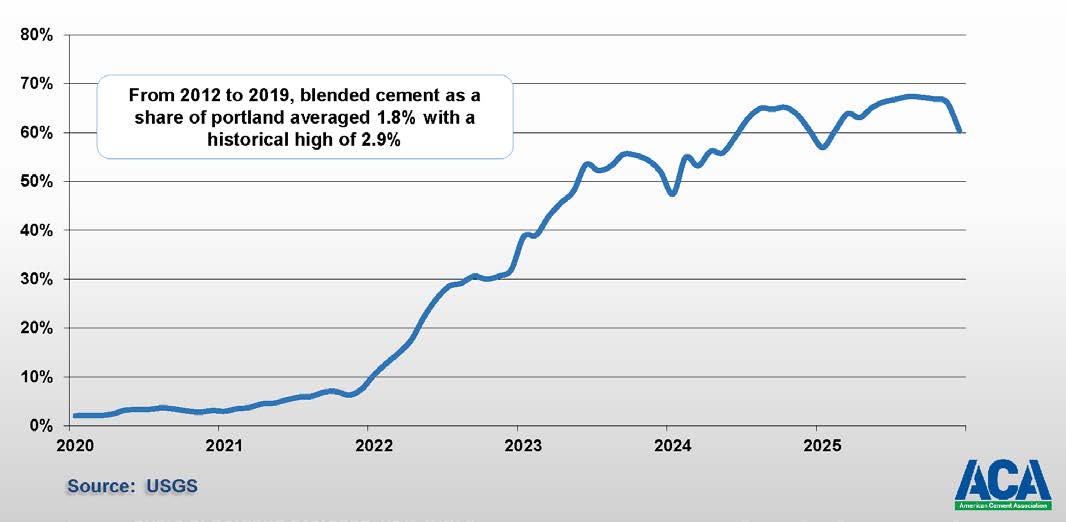
Durante mucho tiempo, el cemento Portland ASTM C150/C150M fue el producto predominante para los usuarios de concreto. Las normas de cemento en América del Norte han evolucionado para priorizar el rendimiento y la sostenibilidad, lo que ha permitido un aumento en la cantidad de cemento adicionado producido y utilizado. La Figura 1 muestra la proporción de los envíos de cemento adicionado a partir de 2020.
Blended Cement as a Share of Total Cement – US [Cemento mezclado como proporción del cemento total – EE. UU.]
From 2012 to 2019, blended cement as a share of portland averaged 1.8% with a historical high of 2.9%. [Entre 2012 y 2019, el cemento mezclado como proporción del cemento Portland promedió el 1,8 %, con un máximo histórico del 2,9 %.]
Source: USGS [Fuente: USGS]
Fig. 1: En 2020, la proporción de cemento adicionado comenzó a aumentar, aumentando alrededor del 3 % de los envíos en EE. UU. a más del 60 % de los envíos en 2025. (Fuente: USGS.)
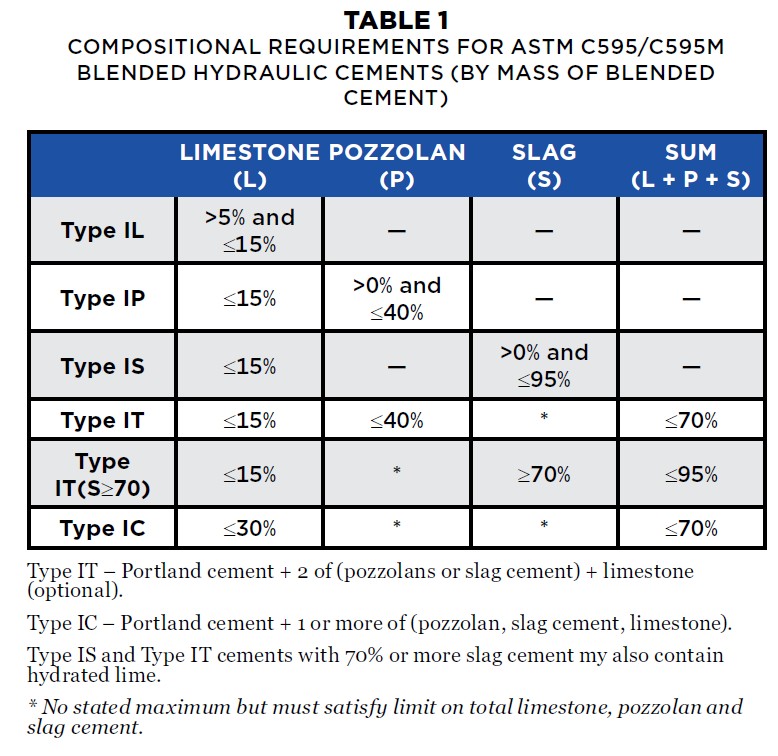
Tras años de desarrollo, la norma de cemento adicionado ASTM C595/C595M añadió un nuevo tipo de cemento, aumentando la cantidad a cinco: Tipo IL, cemento Portland con caliza (o PLC); Tipo IP, cemento Portland con puzolana; Tipo IS, cemento Portland con escoria de alto horno; Tipo IT, cemento adicionado ternario; y Tipo IC, cemento Portland compuesto. Estos productos son alternativas más sostenibles al cemento Portland tradicional, ya que reducen la huella de carbono y pueden mejorar la durabilidad del concreto. Incorporan piedra caliza molida y materiales cementosos suplementarios (SCM, por sus siglas en inglés) como cenizas de carbón, cemento con escoria y puzolanas, lo que reduce las emisiones y el uso de recursos naturales. La Tabla 1 muestra los requisitos de composición de los cementos adicionados.
Tabla 1: Requisitos de composición para los cementos hidráulicos adicionados ASTM C595/C595M (por masa de cemento adicionado)
| Piedra caliza (L) | Puzolana (P) | Escoria (S) | Suma (L + P + S) | |
| Tipo IL | >5 % y ≤ 15 % | ─ | ─ | ─ |
| Tipo IP | ≤ 15 % | > 0 % y ≤ 40 % | ─ | ─ |
| Tipo IS | ≤ 15 % | ─ | > 0 % y ≤ 95 % | ─ |
| Tipo IT | ≤ 15 % | ≤ 40 % | * | ≤ 70 % |
| Tipo IT (S ≥ 70) | ≤ 15 % | * | ≥ 70 % | ≤ 95 % |
| Tipo IC | ≤ 30 % | * | * | ≤ 70 % |
Tipo IT: Cemento Portland + 2 de (puzolanas o cemento con escoria) + piedra caliza (opcional).
Tipo IC: Cemento Portland + 1 o más de (puzolanas, cemento con escoria, piedra caliza).
Los cementos de Tipo IS y Tipo IT con un 70 % o más de cemento con escoria también pueden contener cal hidratada.
*No se establece un máximo, pero deben cumplir el límite sobre el total de piedra caliza, puzolana y cemento con escoria.
Rendimiento del cemento adicionado
Los fabricantes de cemento prueban y controlan las propiedades del cemento para garantizar el rendimiento constante de cada producto. Los fabricantes de concreto preparado suelen señalar que la consistencia es una de las características más importantes que requieren para poder fabricar concreto que tenga las propiedades esperadas lote tras lote, día tras día. La implementación exitosa de los cementos adicionados requiere pruebas de laboratorio para comprender cómo los diferentes cementos afectan las propiedades del concreto, con ajustes en las mezclas de concreto y los métodos de construcción según sea necesario.3
Los usuarios están dispuestos a aceptar cambios en los materiales, pero necesitan comprender cómo las propiedades clave del cemento podrían afectar su trabajo. Aspectos como el tiempo de fraguado, el desarrollo de la resistencia y la fineza pueden influir en la forma en que los instaladores trabajan con el concreto.
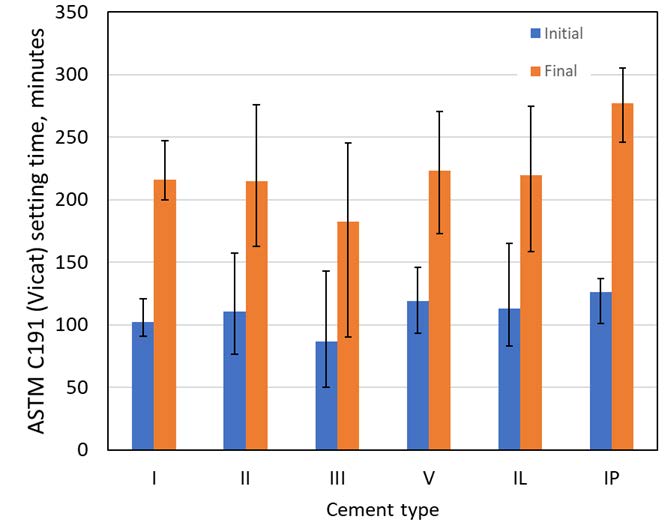
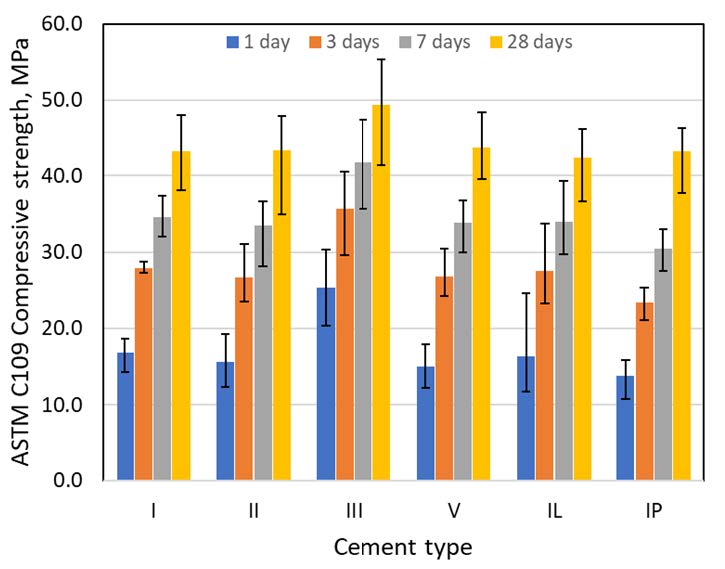
Debido a una menor proporción de clinker con respecto al cemento, los cementos adicionados pueden ser menos reactivos que el cemento Portland tradicional. Los tiempos de fraguado inicial y final pueden ser similares, pero el desarrollo de la resistencia puede ser ligeramente más lento en las primeras etapas, especialmente a medida que aumenta la proporción de ingredientes que no son clinker. Las figuras 2 y 3 muestran el fraguado inicial y final y el desarrollo de la resistencia a lo largo de 28 días para los cementos incluidos en una encuesta de la ACA sobre cementos estadounidenses producidos en 2022.
ASTM C191 (Vicat) setting time, minutes [Tiempo de fraguado ASTM C191 (Vicat), minutos]
Initial [Inicial]
Final [Final]
Cement type [Tipo de cemento]
Fig. 2: Tiempos de fraguado medios según la norma ASTM C191 (método Vicat) para cementos hidráulicos reportados para 2022. Las barras de error indican el rango de los valores reportados.4
Los tiempos de fraguado inicial y final de los cementos de Tipo IL medidos en muestras de pasta en laboratorio son comparables a los del cemento Portland, mientras que tanto el tiempo de fraguado inicial como el final del cemento de Tipo IP se retrasan ligeramente. Los tiempos de fraguado del concreto en aplicaciones de campo serán diferentes y se ven afectados por los ingredientes del concreto, las proporciones y las condiciones ambientales. Sin embargo, los fabricantes de preparado pueden modificar las características de fraguado con aditivos según sea necesario, lo cual es una práctica común en condiciones climáticas de calor y frío para ajustar el rendimiento a las condiciones climáticas y a los materiales cementosos en la mezcla de concreto.
ASTM C109 Compresive strength, MPa [Resistencia a la compresión ASTM C109, MPa]
Cement type [Tipo de cemento]
1 day, 3 days, 7 days 28 days [1 día, 3 días, 7 días, 28 días]
Fig. 3: Resistencias a la compresión medias según la norma ASTM C109 de los cementos hidráulicos para la construcción general con concreto, según lo reportado para los cementos producidos en 2022. En esta figura, las barras de error representan el rango de valores reportados para cada tipo de cemento en cada edad.4
En cuanto a la resistencia, cabe destacar que las cimentaciones a menudo pueden ser muy adecuadas para el uso de cementos adicionados con mayores contenidos de SCM. Aunque el desarrollo de la resistencia sea más lento que en el cemento Portland, los trabajos de cimentación suelen realizarse con suficiente antelación en un proyecto como para que los constructores puedan seleccionar mezclas de concreto que alcancen la resistencia de diseño especificada a edades posteriores. Esto suele ser más sostenible y también puede dar lugar a una elección más económica de los materiales.
ASTM C204 (Blaine) fineness [Fineza (Blaine) ASTM C204]
Cement type [Tipo de cemento]
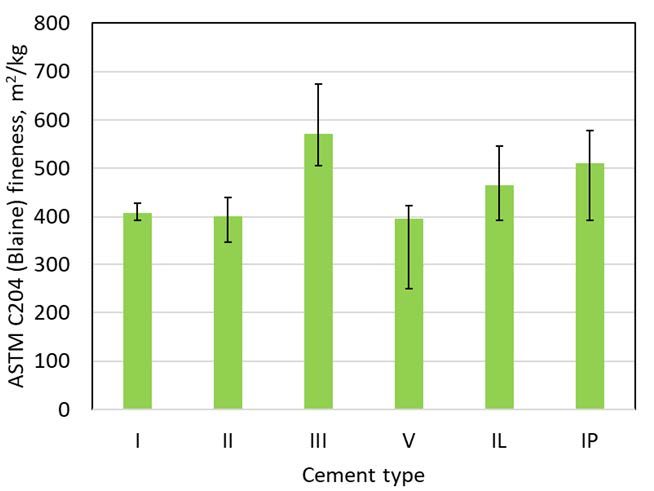
Fig. 4: Fineza media de permeabilidad al aire ASTM C204 (Blaine) de cementos hidráulicos reportada en 2022 para construcción general de concreto. Las barras de error indican el rango de valores reportados.4
La Figura 4 muestra la fineza Blaine de los cementos en una encuesta de la ACA sobre cementos producidos en 2022. La fineza del cemento es un indicador de la reactividad. Los cementos más finos suelen reaccionar más rápido. El cemento Tipo IL se muele más fino por esa razón, para darle una reactividad similar a la del cemento Portland Tipo I o Tipo II. Sin embargo, se sabe que el aumento promedio de la finura afecta el potencial de exudación del concreto. Si bien se ha descubierto que esto afecta el tiempo de acabado de los trabajos de pavimentación, no se ha informado que sea un factor en las paredes de concreto moldeadas. Es probable que los contratistas de cimientos que realizan la construcción de paredes moldeadas no se vean afectados por las diferentes características de exudación del concreto de cemento adicionado.
Transición hacia un mayor uso de cementos adicionados
La industria de la construcción es intrínsecamente conservadora. Esto es razonable, ya que las estructuras destinadas a ser resistentes y duraderas a largo plazo no deberían verse afectadas negativamente por cambios en los materiales o las prácticas. Los pasos clave para implementar nuevos cementos en la fabricación de concreto incluyen realizar pruebas de laboratorio con mezclas de concreto, llevar a cabo pruebas de campo (maquetas) para aplicaciones clave, ajustar las mezclas de concreto según sea necesario y garantizar que se sigan las prácticas recomendadas de colocación, acabado y curado a lo largo de toda la construcción con concreto.3
Comunicación, formación y colaboración
A medida que evoluciona la industria del cemento, las prácticas de construcción con concreto también deben evolucionar. Se llevan a cabo iniciativas de divulgación sobre los cementos adicionados para garantizar que las partes interesadas de la industria comprendan el mejor enfoque para implementar los cementos adicionados en la práctica. Las áreas clave de enfoque incluyen mejorar la comunicación, proporcionar formación a toda la industria y fomentar la colaboración para equilibrar las metas de sostenibilidad con los requisitos de desempeño.1
Para obtener más información sobre los cementos adicionados, visite www.blendedcements.org.
Fuentes
- Wilson, “Cement is Changing for Good: Be Part of the Conversation,” ACI Concrete International, Farmington Hills, MI, pág. 30-32, enero 2025.
- PCA, Roadmap to Carbon Neutrality, Washington, D.C., octubre 2021.
- Giannini,Eric R., et al, “What’s Next After Type IL Cement and How Can We Use Blended Cements Successfully?” ACI Concrete International, Farmington Hills, MI, pág. 38-43, febrero 2026.
- Farny, James A., Chemical and Physical Characteristics of US Hydraulic Cements: 2022, Portland Cement Association, Washington, D.C., SN3354, abril 2025. DOI:
Biografía: James Farny colabora con el Subcomité de cementos adicionados de la ACA para mejorar la aceptación y la adopción de los cementos adicionados en todas las aplicaciones. Es autor de la publicación de la ACA titulada Chemical and Physical Characteristics of US Hydraulic Cements: 2022. Es licenciado en Ingeniería Civil por el Instituto Tecnológico de Illinois y miembro del American Concrete Institute.
El futuro de la construcción de viviendas: Preguntas y respuestas con John Smoll sobre la impresión 3D de casas
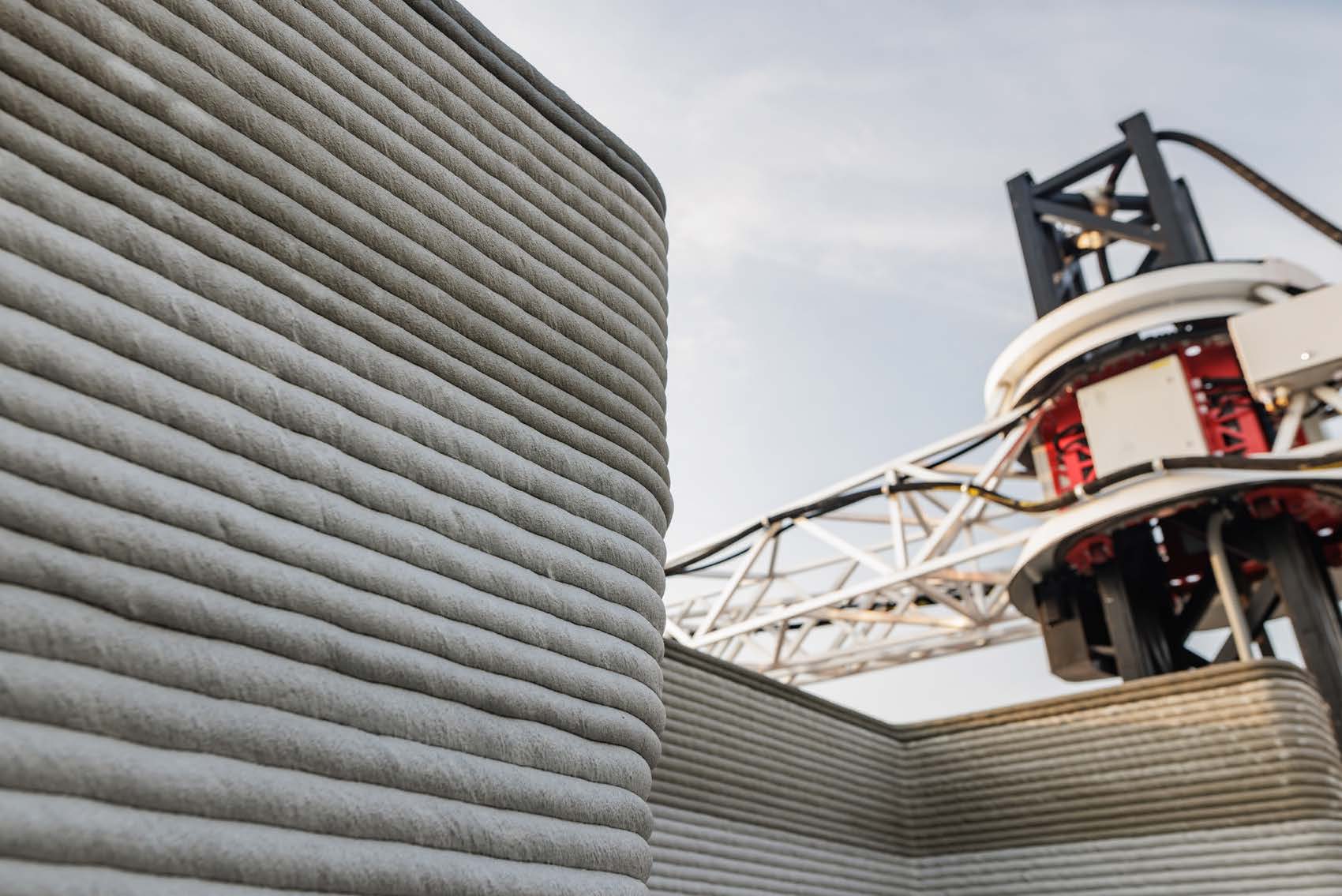
La primera casa impresa en 3D de Ohio fue construida en 2024 por Sustainable Concrete Innovations, LLC. Tuvimos la oportunidad de sentarnos con su cofundador, John Smoll, para hablar sobre sus experiencias, retos y visión del futuro de la vivienda impresa en 3D. La habilidad de Smoll para pensar de manera creativa y adoptar nuevas tecnologías lo ha posicionado como un líder en soluciones de construcción sostenible. En este artículo, Smoll comparte sus conocimientos sobre sus esfuerzos pioneros y lo que impulsa su pasión por revolucionar la vivienda.
P: Con su formación en construcción tradicional, ¿qué fue lo que inicialmente le atrajo de la idea de la impresión 3D de concreto? ¿Cómo superó el escepticismo sobre su viabilidad para construir viviendas?
Smoll: Honestamente, al principio era escéptico. Mis dos socios me propusieron incursionar en la impresión 3D allá por 2022, y yo no estaba convencido de que estuviera lista para la construcción convencional. Visitamos un proyecto en Texas que, tras siete meses de trabajo, apenas llegaba a la mitad. Eso confirmó mis dudas.
Pero a principios de 2023, mis socios regresaron con entusiasmo renovado y me pidieron que me uniera como contratista general para un proyecto. Acepté, y empezamos a trabajar en los retos de diseño, como abordar los puentes térmicos en el concreto. A finales de 2023, comenzamos a imprimir nuestra primera casa, y para 2024, estaba terminada. A pesar de los retos, quedé cautivado. El aspecto de resolución de problemas de este campo emergente me atrajo, y vi el potencial de lo que la impresión 3D podría hacer por el sector.
P: Mencionó que el sector aún no está del todo listo para adoptar o respaldar plenamente la impresión 3D. ¿De qué maneras cree que esta tecnología podría cambiar la forma en que construimos viviendas en el futuro?
Smoll: Las tres grandes claves son la sostenibilidad, la asequibilidad y la durabilidad. En este momento, muchas viviendas se construyen con materiales diseñados para durar entre 15 y 20 años antes de que haya que reemplazarlos. Con la impresión 3D, podemos crear viviendas más duraderas que resistan desafíos climáticos como las tormentas y reduzcan los residuos durante la construcción. La mayor parte de los residuos que se generan son reciclables, lo cual es un gran logro en materia de sostenibilidad.
El ahorro en mano de obra es otro beneficio clave. La mano de obra en la construcción se está reduciendo, por lo que la automatización y la robótica pueden ayudarnos a hacer más con menos personas. Curiosamente, la tecnología también está atrayendo a personas ajenas a los campos tradicionales de la construcción, gracias a su dependencia de la automatización y la robótica.
P: ¿Cuáles son algunas de las ventajas más destacadas de las casas impresas en 3D en comparación con la construcción tradicional?
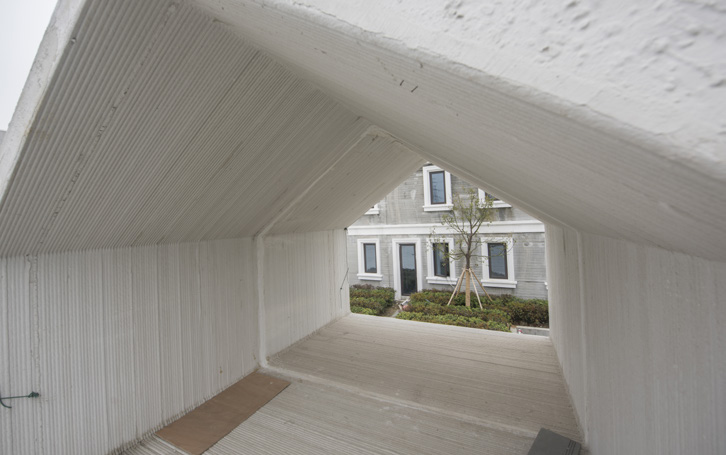
Smoll: Uno de los aspectos más emocionantes es la flexibilidad de diseño. La construcción tradicional suele limitarse a líneas rectas y esquinas cuadradas debido a las restricciones de costos. Con la impresión 3D, es tan fácil diseñar paredes curvas o con textura como crear paredes rectas. Se pueden incorporar patrones intrincados, como trenzados de mimbre o texturas de piedra, en las paredes sin aumentar significativamente los costos. Esto abre un mundo completamente nuevo de creatividad arquitectónica.
Además, las viviendas impresas en 3D vienen con paredes acabadas, tanto en el interior como en el exterior, lo que elimina la necesidad de mano de obra y materiales adicionales para aplicar los acabados. Esta es una ventaja significativa en cuanto al ahorro de costos en comparación con métodos tradicionales como las casas de encofrado de concreto aislado (ICF, por sus siglas en inglés), que aún requieren trabajos de acabado.
P: ¿Qué tan extendida está la impresión 3D en el sector de la construcción en este momento?
Smoll: Todavía es un nicho de mercado, pero está creciendo. En Estados Unidos hay decenas de empresas que trabajan en distintos aspectos de la impresión 3D, desde la fabricación de impresoras hasta el desarrollo de materiales de impresión (o «tinta»), e incluso la construcción de viviendas. Sin embargo, la industria aún no ha alcanzado su madurez. Muchas empresas se enfrentan a desafíos debido al servicio limitado de asistencia técnica de los fabricantes de impresoras, quienes a menudo pasan a vender la siguiente máquina en lugar de brindar asistencia continua.
Es por eso que hemos adoptado un enfoque más práctico, no solo imprimiendo casas, sino también apoyando a otros en el sector. Incluso hemos comenzado a diseñar nuestras propias impresoras y a desarrollar nuestros propios materiales de impresión para abordar las brechas que hemos encontrado.
P: ¿Qué es lo que la mayoría de la gente no sabe sobre las viviendas impresas en 3D, pero que sin duda debería saber?
Smoll: Un error común es pensar que la impresión 3D es la respuesta inmediata a la vivienda asequible. Si bien tiene un potencial increíble, actualmente construir una vivienda impresa en 3D implica más trabajo que una convencional. Los obstáculos normativos, la integración con otros oficios y la formación de las industrias relacionadas, como los tasadores y las aseguradoras, son desafíos importantes.
Por ejemplo, asumimos que el sector de los seguros aceptaría las viviendas impresas en 3D debido a su durabilidad y sostenibilidad. En cambio, nos encontramos con que muchas aseguradoras se mostraban reticentes a suscribir pólizas debido a la falta de datos. Esa ha sido una de las mayores sorpresas para nosotros. Sin embargo, a medida que se construyan más viviendas y resistan fenómenos meteorológicos extremos, esperamos que esto cambie.
P: Tras completar una de las primeras viviendas impresas en 3D en Ohio, ¿cuáles son los próximos pasos para usted y su equipo?
Smoll: Tenemos tres proyectos programados para el verano de 2026 en Dayton, Lima y Akron, Ohio. Ya se han colocado los cimientos de uno de ellos y está listo para imprimir, mientras que los otros dos se encuentran en proceso de obtención de permisos. Además, estamos trabajando con constructores de Ohio y otros estados para ayudarles a dar sus primeros pasos en la impresión 3D.
Nuestra meta es hacer que la impresión 3D sea accesible a más constructores sin que tengan que invertir en equipos costosos.
P: ¿Algún comentario final que quiera compartir con nuestros lectores antes de su presentación en CFACON26?
Smoll: Creo que la conclusión clave es que la impresión 3D aún se encuentra en su fase inicial, pero el potencial es enorme. No se trata solo de construir viviendas, sino de replantearnos cómo abordamos la construcción para hacerla más sostenible, asequible y duradera. Estoy emocionado por compartir más en la CFACON26 y espero poder conectarme con otras personas apasionadas por el futuro de nuestra industria.
No se pierda la presentación de John Smoll en la CFACON26, donde profundizará en los retos y oportunidades de la impresión 3D de viviendas. Ya sea un contratista experimentado o simplemente tenga curiosidad por la tecnología, ¡esta es una sesión que no querrá perderse! Inscríbase en la CFACON26 visitando www.cfaconcretepros.org/events o escaneando el código QR.

Construir cimientos más sólidos: cómo los miembros de la CFA obtienen una ventaja competitiva en materia de prestaciones para empleados
De John Puetz y Devin Pickett, Marsh McLennan Agency
En el sector de la construcción con concreto, los márgenes son ajustados, los plazos son implacables y la fuerza laboral lo es todo. Los equipos de trabajo, los jefes de proyecto, los estimadores y el personal de oficina que mantienen su empresa en marcha no son solo empleados, son los cimientos sobre los que se asienta su empresa. Por eso, cuando se trata de los beneficios que les ofrece, conformarse con lo promedio no es solo una oportunidad perdida. Es una desventaja competitiva.
Es por eso que la Concrete Foundation Association se ha asociado con Marsh McLennan Agency para ofrecer algo que la industria ha necesitado durante mucho tiempo: un programa de beneficios coordinado y estructurado junto con las aseguradoras, diseñado específicamente en torno a las necesidades de las empresas miembros de la CFA.
El Problema Que Todo Contratista Conoce
El aumento de los costos de la asistencia médica no es una novedad para nadie que dirija una empresa. Se espera que en 2026 se produzca el mayor incremento en los costos de la asistencia médica en aproximadamente 15 años, según la comparativa de mercado de Mercer. Ese aumento oscila entre el 6 % y el 9 %. Esto se atribuye a una serie de factores, como el aumento de los precios de la asistencia médica, el mayor uso de los servicios de salud, el incremento en los gastos de medicamentos (un 9 % más solo para los empleadores) y el envejecimiento de la fuerza laboral. Sin embargo, lo que a menudo no se aborda es cómo esos costos afectan de manera desproporcionada a las empresas constructoras pequeñas y medianas que no tienen el poder de negociación de una gran corporación. Un contratista de concreto con 25 empleados no tiene el mismo peso en la mesa que un constructor nacional con 5000 empleados, y las compañías aseguradoras lo saben. Las complejas normas de cumplimiento, como las leyes estatales de ausencias y licencias, los requisitos de reporte de la ACA, los incumplimientos del COBRA, los errores en el cálculo de la asequibilidad y los requisitos legales de cobertura de beneficios, representan obstáculos adicionales para acceder a beneficios de calidad para los empleados, especialmente para quienes trabajan en distintos estados. Y eso ni siquiera incluye los efectos de contar con un departamento de recursos humanos limitado en las empresas más pequeñas, como el exceso de trabajo y la falta de comunicación.
¿El resultado? Las empresas miembros suelen quedarse atascadas con planes que son caros, genéricos y decepcionantes para los empleados que han llegado a esperar más. Los deducibles altos, las redes limitadas y los diseños de planes obsoletos no son solo un problema de presupuesto. Son un problema de reclutamiento y retención. En un mercado laboral donde los trabajadores calificados tienen opciones reales, el paquete de beneficios es parte de su oferta.
Lo que cambia con la alianza entre la CFA y la MMA
El mercado laboral de la industria de la construcción es competitivo, y para atraer y retener talento de calidad, las empresas deben ofrecer una remuneración competitiva. Aquí es donde entran en juego los beneficios. Los beneficios son una declaración de recompensa total, que garantiza que los empleados comprendan que no solo están recibiendo una remuneración de calidad, sino también beneficios de calidad que se alinean con las necesidades de sus empleados actuales y futuros.
A través de la alianza de la CFA con Marsh McLennan Agency, las empresas miembro tienen acceso a una solución de beneficios estructurada que nivela el campo de juego, aportando influencia a nivel de grupo, relaciones con las aseguradoras y experiencia estratégica a empresas de todos los tamaños dentro de la asociación.
El pilar de la Fase 1 es un descuento por volumen negociado con Aetna en la cobertura médica, disponible para las empresas miembro que operan en estados específicos que cumplan los requisitos. No se trata de un descuento mínimo. Es una reducción significativa y directa sobre el costo de la prima, de la que las empresas miembro pueden beneficiarse simplemente por formar parte de la CFA, incluso antes de que comience cualquier mejora adicional del plan.
Tenga en cuenta cómo se ve eso en la práctica. Una empresa miembro de 35 personas en un estado que cumple con los requisitos, que antes no tenía ventajas en las negociaciones con las aseguradoras, ahora entra al mercado con el poder de compra de todos los miembros de la CFA respaldándola. Ese tipo de ventaja estructural se traduce directamente en dólares ahorrados —dólares que pueden reinvertirse en la empresa, devolverse a los empleados a través de planes más completos o ambas cosas.
«Tuvimos una excelente experiencia al trabajar con Marsh», dijo Tim Ball, presidente de Origin Concrete, Inc. «El programa que nos ofrecieron estaba bien diseñado y fue muy informativo. Utilizan todo su poder y los conocimientos adquiridos a través de su modelo de negocio a gran escala y son capaces de aplicarlos a nuestras empresas, mucho más pequeñas. Pudimos aprender cosas sobre cómo planificar el futuro». No todos los miembros de la CFA operan en un estado de Fase 1, y el programa lo tiene en cuenta. Para las empresas fuera del área de cobertura principal de Aetna, Marsh McLennan Agency ha alineado opciones de aseguradoras secundarias y terciarias específicamente para garantizar que la ubicación geográfica no deje atrás a ninguna empresa miembro.
Estas relaciones con las aseguradoras no son meras soluciones de último momento. Son alternativas diseñadas específicamente para ofrecer los mismos resultados fundamentales: una reducción significativa de los costos, un diseño mejorado de los planes y una estrategia de prestaciones que realmente beneficie a su empresa en lugar de perjudicarla. El objetivo es el mismo: ya sea que sus operaciones se desarrollen en el Medio Oeste, el Sureste o a lo largo de las costas, existe un marco para aportar mejoras significativas a su panorama de prestaciones médicas.
La cobertura médica es la partida más importante, pero rara vez es la única que importa a los empleados. La cobertura dental, oftalmológica, de seguro de vida, de discapacidad y los beneficios voluntarios, como el seguro de accidentes o los planes para enfermedades graves, completan un paquete total de beneficios, y también son un área en la que los miembros de la CFA pueden beneficiarse a través de este programa.
Marsh McLennan Agency ha coordinado aseguradoras especializadas en coberturas complementarias y voluntarias para reforzar la estrategia médica. Esto es más importante de lo que podría parecer. Cuando el paquete de beneficios está bien coordinado —cuando las coberturas médica, dental, de visión y voluntarias trabajan de la mano y los planes se complementan entre sí— la experiencia de los empleados mejora de manera notable. Los reclamos son más claros, la administración es más sencilla y el valor que perciben los empleados aumenta. Esa percepción impulsa el compromiso, la satisfacción y, en última instancia, la retención.
Un programa de beneficios voluntarios bien diseñado también ofrece a los empleados opciones para personalizar la cobertura según sus propias situaciones sin aumentar el costo para el empleador. Para una fuerza laboral que abarca desde empleados recién contratados en sus veinte años hasta capataces con mucha antigüedad en sus cincuenta, esa flexibilidad es realmente significativa.
El siguiente paso
El proceso para comenzar es sencillo. Se invita a los miembros de la CFA a concertar una breve conversación introductoria con John Puetz y Devin Pickett, del equipo de Marsh McLennan Agency. Esa llamada es simplemente una oportunidad para conocer mejor su empresa: su configuración actual de beneficios, el perfil del total de los trabajadores, sus metas y lo que ha funcionado o no en su programa actual.
A partir de ahí, el equipo de MMA selecciona las soluciones adecuadas y elabora una presentación adaptada a la situación específica de su empresa. Aquí no hay un enfoque único para todos. Las aseguradoras están listas, el marco está construido y la ventaja existe —el trabajo consiste en emparejar la estrategia correcta con la empresa correcta.
«Pudimos utilizar sus servicios y hemos quedado muy satisfechos con los precios y el servicio prestado», dijo Ball. «Recomendamos encarecidamente a todos los miembros de la CFA que sigan su protocolo de evaluación. Les resultará muy informativo y supongo que se les presentará una opción mejor que la que tienen actualmente».
En un panorama donde los costos de los beneficios siguen aumentando y las soluciones genéricas se quedan cortas, la alianza entre la CFA y MMA ofrece algo que merece una conversación: una vía concreta hacia mejores beneficios, menores costos y empleados que se sientan valorados como la inversión que representan. Póngase en contacto con John Puetz (John.A.Puetz@MarshMMA.com) y Devin Pickett (Devin.Pickett@MarshMMA.com) de Marsh McLennan Agency para programar su llamada introductoria.
Building Stronger Foundations: How CFA Members Are Gaining a Competitive Edge on Employee Benefits
By John Puetz and Devin Pickett, Marsh McLennan Agency
In the concrete construction industry, margins are tight, timelines are unforgiving, and your workforce is everything. The crews, project managers, estimators and office staff who keep your business running aren’t just employees—they’re the foundation your company is built on. So, when it comes to the benefits you offer them, settling for average isn’t just a missed opportunity. It’s a competitive liability.
That’s why the Concrete Foundation Association has partnered with Marsh McLennan Agency to deliver something the industry has needed for a long time: a coordinated, carrier-aligned benefits program built specifically around the needs of CFA member companies.
The problem every contractor knows
Rising healthcare costs aren’t news to anyone running a business. 2026 is expected to be the highest increase in healthcare in approximately 15 years per Mercer benchmarking. That increase is anywhere from 6 to 9%. This is attributed to a number of things like higher healthcare prices, increased utilization, the rise in pharmacy drugs (drug spending up 9% for employers alone) and an aging workforce.
What often goes unaddressed, however, is how those costs disproportionately affect small-to-midsize construction firms that don’t have the purchasing leverage of a large corporation. A 25-person concrete contractor doesn’t have the same seat at the table as a 5,000-employee national builder—and insurance carriers know that. Complex compliance rules like state-specific absence leave laws, ACA reporting mandates, COBRA failures, affordability miscalculations and benefit coverage mandates are more barriers to getting quality employee benefits, especially for employees across state lines. And that doesn’t even include the effects of having a limited human resources department in smaller companies such as overwork and lack of communication.
The result? Member companies are frequently stuck with plans that are expensive, generic and underwhelming to employees who have come to expect more. High deductibles, limited networks and outdated plan designs aren’t just a budget problem. They’re a recruiting and retention problem. In a labor market where skilled tradespeople have real choices, your benefits package is part of your offer.
What the CFA-MMA partnership changes
The construction industry labor market is competitive, and to attract and retain quality talent, companies need to offer competitive compensation. This is where benefits come into play. Benefits are a total reward statement, ensuring that employees understand they’re getting not only quality compensation but also quality benefits that align with the needs of your current and future employees
Through the CFA’s partnership with Marsh McLennan Agency, member companies have access to a structured benefits solution that levels the playing field—bringing group-level leverage, carrier relationships and strategic expertise to companies of every size within the association.
The cornerstone of Phase 1 is a negotiated block discount with Aetna on medical coverage, available to member companies operating within specific qualifying states. This isn’t a marginal discount. It’s a meaningful, off-the-top reduction in premium cost that member companies can benefit from simply by being part of the CFA—before any further plan optimization even begins.
Consider what that looks like in practice. A 35-person member company in a qualifying state that previously had no leverage in carrier negotiations now walks into the market with the buying power of the entire CFA membership behind them. That kind of structural advantage translates directly into dollars saved—dollars that can be reinvested into the business, passed back to employees through richer plan designs or both.
“We had a great experience dealing with Marsh,” said Tim Ball, president, Origin Concrete, Inc. “The program they offered to run us through was well designed and very informative. They use all their muscle and knowledge acquired through their large business model and are able to apply it to our much smaller businesses. We were able to learn things about how to plan for the future.”
Not every CFA member operates in a Phase 1 state, and the program accounts for that. For companies outside the primary Aetna footprint, Marsh McLennan Agency has aligned secondary and tertiary carrier options specifically to ensure that geographic location doesn’t leave any member company behind.
These carrier relationships aren’t afterthoughts. They’re purpose-built alternatives designed to deliver the same core outcomes: significant cost relief, upgraded plan design and a benefits strategy that’s actually working for your company rather than against it. The goal is consistent—whether your operations are in the Midwest, the Southeast or along the coasts, the framework exists to bring meaningful improvement to your medical benefits picture.
Medical is the largest line item, but it’s rarely the only one that matters to employees. Dental, vision, life insurance, disability coverage and voluntary benefits like accident insurance or critical illness plans round out a total benefits package—and they’re also an area where CFA members stand to gain through this program.
Marsh McLennan Agency has aligned carriers across the ancillary and voluntary space to complement the medical strategy. This matters more than it might seem. When your benefits stack is coordinated—when the medical, dental, vision and voluntary carriers are aligned and the plan designs work together—the overall experience for employees improves dramatically. Claims are cleaner, administration is simpler and the value employees perceive goes up. That perception drives engagement, satisfaction and ultimately, retention.
A well-designed voluntary benefits lineup also gives employees options to customize coverage to their own situations without increasing employer cost. For a workforce that spans recent hires in their twenties and long-tenured foremen in their fifties, that flexibility is genuinely meaningful.
The next step
The process to get started is straightforward. CFA members are invited to set up a brief introductory conversation with John Puetz and Devin Pickett from the Marsh McLennan Agency team. That call is simply a chance to learn more about your company—your current benefits setup, your workforce profile, your goals and what’s been working or not working in your current program.
From there, the MMA team aligns the appropriate solutions and builds a presentation tailored to your company’s specific situation. There’s no one-size-fits-all approach here. The carriers are in place, the framework is built and the leverage exists—the work is matching the right strategy to the right company.
“We were able to use their services and have been very happy with the pricing and the service given,” said Ball. “We would highly recommend every CFA member to go through their assessment protocol. It will be very informative for you and my guess is you’ll be presented a better option than you currently have.”
In a landscape where benefits costs keep rising and generic solutions keep falling short, the CFA-MMA partnership offers something worth a conversation: a real path to better benefits, lower costs and a workforce that feels like the investment they are. Reach out to John Puetz (John.A.Puetz@MarshMMA.com) and Devin Pickett (Devin.Pickett@MarshMMA.com) at Marsh McLennan Agency to schedule your introductory call.
The Future of Homebuilding: A Q&A with John Smoll on 3D Printing Homes
Ohio’s first 3D-printed home was built in 2024 by Sustainable Concrete Innovations, LLC. We had the chance to sit down with its co-founder, John Smoll, to discuss his experiences, challenges and vision for the future of 3D-printed housing. Smoll’s ability to think creatively and adopt new technologies have positioned him as a leader in sustainable building solutions. In this article, Smoll shares insights into his pioneering efforts and what drives his passion for revolutionizing housing.
Q: COMING FROM A BACKGROUND IN TRADITIONAL CONSTRUCTION, WHAT INITIALLY DREW YOU TO THE IDEA OF 3D CONCRETE PRINTING? HOW DID YOU OVERCOME ANY SKEPTICISM ABOUT ITS FEASIBILITY FOR BUILDING HOMES?
Smoll: Honestly, I was a skeptic at first. My two partners approached me about getting into 3D printing back in 2022, and I wasn’t convinced it was ready for mainstream construction. We visited a project in Texas that had been under construction for seven months and was only halfway done. That confirmed my doubts.
But in early 2023, my partners came back with renewed enthusiasm and asked me to join as a general contractor for a project. I agreed, and we started working through design challenges, like addressing thermal bridging in concrete. By late 2023, we started printing our first house, and by 2024, it was complete. Despite the challenges, I was hooked. The problem-solving aspect of this emerging field drew me in, and I saw the potential for what 3D printing could do for the industry.
Q: YOU MENTIONED THE INDUSTRY ISN’T QUITE READY TO FULLY ADOPT OR SUPPORT 3D PRINTING. WHAT ARE SOME WAYS YOU THINK THIS TECHNOLOGY COULD CHANGE THE WAY WE BUILD HOMES IN THE FUTURE?
Smoll: The three big drivers are sustainability, affordability and durability. Right now, many homes are built with materials designed to last 15 to 20 years before needing replacement. With 3D printing, we can create more durable homes that withstand climate challenges like storms and reduce waste during construction. Most of the waste generated is recyclable, which is a huge sustainability win.
Labor savings is another key benefit. The construction labor pool is shrinking, so automation and robotics can help us do more with fewer people. Interestingly, the technology is also attracting individuals from outside traditional construction fields, thanks to its reliance on automation and robotics.
Q: WHAT ARE SOME OF THE STANDOUT BENEFITS OF 3D-PRINTED HOMES COMPARED TO TRADITIONAL CONSTRUCTION?
Smoll: One of the most exciting aspects is design flexibility. Traditional construction is often limited to straight lines and square corners because of cost constraints. With 3D printing, it’s just as easy to design curved or textured walls as it is to create straight ones. You can incorporate intricate patterns, like basket weaves or stone textures, into the walls without significantly increasing costs. This opens up a whole new world of architectural creativity.
Additionally, 3D-printed homes come with finished walls, both interior and exterior, which eliminates the need for additional labor and materials to apply finishes. This is a significant cost-saving advantage over traditional methods like ICF (Insulated Concrete Form) homes, which still require finishing work.
Q: HOW WIDESPREAD IS 3D PRINTING IN THE CONSTRUCTION INDUSTRY RIGHT NOW?
Smoll: It’s still a niche market, but it’s growing. There are dozens of companies in the U.S. working on different aspects of 3D printing, from manufacturing printers to developing print media
(or “ink”) and actually building homes. However, the industry is far from mature. Many companies face challenges with limited support from printer manufacturers, who often move on to selling
the next machine instead of providing ongoing assistance.
That’s why we’ve taken a more hands-on approach, not just printing homes but also supporting others in the industry. We’ve even started designing our own printers and developing our own
print media to address the gaps we’ve encountered.
Q: WHAT’S ONE THING ABOUT 3D-PRINTED HOMES THAT MOST PEOPLE DON’T KNOW BUT ABSOLUTELY SHOULD?
Smoll: A common misconception is that 3D printing is the immediate answer to affordable housing. While it has incredible potential, there’s currently more work involved in building a 3D-printed home than a conventional one. Regulatory hurdles, integrating with other trades and educating surrounding industries like appraisers and insurers are significant challenges. For example, we assumed the insurance industry would embrace 3D-printed homes because of their durability and sustainability. Instead, we found many insurers reluctant to write policies due to a lack of data. That’s been one of the biggest surprises for us. However, as more homes are built and withstand extreme weather events, we expect this to change.
Q: AFTER COMPLETING ONE OF THE FIRST 3D-PRINTED HOMES IN OHIO, WHAT’S NEXT FOR YOU AND YOUR TEAM?
Smoll: We have three projects lined up for the summer of 2026 in Dayton, Lima and Akron, Ohio. One foundation is already poured and ready to print, while the other two are in the permitting process. Beyond that, we’re working with builders in Ohio and other states to help them get started with 3D printing. Our goal is to make 3D printing accessible to more builders without requiring them to invest in expensive equipment.
Q: ANY FINAL THOUGHTS TO SHARE WITH OUR READERS AHEAD OF YOUR PRESENTATION AT CFACON26?
Smoll: I think the key takeaway is that 3D printing is still in its early stages, but the potential is enormous. It’s not just about building homes, it’s about rethinking how we approach construction to make it more sustainable, affordable and durable.
I’m excited to share more at CFACON26 and look forward to connecting with others who are passionate about the future of our industry.
Blended Cements and Concrete Foundations
By James A. Farny, Director of Environmental Measurement & Metrics, American Cement Association
Concrete foundation applications range from single-family homes to apartment buildings and all types of private development and public infrastructure. With its ease of placement and resilient performance, concrete is suited to all sizes of projects. Because the concrete industry has chosen to elevate sustainability in its practices, all stakeholders need to stay informed about evolving practices and materials that can support sustainable construction (Wilson, 2025).
The American Cement Association (ACA) introduced its Roadmap to Carbon Neutrality in 2021, targeting carbon neutrality across the cement value chain (clinker, cement, concrete, construction and carbon uptake) by 2050 (PCA, 2021). The Roadmap promotes optimization for each link in the chain. For cement and concrete, a move toward lower carbon results in more efficient use of materials, supports greater production of domestic cement, and improves energy security for the U.S. ACA members, who are U.S. cement producers, identified many opportunities for working toward carbon neutrality, placing a focus on three areas initially:
- Blended cements,
- Alternative fuels and
- Carbon capture, utilization and storage (CCUS).
Blended cements are the “low-hanging fruit” of the Roadmap, a near-term change with immediate impact. Lower-carbon cements with a reduced clinker-to-cement ratio have lower environmental impacts. Increased adoption and use of blended cements to replace traditional portland cement results in greater CO2 reductions. Concrete producers and contractors use the same equipment to mix, place and finish concrete made with blended cements. With proper testing and a good understanding of concrete properties, blended cements can replace portland cement with relatively minor adjustments to concrete practices when needed.
For mid- and long-term changes, cement producers also identified alternative fuels for cement kilns and CCUS of cement plant emissions as opportunities to offer meaningful reductions in carbon footprint.
EVOLVING CEMENT SPECIFICATIONS AND THE EMERGENCE OF BLENDED CEMENTS
For a long time, ASTM C150/C150M portland cement was the predominant cement product for concrete users. Cement standards in North America have evolved to prioritize performance
and sustainability, enabling an increase in the amount of blended cement produced and used. Figure 1 shows the share of blended cement shipments from 2020 onward.
Following years of development, the ASTM C595/C595M blended cement standard added a new cement type, bringing the number to five: Type IL, portland-limestone cement (or PLC); Type IP, portland-pozzolan cement; Type IS, portland blast-furnace slag cement; Type IT, ternary blended cement; and Type IC, portland-composite cement. These products are more sustainable alternatives to traditional portland cement that reduce carbon footprints and can improve concrete durability. They incorporate ground limestone and supplementary cementitious materials (SCMs) like coal ash, slag cement and pozzolans, reducing emissions and natural resource use. Table 1 shows the compositional requirements of blended cements.
BLENDED CEMENT AS A SHARE OF TOTAL CEMENT – US
Fig. 1—In 2020, blended cement share began to increase, rising from about 3% of U.S. shipments to more than 60% of shipments in 2025. (Source: USGS.)
BLENDED CEMENT PERFORMANCE
Cement producers test and control cement properties to ensure the consistent performance of each product. Ready-mix concrete producers often note that consistency is one of the most important characteristics they require to allow them to produce concrete that has the expected properties batch to batch, day in and day out. Successful implementation of blended cements requires lab testing to understand how different cements affect concrete properties, with adjustments made to concrete mixtures and construction methods as needed (Giannini, 2026).
Users are willing to accept changes to materials but need to understand how key properties of cement might affect their work. Things like setting time, strength development and fineness can change how installers work with concrete.
Owing to a lower clinker-to-cement ratio, blended cements can be less reactive than traditional portland cement. Initial and final setting times may be similar, but strength development
may be slightly slower at early ages, especially as the proportion of non-clinker ingredients increases. Figures 2 and 3 show initial and final set and strength development through 28 days for cements in an ACA survey of U.S. cements produced in 2022.
Initial and final setting times of Type IL cements measured on paste samples in a laboratory are comparable to portland cement, while both initial and final setting times of Type IP cement are slightly delayed. Concrete setting times in field applications will be different and are affected by concrete ingredients, proportions and ambient conditions. Ready-mix producers, however, can modify setting characteristics with admixtures as needed, which is common practice for hot and cold weather conditions to adjust performance for climatic conditions and the cementitious materials in the concrete mixture.
For strength, it’s worth noting that foundations may often be well-suited to the use of blended cements with higher SCM contents. Even if strength development is slower than portland cement, foundation work is often done early enough in a project that builders can select concrete mixes that achieve specified design strength at later ages. This is usually more sustainable and can result in a more economical choice of materials, too.
Figure 4 shows Blaine fineness for cements in an ACA survey of cements produced in 2022. Cement fineness is one indicator of reactivity. Finer cements generally react faster. Type IL cement is ground finer for that reason, to give it a similar reactivity to Type I or Type II portland cement. The average increased fineness, however, is known to impact the bleeding potential of the concrete. While this has been found to affect the timing of finishing for flatwork, it has not been reported to be a factor in formed concrete walls. Foundation contractors doing formed wall construction would likely not be affected by different bleeding characteristics of blended cement concrete.
Fig. 2—Mean ASTM C191 setting times (Vicat method) for hydraulic cements reported for 2022. Error bars indicate the range of reported values (Farny, 2025).
Fig. 3–Mean ASTM C109 compressive strengths of hydraulic cements for general concrete construction as reported for cements produced in 2022. In this figure, error bars represent the range of reported values for each cement type at each age (Farny, 2025).
Fig. 4–Mean ASTM C204 air-permeability (Blaine) fineness of hydraulic cements reported for 2022 for general concrete construction. Error bars indicate the range of reported values (Farny, 2025).
TRANSITIONING TO GREATER USE OF BLENDED CEMENTS
The construction industry is inherently conservative. This is understandable, as structures intended to be resilient and durable for the long term should not be adversely impacted by changing
materials or practices. Key steps for implementing new cement into concrete production include lab testing concrete mixtures, performing field test placements (mockups) for key applications, adjusting concrete mixtures as needed and ensuring that best practices for placing, finishing and curing are followed throughout concrete construction (Giannini, 2026).
COMMUNICATION, EDUCATION AND COLLABORATION
As the cement industry evolves, concrete construction practices must evolve, too. Outreach efforts for blended cements are ongoing to ensure that industry stakeholders understand the best approach to implementing blended cements in practice.
Key areas of focus include improving communication, providing industry-wide education, and fostering collaboration to balance sustainability goals with performance requirements (Wilson, 2026). Learn more about blended cements at blendedcements.org.
SOURCES
1. Wilson, “Cement is Changing for Good: Be Part of the Conversation,” ACI Concrete International, Farmington Hills, MI, pp. 30-32, January 2025.
2. PCA, Roadmap to Carbon Neutrality, Washington, D.C., October 2021.
3. Giannini, Eric R., et al, “What’s Next After Type IL Cement and How Can We Use Blended Cements Successfully?” ACI Concrete International, Farmington Hills, MI, pp. 38-43,
February 2026.
4. Farny, James A., Chemical and Physical Characteristics of US Hydraulic Cements: 2022, Portland Cement Association, Washington, D.C., SN3354, April 2025. DOI: https://doi.org/10.70909/pca.2025.SN3354
James Farny works with ACA’s Blended Cements Subcommittee to improve the acceptance and adoption of blended cements for all applications. He authored the ACA publication, Chemical
and Physical Characteristics of US Hydraulic Cements: 2022. He holds a B.S. degree in Civil Engineering from the Illinois Institute of Technology and is a Fellow of the American Concrete Institute.
How to Protect Your Assets
By Larry Oxenham, Senior Advisor, American Society for Asset Protection
Concrete contractors operate in one of the highest-risk segments of the construction industry. Among heavy equipment, jobsite hazards, employees, vehicles and the public, the potential for lawsuits is constant. One accident, defect claim or employment dispute can quickly escalate into a legal battle that threatens not only your business, but your personal wealth as well.
Understanding how lawsuits work and how to reduce your exposure is the first step toward protecting everything you’ve built. While insurance is essential, it is not enough on its own. A strong asset protection strategy, including properly structured LLCs, can make the difference between a manageable situation and financial devastation.
STEP 1. INJURY OR LOSS
Every lawsuit begins with some form of injury or financial loss. For concrete contractors, this can stem from a wide range of situations. A worker may be injured on a jobsite, a pedestrian could trip on freshly poured or uneven concrete or a structural failure may cause property damage. Vehicle accidents involving company trucks or equipment are another common source of claims. In addition, contractors can face employment-related lawsuits such as wrongful termination, discrimination or harassment. Because concrete work often involves public exposure and long-term structural performance, even a small issue can evolve into a significant legal claim.
STEP 2. FIND A DEFENDANT(S) WHO CAN PAY
Most lawsuits are handled on a contingency basis, meaning the attorney only gets paid if they recover money. Because of this, one of the first steps an attorney takes is determining whether a potential defendant has assets worth pursuing. In many cases, individuals and businesses are targeted not because they are clearly at fault, but because they have the ability to pay.
To ensure your business and personal assets are not subject to seizure, you want to hold them in multiple LLCs (limited liability companies). With your assets in properly drafted and funded LLCs, they are no longer owned by you or the business but are owned by a separate legal entity, and the attorney’s asset search will find no assets that can be taken through a lawsuit.
STEP 3. CONSTRUCT A THEORY OF LIABILITY
If the person immediately responsible for the loss or injury does not have the ability to pay, the attorney will likely search for a deep-pocketed defendant and a theory of liability that can be developed against him or her, showing why that defendant should be held responsible. The success of the trial attorney is dependent on this. Trial attorneys comprise one of the largest lobbyist groups in the country and have created laws to increase the level of vicarious liability. Vicarious liability means you can be held responsible for the actions of others. Trial attorneys have worked hard to ensure that whoever has the money can be held responsible for negative outcomes through vicarious liability, even if they committed no wrong. One example of this is premise liability. Premise liability is a law that was lobbied for by trial attorneys. This law states that the owner of a property is responsible for any injury or loss that occurs on that property. This is why you see lawsuits where a homeowner is held responsible when a burglar is injured while robbing a home. The homeowner did nothing wrong. The burglar was trespassing and stealing, but by law the homeowner is still responsible if the burglar is hurt while on their property.
STEP 4. TRIAL
Every day we see trial attorneys winning cases that appear to be irrational, absurd and without merit. Many attorneys will even pursue a bad case if they can find a defendant with the ability to pay. They hope they can obtain a settlement or convince the jury to award cash to the injured plaintiff from the comparatively wealthy defendant. Many jurors have freely admitted that they have overlooked whether the defendant was at fault if they felt sorry for the plaintiff.
STEP 5. JUDGMENT
If the plaintiff (person filing the lawsuit) wins the trial and the defendant (the person they are suing) is found responsible for the injury or loss, the court renders a judgment to compensate the plaintiff for their injury and/or loss. It is now routine for judgments to be millions of dollars.
STEP 6. COLLECT ON JUDGMENT
A judgment only has value if it can be collected. This is why attorneys focus so heavily on identifying defendants with reachable assets. If your assets are held in your personal name or directly within your operating business, they may be seized to satisfy the judgment.
However, when assets are properly structured within separate LLCs, they are significantly more difficult to access. In many cases, if there are no reachable assets beyond insurance coverage, the incentive to pursue or continue a lawsuit is greatly reduced.
SETTLEMENT
Anytime during the lawsuit process, you can come to a settlement to end the lawsuit. If a lawsuit falls under items covered by your insurance company, they will cover the cost of your defense. The insurance company will often settle to avoid the high cost of the case going to trial. If your business or personal assets are protected from being seized to satisfy a judgment, the person suing is also more likely to settle with the insurance company than go for a large judgment that could excess your insurance coverage because there are no assets to seize to satisfy a judgment in excess of your insurance coverage.
While we recommend you have reasonable insurance coverage, it is impossible to have insurance that covers all potential lawsuits and judgments. Insurance companies are good at drafting exclusions in their policies to minimize their risk. If you are sued for something that is not covered by your insurance such as sexual harassment, discrimination or violations of Americans with Disabilities Act, you will have to defend yourself. Also, your business and/or personal assets could be seized to satisfy a judgment in excess of your insurance coverage if they are not properly held in LLCs.
LAWSUIT PREVENTION AND ASSET PROTECTION
If you are personally named in the lawsuit, all assets held in your name or in joint ownership can be seized to satisfy the judgment. If your business is sued, all assets held by the business can be seized to satisfy the judgment. To solve this problem, you want to hold your business and personal assets in carefully constructed and properly worded LLCs. The best way to defend against a lawsuit is to take away the financial incentive of attorneys to prevent the lawsuit from ever happening. If you have no reachable and seizable assets, the trial attorney’s strategies of legal extortion will not be effective against you. With proper asset protection in place, attorneys will not want to pursue a lawsuit against you. Larry Oxenham leads seminars on asset protection for business owners throughout America. For information please go to americansocietyforassetprotection.com.