Blended Cements and Concrete Foundations
By James A. Farny, Director of Environmental Measurement & Metrics, American Cement Association
Concrete foundation applications range from single-family homes to apartment buildings and all types of private development and public infrastructure. With its ease of placement and resilient performance, concrete is suited to all sizes of projects. Because the concrete industry has chosen to elevate sustainability in its practices, all stakeholders need to stay informed about evolving practices and materials that can support sustainable construction (Wilson, 2025).
The American Cement Association (ACA) introduced its Roadmap to Carbon Neutrality in 2021, targeting carbon neutrality across the cement value chain (clinker, cement, concrete, construction and carbon uptake) by 2050 (PCA, 2021). The Roadmap promotes optimization for each link in the chain. For cement and concrete, a move toward lower carbon results in more efficient use of materials, supports greater production of domestic cement, and improves energy security for the U.S. ACA members, who are U.S. cement producers, identified many opportunities for working toward carbon neutrality, placing a focus on three areas initially:
- • Blended cements,
- • Alternative fuels and
- • Carbon capture, utilization and storage (CCUS).
Blended cements are the “low-hanging fruit” of the Roadmap, a near-term change with immediate impact. Lower-carbon cements with a reduced clinker-to-cement ratio have lower environmental impacts. Increased adoption and use of blended cements to replace traditional portland cement results in greater CO2 reductions. Concrete producers and contractors use the same equipment to mix, place and finish concrete made with blended cements. With proper testing and a good understanding of concrete properties, blended cements can replace portland cement with relatively minor adjustments to concrete practices when needed.
For mid- and long-term changes, cement producers also identified alternative fuels for cement kilns and CCUS of cement plant emissions as opportunities to offer meaningful reductions in carbon footprint.
EVOLVING CEMENT SPECIFICATIONS AND THE EMERGENCE OF BLENDED CEMENTS
For a long time, ASTM C150/C150M portland cement was the predominant cement product for concrete users. Cement standards in North America have evolved to prioritize performance
and sustainability, enabling an increase in the amount of blended cement produced and used. Figure 1 shows the share of blended cement shipments from 2020 onward.
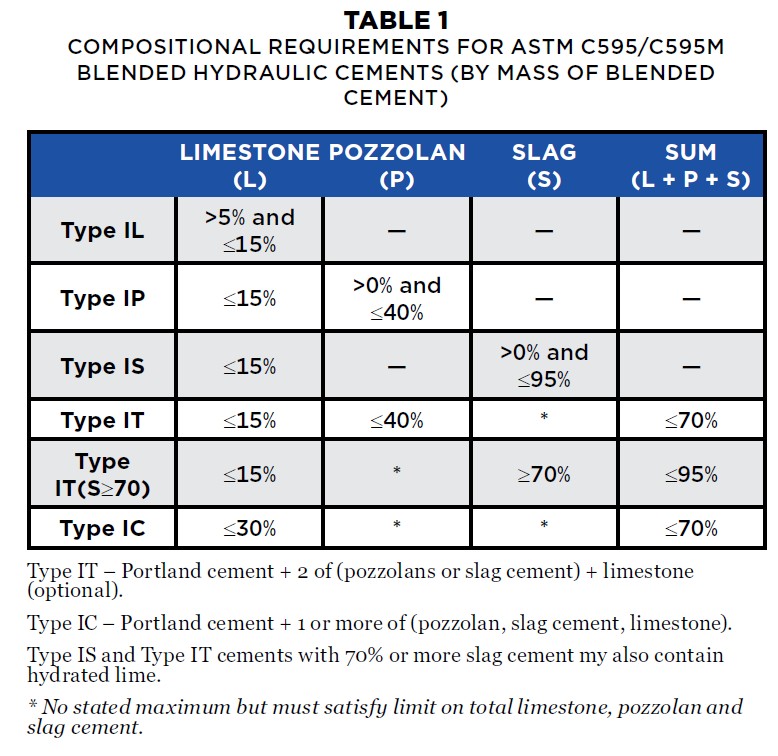
Following years of development, the ASTM C595/C595M blended cement standard added a new cement type, bringing the number to five: Type IL, portland-limestone cement (or PLC); Type IP, portland-pozzolan cement; Type IS, portland blast-furnace slag cement; Type IT, ternary blended cement; and Type IC, portland-composite cement. These products are more sustainable alternatives to traditional portland cement that reduce carbon footprints and can improve concrete durability. They incorporate ground limestone and supplementary cementitious materials (SCMs) like coal ash, slag cement and pozzolans, reducing emissions and natural resource use. Table 1 shows the compositional requirements of blended cements.
BLENDED CEMENT AS A SHARE OF TOTAL CEMENT – US
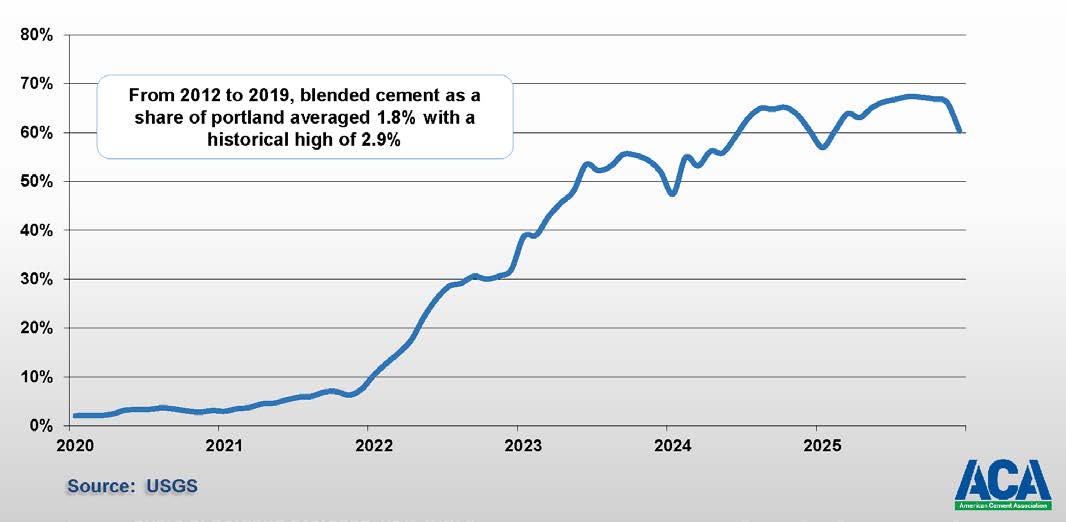
Fig. 1—In 2020, blended cement share began to increase, rising from about 3% of U.S. shipments to more than 60% of shipments in 2025. (Source: USGS.)
BLENDED CEMENT PERFORMANCE
Cement producers test and control cement properties to ensure the consistent performance of each product. Ready-mix concrete producers often note that consistency is one of the most important characteristics they require to allow them to produce concrete that has the expected properties batch to batch, day in and day out. Successful implementation of blended cements requires lab testing to understand how different cements affect concrete properties, with adjustments made to concrete mixtures and construction methods as needed (Giannini, 2026).
Users are willing to accept changes to materials but need to understand how key properties of cement might affect their work. Things like setting time, strength development and fineness can change how installers work with concrete.
Owing to a lower clinker-to-cement ratio, blended cements can be less reactive than traditional portland cement. Initial and final setting times may be similar, but strength development
may be slightly slower at early ages, especially as the proportion of non-clinker ingredients increases. Figures 2 and 3 show initial and final set and strength development through 28 days for cements in an ACA survey of U.S. cements produced in 2022.
Initial and final setting times of Type IL cements measured on paste samples in a laboratory are comparable to portland cement, while both initial and final setting times of Type IP cement are slightly delayed. Concrete setting times in field applications will be different and are affected by concrete ingredients, proportions and ambient conditions. Ready-mix producers, however, can modify setting characteristics with admixtures as needed, which is common practice for hot and cold weather conditions to adjust performance for climatic conditions and the cementitious materials in the concrete mixture.
For strength, it’s worth noting that foundations may often be well-suited to the use of blended cements with higher SCM contents. Even if strength development is slower than portland cement, foundation work is often done early enough in a project that builders can select concrete mixes that achieve specified design strength at later ages. This is usually more sustainable and can result in a more economical choice of materials, too.
Figure 4 shows Blaine fineness for cements in an ACA survey of cements produced in 2022. Cement fineness is one indicator of reactivity. Finer cements generally react faster. Type IL cement is ground finer for that reason, to give it a similar reactivity to Type I or Type II portland cement. The average increased fineness, however, is known to impact the bleeding potential of the concrete. While this has been found to affect the timing of finishing for flatwork, it has not been reported to be a factor in formed concrete walls. Foundation contractors doing formed wall construction would likely not be affected by different bleeding characteristics of blended cement concrete.
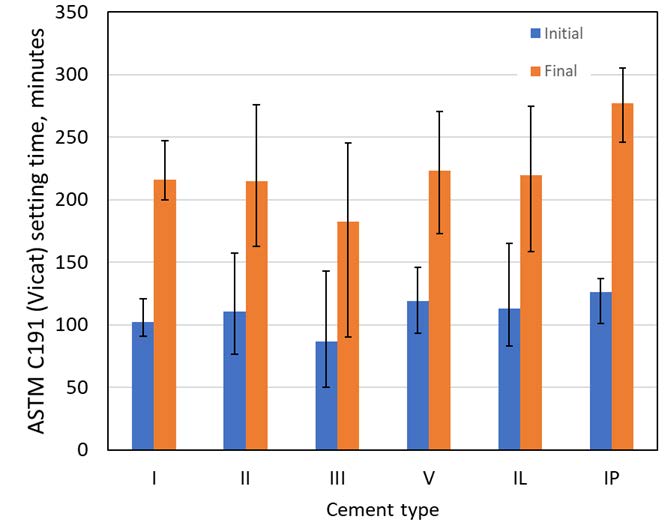
Fig. 2—Mean ASTM C191 setting times (Vicat method) for hydraulic cements reported for 2022. Error bars indicate the range of reported values (Farny, 2025).
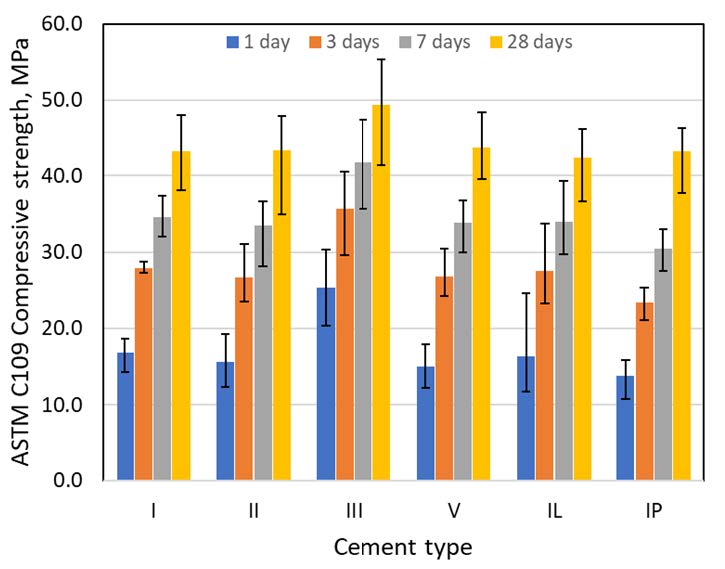
Fig. 3–Mean ASTM C109 compressive strengths of hydraulic cements for general concrete construction as reported for cements produced in 2022. In this figure, error bars represent the range of reported values for each cement type at each age (Farny, 2025).
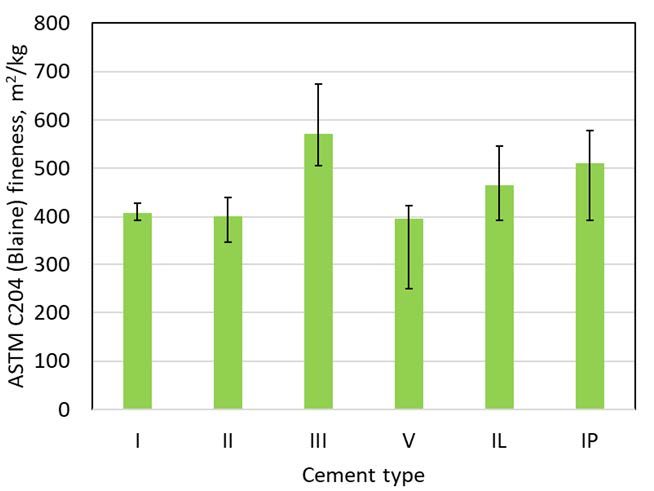
Fig. 4–Mean ASTM C204 air-permeability (Blaine) fineness of hydraulic cements reported for 2022 for general concrete construction. Error bars indicate the range of reported values (Farny, 2025).
TRANSITIONING TO GREATER USE OF BLENDED CEMENTS
The construction industry is inherently conservative. This is understandable, as structures intended to be resilient and durable for the long term should not be adversely impacted by changing
materials or practices. Key steps for implementing new cement into concrete production include lab testing concrete mixtures, performing field test placements (mockups) for key applications, adjusting concrete mixtures as needed and ensuring that best practices for placing, finishing and curing are followed throughout concrete construction (Giannini, 2026).
COMMUNICATION, EDUCATION AND COLLABORATION
As the cement industry evolves, concrete construction practices must evolve, too. Outreach efforts for blended cements are ongoing to ensure that industry stakeholders understand the best approach to implementing blended cements in practice.
Key areas of focus include improving communication, providing industry-wide education, and fostering collaboration to balance sustainability goals with performance requirements (Wilson, 2026). Learn more about blended cements at blendedcements.org.
SOURCES
1. Wilson, “Cement is Changing for Good: Be Part of the Conversation,” ACI Concrete International, Farmington Hills, MI, pp. 30-32, January 2025.
2. PCA, Roadmap to Carbon Neutrality, Washington, D.C., October 2021.
3. Giannini, Eric R., et al, “What’s Next After Type IL Cement and How Can We Use Blended Cements Successfully?” ACI Concrete International, Farmington Hills, MI, pp. 38-43,
February 2026.
4. Farny, James A., Chemical and Physical Characteristics of US Hydraulic Cements: 2022, Portland Cement Association, Washington, D.C., SN3354, April 2025. DOI: https://doi.org/10.70909/pca.2025.SN3354
James Farny works with ACA’s Blended Cements Subcommittee to improve the acceptance and adoption of blended cements for all applications. He authored the ACA publication, Chemical
and Physical Characteristics of US Hydraulic Cements: 2022. He holds a B.S. degree in Civil Engineering from the Illinois Institute of Technology and is a Fellow of the American Concrete Institute.