Out of Plumb may not Mean Damaged and Unsafe
Español | Translation Provided by the CFA
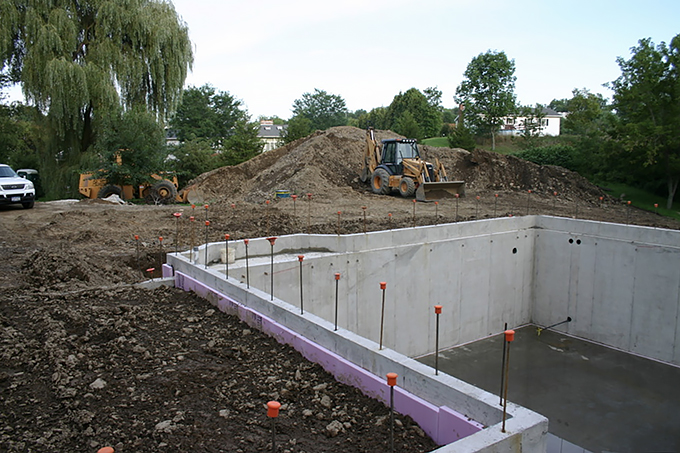
Question: The foundation for my new home has one wall showing two vertical cracks and the top of the wall is not even with the base of the wall. I’m concerned the backfilling has pushed the wall in and the building inspector wants an engineer to certify the wall before the builder can proceed. What should I do? – Home Owner (Wisconsin)
Answer: The process of building a foundation for a home inevitably leads to the two most common issues, both of which have been raised in this inquiry. First, any homeowner who begins inspecting the concrete work performed will have concerns when cracks present. While the following facts about concrete are quite well known in the construction industry, it’s worth laying them out plainly:
- Concrete gets hard.
- Concrete cracks.
Yet, an owner is not prepared to consider this an acceptable explanation.
Cracking, by itself, should never be an immediate cause for concern. There are distinct characteristics of cracking that determine rather quickly whether a crack is problematic or simply a result of the drying and shrinkage process. More information on cracking can be obtained from our website in a free public download (http://bit.ly/aboutcracks).
However, in the case of this inquiry, another concern was identified, one that presented during the final stages of the foundation work—and, unfortunately all too often, this issue emerges before the beginning stages of the above-grade structure work. That is, the wall is out of plumb and backfilling has been completed. It must first be noted that the primary code references for residential foundation walls both state limitations for the backfilling operation. For a practical interpretation of the backfill process, the CFA provides a tech note on backfilling, TN-002.1 The International Residential Code (2015) states:
R404.1.7 Backfill placement. Backfill shall not be placed against the wall until the wall has sufficient strength and has been anchored to the floor above, or has been sufficiently braced to prevent damage by the backfill.2
Furthermore, ACI 332, which provides a broad set of minimum prescriptive code requirements and the performance-based design for the majority of residential foundations, echoes the position of the IRC:
8.2.4 Lateral restraint. The equivalent fluid pressure of the backfill shall be determined, but in no case shall be taken as less than 30 psf/ft. The foundation walls shall be restrained top and bottom against lateral movement. The top and bottom restraint for the foundation wall shall be in place before the introduction of backfill against the foundation wall. Temporary lateral restraint shall be permitted.3
Both code references call attention to the same design assumption for foundation walls: a positive top and bottom connection exists so that the concrete wall performs like a beam and not a cantilever. The difference in behavior of these two wall conditions due to the applied force can be substantial. While it is true there are likely hundreds of thousands of successful constructions where a top connection (the first floor framing) or bracing was not installed prior to backfill, there are enough cases to validate this code position where problems emerged from backfilling without a top connection.
When someone is concerned about movement in a foundation wall, however, they should not immediately assume backfilling has cracked or pushed the wall inward. Some basic questions must first be asked.
First, was the horizontal reinforcement placed continuous in the wall, and does the reinforcement meet the minimum code requirements? The purpose of the horizontal reinforcement is to reduce the number and width of shrinkage cracks.
Second, is the wall bowed out of plane or leaning out of plane? This is an important condition to note. In order to determine the answer to this condition, a string line is the best method to test the position of the wall. A string should be drawn taught from bottom corner to bottom corner and from top corner to top corner. The string should be pulled taught as it approaches the wall so it can be determined if it touches a point near the wall’s center before getting to the corners. There are three potential outcomes from this test.
- String line is true at base of wall; string line at top of wall shows a bow. This is the case most likely to be of concern to an engineer, and if this is the result, it is best to engage in a discussion with the owner, designer and controlling contractor for the project, as applicable. With no bow at the base of the wall, the forms were set up true, and it may be assumed that the top of the wall corresponded to the base, since forms are rigid. The bow evidenced by the string is more likely to be a result of the backfill operation, and the wall’s stability is the next condition to investigate. An engineer should be involved at this stage. (It should be noted that insulated concrete form walls might vary from this assessment if they are plank or block style.)
- String line is bowed at base of wall; string line at top of wall shows a bow. This condition is a bit trickier and may still require an engineer’s assessment. Variation in the bow may still indicate influence by the backfilling operation. However, the bow in both the bottom and top of wall may also indicate a forming tolerance issue and forms that were not set completely straight. This is particular, and the fact that the footing connection provides restraint against bowing or movement further indicates that the wall was likely formed to that bowed shape.
- String line is true at base of wall; string line is true at top of wall. A true string line should be the first indication that a forming tolerance is at hand. Walls that are loaded dynamically and moved from their cast position will evidence stress. Stress is not applied uniformly and movement does not distribute force uniformly. The wall is confined at the corners where it has natural restraint and a much higher resistance to lateral displacement from soil loads. Therefore any movement leads to bowing along a longer section or cracking at or near the corners.

In the case of the project at hand, the contractor engaged the owner and demonstrated that a string line was true at both the top and bottom of the wall. The two cracks were spaced relatively evenly across the wall and were located on form joints, which indicates a pattern of shrinkage cracking. Yet, the top of the wall was out of plumb inward by 1.5 inches, indicating an issue for tolerances.
Any project should be approached with hopes for perfection, and yet construction involves a series of processes that requires allowance for conditions that are less than perfect. The CFA Standard4 offers the following when considering tolerances:
8.3 Foundation Tolerances – The wall should be considered within tolerance if the following conditions are met:
- The deviations did not cause the building to become structurally unstable.
- The deviations did not encroach on areas reserved for other work.
- The deviations did not severely impede other trades from doing their work.
- The deviations did not put the building out of compliance of the governing building code.
- The deviation or blemish did not contradict the specified class of architectural finish (unspecified class assumes “unfinished”).
The investigation of the project resulted in a decision that the foundation wall was formed with a bowing deviation along this particular wall. It was the only wall with such a remarked deviation. Determining if the deviation is within acceptable tolerance is the next consideration. There are three references that influence this determination, as the jurisdictional codes do not address tolerances. Those references are 2010 CFA Standard, ACI 117,5 and Residential Construction Performance Guidelines of the National Association of Homebuilders (NAHB). The particular tolerance for being out of plumb of a vertical plane varies greatly across these three industry references. The NAHB reference is the most directly applicable reference for both residential construction and understanding how something is deemed acceptable or not. This reference states:
2-13 – Concrete walls shall not be out of plumb by more than 1.5 inches in 8 feet when measured from the base to the top of the wall.6
Applying this reference and considering all conditions for this project. The homeowner, builder, and contractor should be having a conversation about how to complete the space for effective finishing of the basement. Concern for structural stability does not seem warranted, despite the builder proceeding with backfill ahead of top connection or temporary bracing.
Want to know more? Contact CFA Executive Director Jim Baty at 866-232-9255 or by email at jbaty@cfaconcretepros.org. The CFA is a national association with the mission to support the cast-in-place contractor as the recognized voice and authority for the residential concrete industry.
References:
- Backfilling Foundation Walls (TN-002), published by the Concrete Foundations Association, 402 1st Ave SE, Mount Vernon, IA 52314 | Phone: 319-895-6940 | www.cfaconcretepros.org
- 2015 International Residential Code® For One- and Two-Family Dwellings, published by the International Code Council, Inc., 4051 West Flossmoor Road, Country Club Hills, IL 60478-5795 | Phone: 888-422-7233 | www.iccsafe.org
- Residential Code Requirements for Structural Concrete (ACI 332-14) and Commentary, published by the American Concrete Institute, 38800 Country Club Drive, Farmington Hills, MI 48331 | Phone: 248-848-3700 | www.concrete.org
- 2010 CFA Standard, published by the Concrete Foundations Association, 402 1st Ave SE, Mount Vernon, IA 52314 | Phone: 319-895-6940 | www.cfaconcretepros.org
- Specification for Tolerances for Concrete Construction and Materials (ACI 117-10) and Commentary, published by the American Concrete Institute, 38800 Country Club Drive, Farmington Hills, MI 48331 | Phone: 248-848-3700 | www.concrete.org
- Residential Construction Performance Guidelines for Professional Builders & Remodelers, published by the National Association of Home Builders, National Housing Center, 1201 15th Street NW, Washington, DC 20005 | 800-368-5242 | www.nahb.org
La gestión del conocimiento es un beneficio solo para miembros
English | Translation Provided by the CFA

Año tras año, evento tras evento, los líderes de compañías que se arriesgan a pasar tiempo lejos de sus negocios para trabajar en sus negocios son recompensados por lo que probablemente es la adquisición más importante de sus carreras profesionales: el conocimiento. Esto es cierto ya sea que participen directamente o envíen a otras personas de la compañía a participar en la oportunidad riesgo-recompensa que se obtiene al asistir a conferencias y eventos. Algunos llaman a estos participantes “líderes emergentes”, otros “jóvenes profesionales”, pero sin importar la edad, experiencia o puesto de alguien en la compañía, es una decisión estratégica y responsable aumentar el conocimiento para refinar y desarrollar el poder.
“Como líder o propietario de un negocio pequeño, las posibilidades de desarrollo profesional o de liderazgo son extremadamente raras”, dijo Zach Wettemann de Wettemann Brothers Concrete en North Branford, Connecticut. “Depende de nosotros no solo ser conscientes de reconocer que podría ser una actividad útil y productiva, sino también que es un compromiso de tiempo adicional para averiguar qué curso o programa sería el mejor. Obviamente, el tiempo siempre es oro. Así que el hecho de que la CFA está aquí no solo para aprobar el contenido, sino también parar crear una oportunidad increíble de aprender junto con otros miembros es absolutamente asombroso”.
Phil Marone de Marone Contractors en Thorofare, Nueva Jersey, recientemente organizó un retiro ejecutivo en Filadelfia. El retiro incluyó un taller de Gallup Strength Finders y tuvo ejecutivos de compañías participantes de Utah, Missouri, Georgia, Pennsylvania, Connecticut, Indiana, Carolina del Norte, Nueva Jersey, Nueva York y Maryland. La asistencia fue exclusiva para miembros de la CFA. Zach Wettemann fue uno de una docena de participantes que inmediatamente reconoció que intercambiar conocimientos fue útil para su negocio. Después de un largo invierno que agotó los recursos de toda la industria, el evento fue diseñado para ayudar a los líderes de negocios a reemplazar las bajas energías y la poca inspiración con una visión y un objetivo. Zach dijo: “El retiro fue extremadamente valioso. Me atrevo a decir que fue legendario. Estoy muy agradecido de tener un asiento en esta mesa de clase mundial. ¡MUCHAS GRACIAS!”
Eventos como este organizados a lo largo del año por la CFA son oportunidades que incluyen a otros líderes en posiciones similares a la suya. Una y otra vez se reaviva la confianza y la esperanza cuando los líderes reconocen que comparten una travesía y, algo más importante, comparten un camino definitivo y muy conocido hacia el futuro.
Ed Rigsbee CSP, CAE, arquitecto en colaboración, CEO de una compañía sin fines de lucro y líder de opinión, recientemente publicó un poco de contenido sobre este mismo tema, al hablar directamente sobre por qué las asociaciones de contratistas y organizaciones sin fines de lucro son los lugares donde las compañías actualmente encontrarán los avances más importantes para los negocios. “La adquisición del conocimiento de la industria o la profesión, actualmente llamada gestión del conocimiento, ha sido y continuará siendo el impulsor principal para las personas y las compañías”, dijo Rigsbee.
Rigsbee destacó que la mayoría de las organizaciones sin fines de lucro definen sus actividades y recursos de la gestión del conocimiento como llevar un registro del conocimiento profesional o de la industria y facilitar el acceso al mismo. Este contenido del conocimiento puede incluir lo siguiente:
- Políticas, normas y guías
- Mejores prácticas
- Artículos de diarios académicos o de prensa de contratistas
- Comunicados de prensa
- Otros documentos específicos de la industria o profesión
- Opinión de expertos
- Disponibilidad y acceso a expertos en la materia
- Comité de revisión de pares
- Investigación
- Encuestas*
- Problemas ocupacionales y de seguridad
- Recursos de conocimientos creados por el personal
- Conocimiento colectivo de interesados en la industria o la profesión
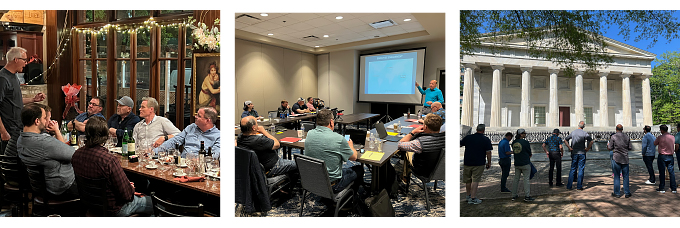
Rigsbee observa que comúnmente 50 al 60% de los miembros de la asociación no invierten en usar los recursos de conocimientos que son intencionalmente organizados y comercializados solo para las organizaciones miembro y sus empleados. Los recursos enumerados arriba contribuyen considerablemente al retorno sobre la inversión de los miembros y muchos de ellos se comparten a través de eventos y actividades para establecer redes de contactos. Por ejemplo, están los Grupos de mejores prácticas (BPG) de la CFA que se reúnen mensualmente, por lo general a la hora del almuerzo; la convención de cada verano conocida como #CFACON23 y más. Durante los eventos, ya sea en persona o virtuales, los líderes de la industria se presentan e intercambian conocimiento, lo que hace que el acervo de conocimientos sea mayor de lo que hubiera sido posible si no todos se reunieran.
“Vine emocionado a Filadelfia para ver qué tipo de grupo nuevo de miembros me pueden acompañar”, dijo Doug Herbert, Presidente de Herbert Construction de Marietta, Georgia. “Agregué una oportunidad de renovar mi certificación como técnico en cimentación, que se llevó a cabo antes del evento principal. Tan solo el almuerzo pagó con creces el tiempo y los recursos del viaje que invertí, debido a la experiencia con nuevas aplicaciones que encontré al tener conversaciones casuales”.
Doug conoce muy bien las ventajas que tiene arriesgarse a dejar la oficina para trabajar en el negocio. Él aprendió esto de su padre, que fue un mentor para él y su hermana, Amanda, antes de entregarles el negocio. “Hacer el compromiso de dejar de lado las reuniones y prioridades es consistentemente una de las decisiones más difíciles que tomo en mi negocio,” dijo Doug. “Sin embargo, hacerlo para tener intercambios con mis pares, así como exponerme a nuevas ideas y prácticas es siempre una de las decisiones más satisfactorias que tomo en mi negocio”.
Determinar el valor real en dólares de la gestión del conocimiento
Rigsbee propone que una de las partes más difíciles de la ecuación para los propietarios de negocios es cómo determinar el valor de obtener el conocimiento. La decisión de unirse a una red de profesionales como la Concrete Foundations Association es un compromiso menor. Sin embargo, acceder a los recursos para miembros de una organización de este tipo, como conectarse a reuniones, asistir a oportunidades educativas en línea y unirse a programas de investigación, significa que el estrés cotidiano del negocio debe dejarse de lado en ocasiones por varios días. Rigsbee afirma que el beneficio real en dólares de las prácticas de la gestión del conocimiento de una organización se puede calcular al usar:
- La disponibilidad del conocimiento total
- La concientización de los miembros sobre la gestión del conocimiento disponible
- La originalidad de la gestión del conocimiento exclusivo
- La facilidad y velocidad del acceso a conocimientos específicos
- El ahorro de tiempo en la adquisición de recursos medido en horas
“Aunque muchos de los elementos de cálculo anteriores pueden a primera vista parecer confusos, pueden medirse”, afirma Rigsbee. “El conocimiento exclusivo puede valorarse en dólares reales mediante el costo de la adquisición a través de fuentes (externas) de beneficios para no miembros o el costo para la organización del miembro por no tener acceso al conocimiento”. Esto significa que el tiempo y el dinero que le toma a cualquier persona u organización obtener un conocimiento similar o relacionado con lo que se organiza y se accede con mayor facilidad a través de la organización profesional cuestan mucho menos de lo que costaría fuera de esa organización. También significa que no tener acceso a esta información, como la información que solo los miembros intercambian entre ellos fuera de los límites de negocios competitivos, tiene un impacto de costo real en el negocio que están llevando a cabo, ya sea o no de manera exitosa.
“Asistí al Retiro Ejecutivo de la CFA en Filadelfia,” dijo Jim Bartley, Presidente de Bartley Corp en Silver Spring, Maryland. “Esta fue una gran oportunidad para establecer redes de contactos y profundizar en un tema específico que aún debía considerar para mí o mi negocio. En definitiva, regresé para identificar algunas áreas donde necesitaba depender de las fortalezas de los demás”. Los miembros de la CFA como Bartley, Wettemann, Herbert y muchos otros durante los casi 50 años de existencia de la CFA han considerado el costo una y otra vez para concluir que la membresía vale la pena.
Rigsbee anima a las asociaciones y líderes de negocios a que cuantifiquen los beneficios a través de un proceso de evaluación habitual. La facilidad y la velocidad del acceso a los recursos que contienen el conocimiento deben evaluarse cada año. “Multiplicar el tiempo ahorrado (en horas) por el salario del miembro (dólares por hora) es un ejercicio revelador y se sorprenderá de la cifra que obtenga. Aunque es cierto que gran parte del conocimiento actualmente se puede encontrar a través de servicios gratuitos como Google, el tiempo que uno puede tardar en hacer la búsqueda, leer varios sitios y agregar el conocimiento necesario podría ser abrumador y consumir mucho tiempo. Esto quizá es el beneficio más importante y distintivo de la membresía con una asociación de la industria: el ahorro de tiempo en el mundo actual de acceso fácil a cantidades enormes de información. El Internet está lleno de opiniones infravaloradas y narrativas contradictorias, así que es un alivio tener información relevante y revisada por pares recopilada para su negocio.
Entonces, ¿qué recomiendan los líderes como Rigsbee para su negocio y su asociación? Continúe fortaleciendo a sus miembros con recursos y oportunidades para intercambiar información. “Si su organización pone a disposición la gestión del conocimiento de la industria a personas que no son miembros, yo diría que se está ahorcando sola, metafóricamente, todos los días”, dijo Rigsbee. “Si los interesados en la industria que no son miembros pueden tener acceso a cualquier cosa más allá del encabezado a través de su sitio web o del personal de la sede, ¿para qué entonces invertirían dinero en comprar una membresía?
La Concrete Foundations Association continúa generando nuevos recursos basados en conocimiento y evaluando el interés, la consistencia y la facilidad del acceso tanto para el personal de la Asociación como para cada miembro. Se les da un gran valor a las actividades de gestión del conocimiento como las reuniones presenciales, tanto regionales como nacionales, las redes de conexiones virtuales y en mantener una comunicación eficaz a través de mensajes de correo electrónico, mensajes de texto, plataformas sociales y conexiones con miembros por teléfono. Aunque la CFA sí proporciona al público algunos recursos importantes como declaraciones de posturas y soporte técnico, continuamos reservando todo, excepto los encabezados más básicos de la industria, para los miembros, de modo que puedan acceder a los materiales a través de un entorno seguro para negocios que consiste en secciones exclusivas para miembros protegidas con contraseña en nuestro sitio web: www.cfaconcretepros.org. Tenemos un rico acervo de artículos informativos que se mantienen en línea y se ofrecen inicialmente aquí en las páginas de Concrete Facts, así como clasificados que sirven a los miembros y acceso a más materiales a través de www.concretefactsmagazine.com.
¿Cuándo fue la última vez que evaluó el costo de no tener información importante o imprescindible en el momento correcto? ¿Cuándo fue la última vez que calculó los ahorros que obtuvo por recibir apoyo, obtener información de otro miembro o enterarse de una solución a su problema de manera oportuna? Estos son a menudo aspectos ocultos y subestimados (y subvalorados) de pertenecer a la Concrete Foundations Association. ¿Es momento de que reconsidere estos valores, perdidos o heredados? Puede obtener ayuda para ello al comunicarse con nuestro enlace de los miembros con el personal, Skye Kelley, en skelley@cfaconcretepros.org.
La versión original de este artículo se publicó en LinkedIn, por Ed Rigsbee, CSP, CAE, arquitecto en colaboración, CEO de una organización sin fines de lucro, líder de comunidades virtuales, investigación para estimar el ROI de los miembros, conferencista magistral y autor de cinco libros (temas: desarrollo de una alianza estratégica y el crecimiento de las membresías). Visite el enlace para obtener más información sobre sus recursos en https://www.linkedin.com/in/edrigsbee/.
Knowledge Management is a Member-Only Benefit
Español | Translation Provided by the CFA
Year after year, event after event, company leaders who risk time away from their business to work on their business are rewarded by arguably the number-one acquisition of their professional careers: knowledge. This holds true whether they are actually participating themselves or having others in the company participate in the risk-reward opportunity of attending conferences and events. Some call these participants “emerging leaders,” others “young professionals”—but regardless of someone’s age, experience, or position in the company, it is a strategic and responsible decision to increase knowledge to refine and grow power.
“As a leader or owner of a small business, chances for professional or leadership development are extremely rare,” said Zach Wettemann of Wettemann Brothers Concrete in North Branford, Connecticut. “It’s on us to not only have the self-awareness to recognize it could be a useful or productive activity, but then an additional time commitment to figure out what course or program would be best. Obviously, time is always of the essence. So the fact that the CFA is here to not only vet the content, but also create an amazing opportunity to learn besides other members is absolutely amazing.”
Phil Marone of Marone Contractors in Thorofare, New Jersey, recently hosted an executive retreat in Philadelphia. The retreat featured a Gallup Strength Finders workshop and had participating company executives from Utah, Missouri, Georgia, Pennsylvania, Connecticut, Indiana, North Carolina, New Jersey, New York, and Maryland—only open to CFA members. Zach Wettemann was one of a dozen participants who immediately found the knowledge sharing useful for his business. Coming after a long winter that strained resources across the industry, the event was designed to help business leaders replace low energy and waning inspiration with vision and purpose. Zach said the retreat was “extremely valuable. Dare I say legendary. And I am very grateful to have had a seat at such a world-class table. THANK YOU!”
Events like this hosted throughout the year by the CFA are opportunities to come alongside other leaders in similar positions to yourself. It repeatedly rekindles confidence and hope when leaders recognize they share a journey and, more importantly, share a definite, well-worn path forward.
Collaboration architect, nonprofit CEO, and thought leader, Ed Rigsbee CSP, CAE, recently published some content on this very topic, speaking to the heart of why trade associations and nonprofit organizations are where companies today will find the most important advancements for business. “The acquisition of industry or profession knowledge, today called Knowledge Management, has been and will continue to be a primary driver for individuals and companies,” Rigsbee said.
Rigsbee noted that most nonprofit organizations define their knowledge management activities and resources as keeping track of, and making easily available, industry or professional knowledge. Such knowledge content might include:
- Policies, standards, and guidelines
- Best practices
- Trade press/scholarly journal articles
- News releases
- Other industry- or profession-specific documents
- Expert opinion
- Availability of, and access to, subject matter experts
- Peer review committees
- Research
- Surveys*
- Safety and occupational issues
- Knowledge resources created by staff
- Collective industry or profession stakeholder knowledge
Rigsbee sees commonly that 50–60% of association members fail to invest in using knowledge resources that are intentionally curated and marketed solely for member organizations and their employees. The resources listed above significantly contribute to member return on investment, and many of them are shared through events and networking activities. For example, there is the CFA’s Best Practice Groups (BPGs), which gather monthly over a general lunch timeslot; the annual convention each summer known as #CFACON23; and more. During events, whether in-person or virtual, the industry’s leaders show up and share knowledge, making the overall pool of knowledge greater than it could have ever been without everyone gathering.
“I came to Philly excited to just see what kind of new collection of members might join me,” said Doug Herbert, president of Herbert Construction from Marietta, Georgia. “I added a chance to renew my certification as a foundation technician, which took place before the main event. During the lunch break alone I more than paid for the time and travel resources I was investing from the experience in new applications that I encountered in casual conversation.”
Doug is well versed in the advantages that come from risking time away to work on business. He learned this from his dad, who mentored he and his sister, Amanda, before turning over the business. “Making the commitment to set aside meetings and priorities is consistently one of the hardest decisions I make in my business,” Doug said. “However, doing so in order to share with peers as well as exposing myself to new ideas and practices is consistently one of, if not the most, rewarding decisions I make in my business.”
Determine Real-Dollar Value of Knowledge Management
Rigsbee proposes that one of the most difficult parts of the equation for business owners is how to determine the value of attaining knowledge. The decision to join a professional network like the Concrete Foundations Association is a minor commitment. However, accessing such an organization’s member resources—like connecting in meetings, attending online education opportunities, and joining researching programs—means that the everyday business stress must be set aside, at times for multiple days. Rigsbee contends that the real-dollar benefit for an organization’s knowledge management practices can be calculated using:
- Total knowledge availability
- Member awareness of available knowledge management
- Uniqueness of proprietary knowledge management
- Ease and speed of access to specific knowledge
- Resource acquisition time saving in hourly measurement
“While many of the above elements of calculation might at first glance appear nebulous, nevertheless, all can be measured,” states Rigsbee. “Proprietary knowledge can be valued in real-dollars by the cost of acquisition through non-member benefit (outside) sources and/or the cost to the member’s organization of not having access to the knowledge.” This means that the time and money it takes any person or organization to obtain similar or related knowledge to what is curated and more easily accessed through their professional organization costs far less than what it would cost outside that organization. It also means that not having access to this information, such as information members only share with each other outside of competitive business boundaries, has a real cost impact on the business they are conducting, successfully or not.
“I attended CFA’s Executive Retreat in Philly,” said Jim Bartley, president of Bartley Corp from Silver Spring, Maryland. “This was a great opportunity to network and dive into a specific subject I had yet to consider for me or my business. I definitely came away seeing some areas where I need to lean on strengths of others.” CFA members like Bartley, Wettemann, Herbert, and countless others over the nearly 50 years of the CFA’s existence have counted the cost over and over, each time concluding that membership is worthwhile.
Rigsbee encourages associations and business leaders to quantify benefits through a regular evaluation process. The ease and speed of access to resources containing the knowledge should be evaluated yearly. “Multiplying the time saved (in hours) by your member’s wage (dollars per hour) is a telling exercise—you’ll be amazed at the number.” While it is true that much knowledge is currently accessible through free services like Google, the length of time it might take one to do the search, read through numerous sites, and aggregate the needed knowledge could be daunting and very time consuming. This is perhaps the most important and distinguishing benefit to membership with an industry association, saving so much time in today’s world of easy access to massive amounts of information. The internet is choked with under-evaluated opinions and conflicting narratives, so it is a relief to have peer-reviewed, relevant information collected for your business.
So what do leaders like Rigsbee instruct for your business, for your association? Continue to strengthen your members with resources and information-sharing opportunities. “If your organization makes industry knowledge management available to non-members, my bet is that you are metaphorically shooting yourself in the foot every day,” Rigsbee said. “If non-member industry stakeholders can access anything more than headlines through your website or from headquarter staff, why in the world would they invest in membership?”
The Concrete Foundations Association continues to generate new knowledge-based resources and evaluate the interest, consistency and ease of access, both for the Association staff and for each members. A high value is placed on knowledge management activities like regional and national in-person gatherings, virtual networking, and maintaining efficient communication across email, text, social platforms and member connections by phone. While the CFA does provide the public with some important resources like position statements and technical support, we continue to reserve all but the most basic industry headlines for members so that members can access material through a business-safe environment which consists of password-protected, members-only sections on our website, www.cfaconcretepros.org. We have a rich history of informative articles maintained online, offered initially here in the pages of Concrete Facts, as well as having member-serving classifieds and access to more material through www.concretefactsmagazine.com.
When was the last time you evaluated the cost of not having important or imperative information at just the right time? When was the last time you calculated the savings achieved by receiving support, getting information from another member, or learning about a solution to your problem in a timely fashion? These are the often hidden and underappreciated (and undervalued) aspects of belonging to the Concrete Foundations Association. Is it time for you to revisit these values, lost or received? You can get help to do so by contacting our staff member liaison, Skye Kelley, at skelley@cfaconcretepros.org.
The original version of this article was published on LinkedIn, published by Ed Rigsbee, CSP, CAE, Collaboration Architect, Nonprofit CEO, Virtual Communities Leader, Member ROI Valuation Research, Keynote Speaker, and author of five books (topics: strategic alliance development and membership growth). Visit more of his resources via https://www.linkedin.com/in/edrigsbee/.
¿Quiere un cambio en el desempeño del reclutamiento? Vamos a hacer algo diferente
English | Translation Provided by the CFA
¿Qué sucede cuando su compañía tiene el mismo problema continuamente? El problema podría ser moldes de aceras y canaletas que necesitan repararse constantemente. El problema puede ser un encofrado de concreto para muros que de alguna manera fracasa. Puede ser un proveedor esencial que nunca cumple con la fecha límite, atrasa su programa de trabajo y le cuesta dinero a su compañía.
¿Continúa usando los mismos moldes o proveedores que le están costando tiempo y dinero a su compañía mientras se queja de que no funcionan?
Sospecho que hace algún ajuste. Puede mejorar los moldes para que sean más confiables o puede llamar al proveedor y darle la opción de arreglar los moldes o aceptar la devolución.
¿Cómo se relaciona este tema con el reclutamiento para atraer talento? Con demasiada frecuencia escucho a las compañías quejarse de que están teniendo problemas para atraer a los mejores trabajadores, “¡No podemos encontrar buenos trabajadores!” Cuando les pregunto qué pueden cambiar, contestan algo como “Buscaremos otro lugar para publicar las vacantes”.
El reclutamiento es muy parecido a un proceso de ventas, línea por línea, paso por paso. ¿Los empleados de su personal de reclutamiento son profesionales de ventas? Publicar vacantes en línea y esperar que los mejores candidatos vean las vacantes y soliciten el puesto es un método poco confiable cuando buscar y reclutar nuevos empleados es un problema para el negocio.
Veamos de cerca a los vendedores de su compañía (si su compañía tiene el tamaño para tener profesionales de ventas). ¿Ellos venden publicando en línea la disponibilidad de su compañía como contratista de concreto? ¿Sería eso algo funcional? Si no le aportan suficientes trabajos, ¿cuánto tiempo continúan trabajando en ventas en su compañía?
Los profesionales de ventas tienen la responsabilidad de desarrollar relaciones, no de publicar y esperar que pase lo mejor. ¿Estaría de acuerdo con esto? Puesto que el reclutamiento es un puesto de ventas, ¿qué haría su compañía de manera diferente para mejorar su capacidad de atraer a los mejores trabajadores? ¿Continuará publicando vacantes y esperando lo mejor o hará cambios significativos para atraer a los mejores trabajadores de la industria del concreto?
Como la consultoría de atracción de talento número uno según lo reportado por Google y Bing, yo puedo instruir a su compañía para que tenga un enorme éxito para atraer a los mejores trabajadores. Para obtener más información, lea este artículo en Newsbreak acerca de mi negocio: https://www.newsbreak.com/@dr-pam-perry-1598282/2997172915633-bill-humbert-the-ceo-s-secret-weapon-to-attracting-top-talent?s=mp_1598282
Want a Change in Recruiting Performance? Let’s do Something Different
Español | Translation Provided by the CFA
What happens when your company experiences the same problem continuously? The problem could be curb and gutter forms that constantly need to be repaired. The problem could be concrete formwork for walls that somehow fail. It may be a critical vendor who never makes their deadline – and puts your work behind schedule and costs your company money.
Do you continue to use the same forms or vendors that are costing your company time and money while complaining they do not work?
My suspicion is that you make some adjustments. You may improve the forms to be more reliable, or you may call the supplier and give them the choice: fix the forms or return them.
How is this topic relevant to talent attraction recruiting? Far too often, I listen to companies that are having a difficult time attracting the best workers complain amongst themselves, “We cannot find good people!” When I ask what they can do different, they say something like, “We will find another place to post open positions.”
Recruiting mirrors the sales process perfectly, line by line, step by step. Are the employees on your recruiting staff sales professionals? Posting positions online and hoping the best candidates will see the posts and apply to your positions is an unreliable method when finding and recruiting new employees is a business problem.
Let’s look at your company salespeople (if your company is large enough to have a sales professional). Do they sell by posting your company’s availability for concrete contracting online? Would that work? If they do not bring sufficient business to you, how long are they employed in sales for your company?
Sales professionals have a relationship-building responsibility, not a post-and-hope responsibility. Would you agree? Since recruiting is a sales position, what will your company do different to improve your ability to attract the best workers? Will you continue to post and hope, or will your company make a substantive change to attract the best concrete workers?
As the number-one talent attraction consultant reported by both Google and Bing, I can coach your company to become wildly successful in attracting the best workers. For more information, here is a Newsbreak article about my business: https://www.newsbreak.com/@dr-pam-perry-1598282/2997172915633-bill-humbert-the-ceo-s-secret-weapon-to-attracting-top-talent?s=mp_1598282
Euclid Chemical Completes Environmental Product Declaration for Fiber Reinforcement Products
CLEVELAND, Ohio (May 18, 2023) – Euclid Chemical, a leading manufacturer of concrete and masonry construction products, is pleased to announce the completion of its first Environmental Product Declaration (EPD). The EPD reports on the impacts of four microfibers and one macrofiber used as concrete reinforcement.
An EPD is a communications document that provides transparent and third-party verified data about the environmental impact of products and services based on the results of a life cycle assessment (LCA) of a manufactured material. This enables comparisons between products fulfilling the same function.
Manufactured at Euclid Chemical’s LaFayette, Georgia fiber production facility, PSI Fiberstrand Multi-Mix 80, PSI Fiberstrand 100, PSI Fiberstrand 150, PSI Fiberstrand F, and Tuf-Strand SF were analyzed for the report. The EPD helps quantify the environmental savings or “footprint” that can result when using or converting traditional steel reinforcement to Euclid Chemical’s fibers.
“The Euclid Chemical team is very proud to complete our first EPD and the ability to highlight the positive environmental impact that fiber reinforced concrete offers,” said Michael Mahoney, director of marketing and technology for fiber reinforced concrete at Euclid Chemical. “Fiber reinforcement, along with improved concrete mix designs and advancements in shrinkage technologies, can result in more durable and resilient concrete while also reducing greenhouse gas emissions and our carbon footprint.”
The EPD was conducted in accordance with ISO 21930 as the core product category rule and is also compliant with the ISO 14025 standard. This was the first EPD for a reinforcing fiber product published through the NRMCA EPD program. The EPD is accessible to the public and listed as NRMCA EPD: 20080 Euclid Chemical.
About Euclid Chemical
Headquartered in Cleveland, Ohio, Euclid Chemical has served the global building market for more than a century as a leading manufacturer and supplier of specialty products and technical support services for the concrete and masonry construction industry. Euclid Chemical’s expansive product line includes admixtures, fiber reinforcement, concrete repair products, flooring materials, decorative concrete systems, and more. Learn more at www.euclidchemical.com.
Euclid Chemical holds a National Associate membership in the Concrete Foundations Association, active since 2017. Interested parties can find them exhibiting annually at the annual convention (#CFACON23 San Antonio) and participating in many other Association activities.
Dennis Purinton: Una historia de la ley de Abrams
English | Translation Provided by the CFA
“Cuando el trabajo se convierte en trabajo y no es agradable, es hora de jubilarse. La mayoría de las empresas son usted y algunos equipos. El único valor real para su negocio sin ‘usted’ es el equipo” – Dennis Purinton
Dennis Purinton, una destacada figura fundacional en la industria del concreto se retiró recientemente después de 38 años de contribución. Con un fuerte compromiso altruista con la Concrete Foundations Association y el American Concrete Institute, su pequeña empresa contratista pronto se convirtió en un gigante en su campo. Purinton, en su inmensa humildad, nunca admitiría el impacto masivo que su trabajo ha tenido en la industria del concreto; sin embargo, sus proyectos realmente hablan por sí mismos.
Pero ¿cómo se produce tal presencia en la industria del concreto? “Comenzamos como un contratista general en marzo de 1984”, explicó Purinton. “Ampliamos el negocio del concreto para nuestro propio uso aproximadamente dos años después, y aproximadamente un año después nos expandimos para proporcionar servicios de concreto a otros contratistas generales, lo que se convirtió en una gran demanda y nos permitió interrumpir nuestro propio trabajo de contratista general y concentrarnos en proporcionar servicios a otros contratistas generales”.
A lo largo del éxito progresivo de la compañía, Purinton nunca perdió de vista lo que su carrera significaba para él y cómo su compañía más pequeña podía contribuir a una industria tan esencial. “Siempre he creído que mi conocimiento y experiencia tienen poco valor a menos que los ponga a disposición de otros. Cada vez que asumimos una tarea o compromiso, nos comprometimos a ello al 100 por ciento hasta que se complete. Ofrecerme como voluntario para un compromiso y esperar que otros lleven la carga solo apareciendo para la gloria o las reuniones y funciones sociales no era lo que yo era. Las asociaciones comerciales son una forma de educación superior que genera nuestros líderes de la industria. Estos líderes de la industria cuestionan el valor y la viabilidad de los códigos y estándares existentes. Esos mismos líderes abogan por nuevos códigos y estándares que la última tecnología requiere, pero respetan las formas probadas y verdaderas del pasado”.

Cuando se le pidió que ampliara aún más esta idea de las asociaciones comerciales como una forma de educación superior y qué enfoque adoptaría para enseñar a las mentes jóvenes de hoy el propósito y la maravilla de trabajar en la industria del concreto, Purinton dijo: “Aprendí de la escuela de los golpes duros. Esta industria es muy gratificante y satisfactoria. La mayoría de las personas no tienen la capacidad de conducir y ver su trabajo, sabiendo que se convertirá en parte de la historia. Es importante que aquellos de nosotros que hemos tenido éxito en la industria eduquemos a las generaciones futuras, dondequiera que vayamos en la vida, de los gratificantes aspectos positivos de la industria. Incluso si los jóvenes crecen en una familia involucrada en cualquiera de los oficios, eso no garantiza que ellos también quieran hacer lo mismo. Dondequiera que vaya, si veo a alguien que realmente disfruta trabajar afuera, tiene una gran ética de trabajo, hace preguntas y quiere aprender, intervengo y aliento, nutro y comparto conocimientos. Se necesita mucho más que un aula, lo cual hará que las personas aprendan de manera inteligente y se enseñe funciones básicas de rutina en esta industria, porque cada trabajo es diferente y único. Se necesita alguien con pensamiento rápido mientras mantiene la calma cuando algo sale mal. Se necesita que todos y cada uno de nosotros tomemos a alguien bajo nuestra ala cada vez que tenemos la oportunidad o surge la oportunidad”.
Purinton aplicó esta filosofía a su hijo, quien juega un papel integral en llevar la antorcha brillante de Purinton Builders hacia el futuro. Michael Purinton, hijo de Purinton y socio en los negocios, recuerda la frase “como padre, como hijo”.
“La transición de camiones de juguetes a equipos productivos llegó muy temprano para Mike”, dijo Purinton. “Le encantaba trabajar al aire libre desde el momento en que pudo caminar y estaba a mi lado cada vez que podía desde los ocho años. Tenía una habilidad natural, un gran interés, era muy atento y tenía el deseo de aprender y hacer cualquier cosa necesaria. Era muy hábil usando un martillo y operando varios equipos a los doce años. Cuando se graduó de la escuela secundaria, estaba extremadamente interesado en el negocio y después de un par de años en la universidad estaba ansioso por regresar al negocio a tiempo completo. No podría haber hecho crecer el negocio a lo que es hoy sin su conocimiento y trabajo duro, que fueron invaluables”.
La familia es un pilar central en la industria del hormigón, donde esta forma de arte vital se transmite de generación en generación. Igual de importante para el éxito y el crecimiento de todas las empresas que invierten en el negocio de concreto, sin embargo, es la comunidad. Se le pidió a Purinton que comentara sobre cuán importantes eran las relaciones dentro de la industria para su negocio. “Cuando te das cuenta de que tu competencia no es tu enemigo sino un socio en la expansión de la industria, puedes darte cuenta de los beneficios de las asociaciones de la industria y la experiencia de otros, como los competidores”. Purinton sabe que es fácil quedar atrapado en la competencia de quién obtiene qué clientes, cuyos ingresos son los más altos y quién puede hacer las creaciones concretas más sobresalientes. Sin embargo, trabajar junto con otros contratistas proporcionará crecimiento y éxito mucho más rápido que trabajar de forma independiente.
Otra relación clave integral para el éxito de Purinton Builders es la de negocios con el proveedor. Purinton habla de esas relaciones y cómo han cambiado a lo largo de los años, diciendo: “El servicio de un proveedor confiable y de calidad es mucho más importante que el precio. Un producto y servicio deficientes le costará ganancias, clientes y su reputación como contratista confiable y de calidad”. Una de las formas en que mantuvo buenas relaciones con los proveedores es a través del respeto mutuo. “La comprensión de la logística de los proveedores contribuye a las buenas relaciones con los proveedores. Nunca exigimos un servicio extraordinario a menos que las circunstancias lo requirieran absolutamente. El pago pronto por nuestra parte cada mes hizo que el servicio confiable fuera mucho más fácil de lograr. Mantuvimos relaciones establecidas con nuestros fabricantes y proveedores de confianza durante muchos años. Sabíamos qué esperar de ellos y ellos sabían qué esperar de nosotros”.
Con una miríada de proyectos y tipos de proyectos repartidos a lo largo de casi cuarenta años de negocios, Purinton sabe que su pasión siempre fue el trabajo o proyecto extraño que nadie quería. “Estos proyectos fueron donde siempre estuvo nuestro sustento”, dijo. “Si bien cada uno a menudo significaba aprender algo nuevo o buscar colaboración y experiencia que yo no tenía, la oportunidad de proporcionar la solución correcta siempre trajo una combinación de gratificación sincera y compensación saludable”.
Tal vez por eso es apropiado que la culminación de todo su trabajo, sus conocimientos y la búsqueda de la satisfacción del cliente, se traduzca en su proyecto final de una casa de jubilación para él y su esposa. Si bien tenía un interés personal y apasionado en el resultado, el proyecto fue otro ejemplo del enfoque técnico de la calidad por el que Purinton Builders ha sido conocido en New England. “El proyecto requirió un alto nivel de coordinación con arquitectos, ingenieros, contratistas generales, inspectores, compañías de servicios públicos, vendedores y proveedores, y, por supuesto, los ‘propietarios’”, dijo Purinton. Yo era un contratista de demolición con licencia, por lo que el proyecto comenzó con una cuidadosa atención al reciclaje o la reutilización de la mayor parte de los materiales obtenidos a través de la demolición”. El objetivo del proyecto era crear una casa estructuralmente diseñada para soportar el clima extremo que la pareja podría enfrentar con una estructura respetuosa del medioambiente y una esperanza de vida a largo plazo.
Se hizo mucho hincapié en que el proyecto fuera visualmente agradable y, por supuesto, destacara el uso del hormigón. Al final, Purinton Builders le dio a los Purinton un proyecto con muros de cimentación integralmente aislados y concreto en el camino de entrada, patios, terraza exterior, pisos interiores y escaleras exteriores de concreto que descienden de cada uno de los espacios de entretenimiento al aire libre. “Nos concentramos en accesorios y materiales ecológicos de concreto”, dijo Purinton. “Con la durabilidad a largo plazo, la estabilidad estructural y la eficiencia energética como objetivos focales, aprovechamos décadas de experiencia para seleccionar los sistemas de aislamiento e iluminación adecuados, además de confiar en nuestras relaciones con la industria para optimizar los diseños de mezcla de concreto”. Los materiales utilizados en el proyecto fueron de origen local, incluidos pisos de madera de árboles cosechados localmente. De acuerdo con la alta eficiencia y la masa térmicas del hormigón aislado, Purinton seleccionó sistemas mecánicos de alta eficiencia energética, como tener una alta calificación SEER en el equipo de calefacción y refrigeración y un sistema de calefacción por suelo radiante integrado en una base de Gyp-crete en áreas donde hay pisos de mampostería. Después de haber visto lo último en tecnología para la eficiencia de la iluminación en casas de concreto que había construido, Purinton también incorporó sistemas de iluminación inteligente LED para ayudar a resaltar espacios en toda la casa. Finalmente, utilizando parte de la experiencia más aventurera que él y Michael habían adquirido en la última década, terminaron el proyecto con un trabajo en el sitio que involucró almacenar toda el agua del sitio utilizando concreto permeable y sistemas de dispersión subterráneos. De principio a fin, este proyecto completó un trabajo de amor y compromiso concienzudo con la calidad que resume la carrera de los Purintons.
Cuando las cosas iban tan bien para Purinton Builders, ¿cómo supo Dennis Purinton que era hora de jubilarse y tomar esa decisión increíblemente compleja? “La edad y las continuas restricciones y mandatos que se imponen a las pequeñas empresas le quitaron la diversión a estar en el negocio. El agravamiento de las necesidades cotidianas no justifica los ingresos adicionales ni la pérdida de tiempo personal y familiar. Todavía tengo muchas oportunidades para continuar contribuyendo al mejoramiento de la industria, así como educar y transmitir conocimientos a otros contratistas”. Para Dennis Purinton, al igual que la Ley de Abrams requiere la proporción perfecta de agua a cemento, su carrera requirió un equilibrio saludable de trabajo y alegría. Cuando se le pregunta qué consejo daría para que otros lo sigan, nos deja con esto: “Cuando el trabajo se convierte en trabajo y no es agradable, es hora de jubilarse. La mayoría de las empresas son usted y algunos equipos. El único valor real para su negocio sin ‘usted’ es el equipo”.
Dennis Purinton: An Abrams’ Law Story
Español | Translation Provided by the CFA
“When work becomes work and not enjoyable, it’s time to retire. Most businesses are you and some equipment. The only real value to your business without ‘you’ is the equipment.” – Dennis Purinton
Dennis Purinton, an outstanding foundational figure in the concrete industry, recently retired after an impressive 38 years of contribution. With a strong commitment altruistically to the Concrete Foundations Association and American Concrete Institute, his small contracting company soon became a giant in its field. Purinton, in his immense humility, would never admit the massive impact his work has made on the concrete industry; however, his projects truly speak for themselves.
But how does such a presence in the concrete industry come to be? “We began as a general contractor in March of 1984,” Purinton explained. “We expanded the concrete business for our own use approximately two years later, and approximately one year after that expanded to providing concrete services to other general contractors, which became a big demand, allowing us to discontinue our own general contracting work and concentrate on providing services to other general contractors.”
Throughout the company’s progressing success, Purinton never lost sight of what his career meant to him, and how his smaller company could contribute to such an essential industry. “I have always believed my knowledge and experience have little value unless I make it available to others. Whenever we took on a task or commitment, we committed to it 100 percent until completed. Volunteering to a commitment and expecting others to carry the load by only showing up for the glory or social gatherings and functions was not who I was. Trade associations are a form of higher education that generates our industry leaders. These industry leaders question the value and viability of existing codes and standards. Those same leaders advocate for new codes and standards that the latest technology requires, but respect the tried and true ways of the past.”
When asked to further expand on this idea of trade associations as a form of higher education and what approach he would take in teaching today’s young minds the purpose and wonder of working in the concrete industry, Purinton said, “I learned from the school of hard knocks. This industry is very gratifying and fulfilling. Most people do not have the ability to drive around and see their work, knowing it will become a part of history. It is important that those of us that have had success in the industry educate future generations, wherever we go in life, of the gratifying positives of the industry. Even if young people grow up in a family involved in any of the trades, that does not guarantee they too will want to do the same. Wherever I go, if I see someone who truly enjoys working outside, has a great work ethic, asks questions, and wants to learn, I step in and encourage, nurture, and share knowledge. It takes so much more than a classroom—which will make people book smart and teach basic routine functions in this industry—because each and every job is different and unique. It takes someone with quick thinking while staying calm when something goes wrong. It takes each and every one of us to take someone under our wing every time we have the chance or the opportunity arises.”
Purinton applied this philosophy to his son, who plays an integral part in carrying the bright torch of Purinton Builders into the future. Michael Purinton, Purinton’s son and partner in business, calls to mind the phrase “like father, like son.”
“The transition from sandbox trucks to productive equipment came very early for Mike,” Purinton said. “He loved working outdoors from the time he could walk and was at my side every chance he could get from about age eight. He had a natural ability, keen interest, was very attentive, and held a desire to learn and do anything needed. He was very proficient swinging a hammer and operating various equipment by age twelve. By the time he graduated high school, he was extremely interested in the business and after a couple years at college he was eager to return to the business full time. I could not have grown the business to what it became without his knowledge and hard work, which were invaluable.”
Family is a central pillar in the concrete industry, where this vital artform is passed down from generation to generation. Equally as important to the success and growth of all companies invested in the concrete business, however, is community. Purinton was asked to comment on how important relationships within the industry were to his business. “When you realize that your competition is not your enemy but a partner in the expansion of the industry, you can realize the benefits of industry associations and the experience of others, like competitors.” Purinton knows it is easy to get caught up in the competition of who gets what clients, whose income is the highest, and who can make the most outstanding concrete creations. Working together with other contractors, though, will provide growth and success much faster than working independently.
Another key relationship integral to the success of Purinton Builders is that of buisiness with supplier. Purinton speaks to those relationships and how they have changed over the years, saying, “Service from a dependable, quality supplier is by far more important than price. Poor product and service will cost you profit, customers, and your reputation as a quality, dependable contractor.” One of the ways he maintained good relations with suppliers is through mutual respect. “An understanding of supplier logistics makes for good supplier relationships. We never demanded extraordinary service unless circumstances absolutely required it. Prompt payment by us every month made reliable service much easier to accomplish. We maintained established relationships with our trusted manufacturers and suppliers for many years. We knew what to expect from them and they knew what to expect from us.”
With a myriad of projects and project types spread across nearly forty years of business, Purinton knows his passion was always the odd job or project that nobody wanted. “These projects were where the bread and butter always was,” he said. “While each one often meant learning something new or seeking collaboration and expertise that I didn’t have, the chance to provide the right solution always brought a combination of sincere gratification and healthy compensation.”
Perhaps this is why it is fitting that the culmination of all his work, all his knowledge and the pursuit of customer satisfaction, would lead to his final project being a retirement home for he and his wife. While having a vested and passionate interest in the outcome, the project was yet another example of the technical approach to quality Purinton Builders has been known for throughout New England. “The project required a high level of coordination with architects, engineers, general contractors, inspectors, utility companies, vendors and suppliers, and, of course, the ‘homeowners,’” Purinton said. “I was a licensed demolition contractor, so the project began with careful attention to recycling or repurposing as much of the materials obtained through the demolition.” The objective for the project was to create a home structurally designed to withstand the extreme weather that the couple could face with an environmentally friendly structure and long-term life expectancy.
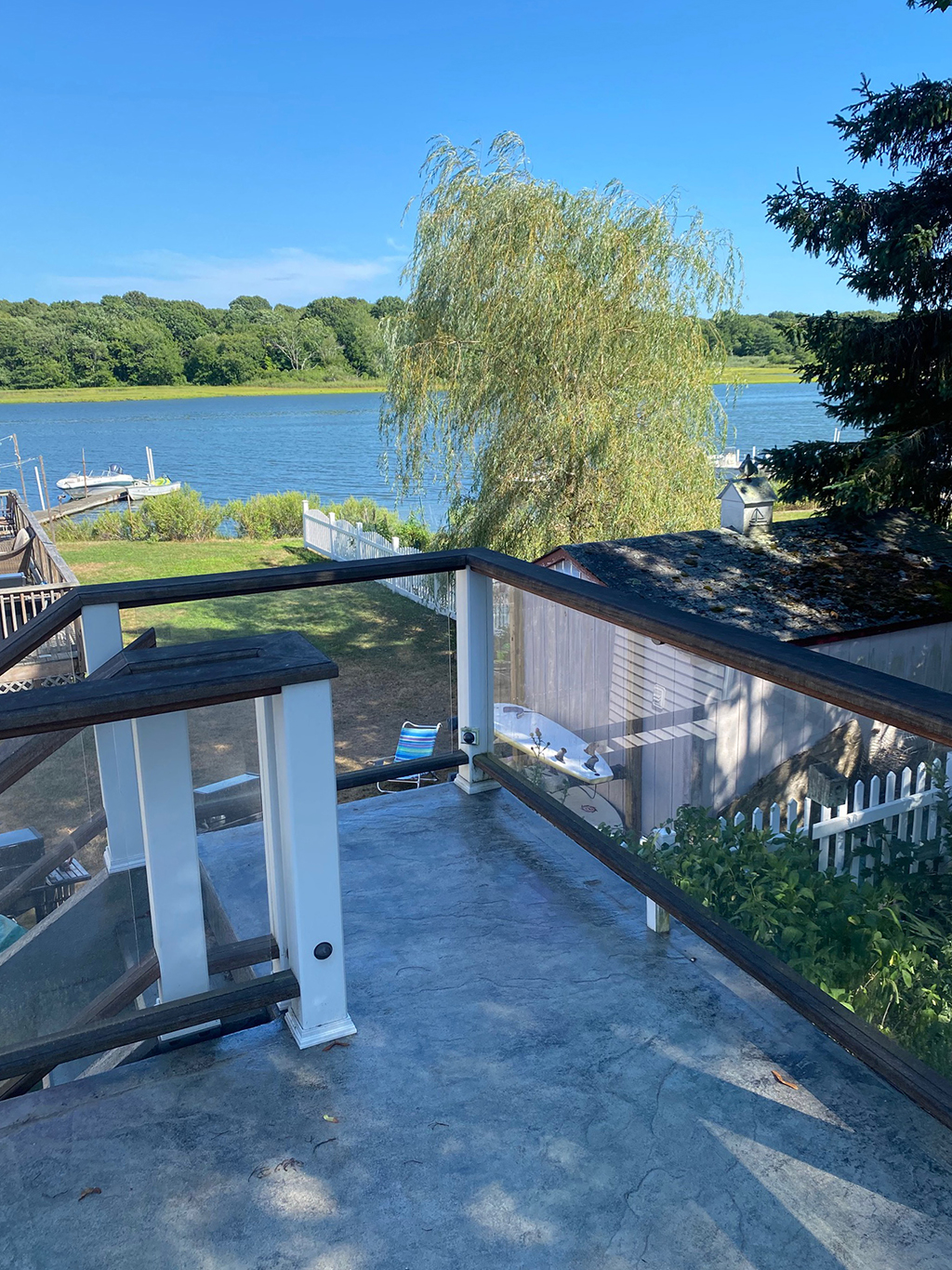
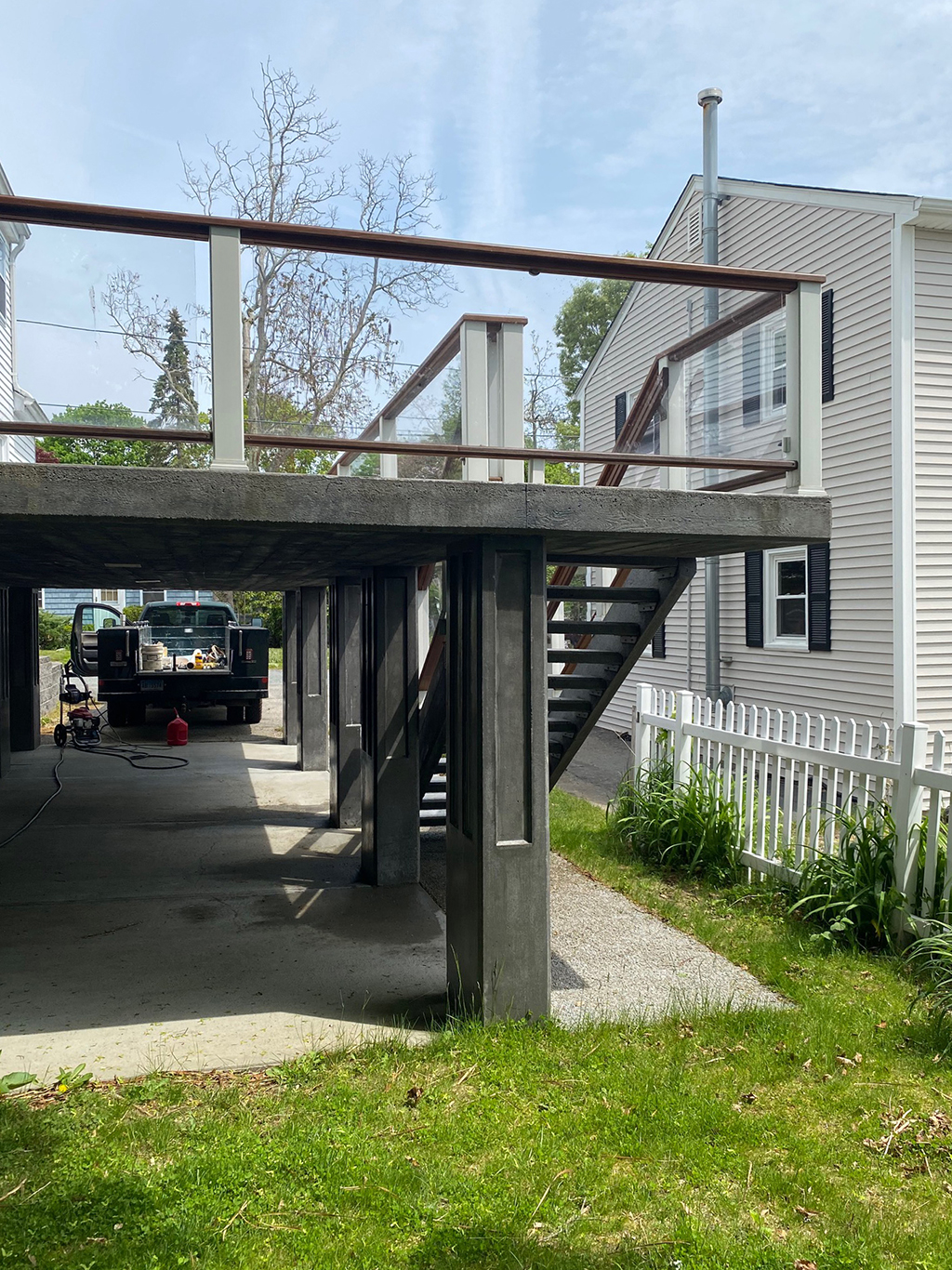
A high emphasis was placed on the project being visually pleasing and, of course, highlighting the use of concrete. In the end, Purinton Builders gave the Purintons a project with integrally insulated foundation walls and concrete featured in the driveway, patios, exterior deck, interior floors, and exterior concrete stairs descending from each of the outdoor entertainment spaces. “We concentrated on environmentally friendly concrete accessories and materials,” Purinton said. “With long-term durability, structural stability, and energy efficiency as focal goals, we pulled on decades of experience to select the right insulating and lighting systems, as well as relying on our industry relationships to optimize the concrete mix designs.” The materials used on the project were locally sourced, including hardwood flooring harvested from locally grown timbers. In keeping with the high thermal efficiency and thermal mass of the insulated concrete, Purinton selected highly energy-efficient mechanical systems, such as having high SEER rating in the heating and cooling equipment and a radiant floor heating system embedded in a gypcrete base in areas where there is masonry flooring. Having seen the latest in technology for lighting efficiency in concrete homes he had built, Purinton also incorporated LED smart lighting systems to help feature spaces throughout the home. Finally, using some of the more adventurous experience he and Michael had gained in the last decade, they finished the project with sitework that involved storing all site water using pervious concrete and underground dispersing systems. Start to finish, this project completed a labor of love and conscientious commitment to quality that summarizes the career of the Purintons.
When things were going so well for Purinton Builders, how did Dennis Purinton know it was time to retire and go about making that incredibly complex decision? “Age and continuing restrictions and mandates being put on small businesses took the fun away from being in business. The aggravation of day-to-day requirements did not justify the additional income or the loss of personal and family time. I still have many opportunities to continue to contribute to the betterment of the industry as well as educate and pass on knowledge to other contractors.” For Dennis Purinton, just like the Abrams’ Law requires the perfect ratio of water to cement, his career required a healthy balance of work and joy. When asked what advice he would give for others to follow, he leaves us with this: “When work becomes work and not enjoyable, it’s time to retire. Most businesses are you and some equipment. The only real value to your business without ‘you’ is the equipment.”
Planificar sus presentaciones
English | Translation Provided by the CFA
La convocatoria de inscripciones para 2023 ya está en www.cfaconcretepros.org, donde se le anima a descargar el formulario de presentación para completar. Las inscripciones están abiertas a cualquier miembro de la Concrete Foundations Association, y es gratis enviar una entrada. ¿Aún no es miembro? Hay una solicitud rápida y fácil para la membresía en línea, o puede inscribirse para la membresía poniéndose en contacto con la sede de la Asociación.
Una vez que haya descargado el formulario de envío, seleccione el tipo de proyecto y proporcione información de contacto. Luego hay tres áreas clave de información para el proyecto que su equipo querrá considerar. La cantidad, precisión y calidad de esta información a menudo marcarán la diferencia en si un proyecto se convierte o no en una mención honorífica, asciende al ganador en una categoría o se convierte en el Gran Proyecto General del Año.
Datos del proyecto
Derivado de su historia de presentar el proyecto más grande, espectacular y más complicado del año, la primera sección que completará para el proyecto es la de especificaciones. Estas estadísticas básicas permiten una comparación rápida dentro de las numerosas categorías disponibles para los proyectos y muestran la razón por la que ha elegido enviar el proyecto. Recuerde, las fundaciones pequeñas no compiten contra las McMansiones, y las fundaciones comerciales no compiten contra las casas sobre nivel, etc.
Narrativa para su trabajo
Cada proyecto tiene una historia que los números no pueden descubrir. Una serie de preguntas lo impulsa a pensar de manera única sobre el proyecto, su enfoque y los obstáculos que superó, y anima a reflexionar sobre la satisfacción de todos los participantes con los resultados finales. Esta información puede escribirse de manera sucinta o elaborada como sea necesario para capturar la sensación que le gustaría que tuvieran los espectadores.
Evidencia gráfica de la obra
Dicen que una imagen vale más que mil palabras, y cada premio comienza con las imágenes. A medida que la disponibilidad de drones, teléfonos inteligentes 4K e incluso video se ha vuelto más generalizada a través de nuestra cultura, muchos contratistas han mejorado el juego cuando se trata de fotografiar el trabajo que hacen semana tras semana. A medida que un proyecto de importancia comienza a desarrollarse, es de gran valor tener un plan sobre cómo comercializará su trabajo, lo que conduce a excelentes registros de presentación de premios. Hay un mínimo recomendado de tres a cuatro imágenes para cada envío de proyecto, y no hay una cantidad máxima. Las empresas que han grabado y enviado videos a menudo se convierten en parte de momentos adicionales de promoción de la Asociación, como ser utilizados en un clip destacado en World of Concrete.
La mayor parte del proceso de presentación del premio es dar el primer paso. ¿Con qué proyecto están más satisfechos usted, su equipo, su cliente y posiblemente el propietario del proyecto? ¿Qué proyecto le da motivos para confiar en el próximo año? Estos son los tipos de proyectos que conforman los Proyectos del Año de la CFA construidos por #CFAConcretePros.
Planning Your Submittals
Español | Translation Provided by the CFA
The Call for Entries for 2023 is already up at www.cfaconcretepros.org, where you are encouraged to download the submittal form for completion. Entries are open to any member of the Concrete Foundations Association, and it is free to submit an entry. Not yet a member? There is a quick and easy application for membership online, or you can sign up for membership by contacting Association headquarters.
Once you have downloaded the submission form, you select the project type and provide contact information. Then there are three key areas of information for the project your team will want to consider. The amount, accuracy, and quality of this information will often make the difference in whether or not a project becomes an honorable mention, ascends to the winner in a category, or becomes the Overall Grand Project of the Year.
Tales of the Tape
Stemming from its history of presenting the biggest, “baddest,” and most complicated project of the year, the first section you will complete for the project is that of specifications. These basic statistics allow for quick comparison within the numerous categories available for projects and show the reason why you have chosen to submit the project. Remember, tiny foundations do not compete against McMansions, and commercial foundations do not compete against above-grade homes, etc.
Narrative for Your Work
Every project has a story that numbers cannot uncover. A series of questions prompts you to think uniquely about the project, your approach, and the hurdles you overcame, and encourages you to reflect on all participants’ satisfaction with the final results. This information can be written as succinctly or elaborately as necessary to capture the feeling you would like the viewers to have.
Graphic Evidence of the Work
They say a picture is worth a thousand words, and every award begins with the pictures. As the availability of drones, 4K smartphones, and even video has become more pervasive through our culture, many contractors have upped the game when it comes to photographing the work they do week in and week out. As a project of significance begins to unfold, it is of great value to have a plan on how you will market your work—which leads to great award submittal records. There is a recommended minimum of three to four images for each project submittal, and no maximum amount. Companies who have shot and submitted video often find their footage becoming part of additional Association promotion moments, such as being used as a featured clip at World of Concrete.
The biggest part of the award submittal process is taking the first step. Which project are you, your crew(s), your customer, and possibly the project owner most satisfied with? Which project gives you reason to be confident in the year ahead? These are the kinds of projects that make up CFA’s Projects of the Year built by #CFAConcretePros.