
Cold Weather Concrete Pumping Tips
How to prevent or deal with concrete freezing in the concrete pump, which can stop the flow of concrete through the pipeline
American Concrete Pumping Association & Schwing America, Inc.
as seen at For Construction Pros.com
Cold weather pumping can present a variety of problems as compared to pumping in moderate temperatures. Most obvious, of course, is if the concrete freezes in the boom or other parts of the unit such as the hopper – thus stopping the flow of concrete through the pipeline.
One way to avoid this from happening is to mix the concrete using very hot water to keep the concrete from freezing during the delivery and waiting period. When priming, slurry should also be mixed with hot water. If the slurry freezes against the walls of the pipeline, it can restrict the flow of concrete causing a blockage. The pumping company can contact the ready mixed company and arrange for the first driver to be loaded with hot water for use when mixing the slurry.
Some companies will also wrap their boom pipeline with insulation. In most cases, the insulation is a foam tube cut to accommodate the pipeline, placed around the pipe, and taped together. The foam holds in the heat of the concrete allowing it to flow as normal.
Another way to keep the pipeline from freezing is to pre-heat the boom pipeline using the exhaust stack from the unit’s engine. Using an exhaust hose specifically made to withstand high temperatures, the boom operator slips the heat resistant hose over the exhaust pipe and places the other end into the tip hose of the boom – allowing its warm air to flow through the pipeline and exit from the hopper. With this procedure, it is important that airflow has an open pathway for exiting. Without an open path, the hot air from the exhaust will be forced backward and create excessive back pressure on the engine of the truck.
If the concrete should freeze in the boom, pumping will stop until the machine has been warmed up. Fortunately, concrete will stop setting when it has frozen. Once the machine has been moved to a warm place and allowed to thaw, it must be cleaned out before fresh concrete can be added and pumping resumed.
Concrete can also freeze in the unit’s hopper preventing it from entering the pipeline. When this happens, the consequences will be the same as if concrete froze in the boom. The concrete must be allowed to thaw and the hopper cleaned out before fresh concrete can be added.
Calcium chloride or other similar type additives are typically used to accelerate the setting of concrete. When using an accelerator, the concrete must be kept alive using the same techniques used for pumping on hot days. As temperatures during the day begin to rise, you should consider decreasing or stopping the use of an accelerator because the concrete can “flash” just like in hot weather.
Although calcium chloride accelerates the setting of concrete, if it freezes, the setting stops. Once the machine begins to thaw, the concrete will begin to set again even more quickly than when on the job because it is now in a warm area. Time should not be wasted when cleaning a machine under these circumstances.
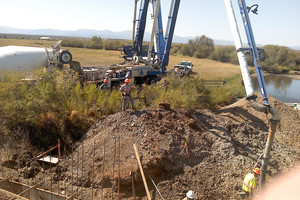
Some companies will also wrap their boom pipeline with insulation, which is often a foam tube cut to accommodate the pipeline, placed around the pipe and taped together. The foam holds in the heat…
It is also possible to pre-heat a separately laid pipeline in much the same manner as pre-heating boom pipe. Using a high-temperature resistant hose, warm air is diverted from the truck’s exhaust into the pipeline allowing it to flow throughout the system and escape out the end.
If the motion of the concrete is stopped in a frosted pipe, the heat will radiate from the concrete so quickly that the entire line can freeze completely in a matter of moments. Usually if this happens, the pour cannot be completed until the slick line is replaced, and the concrete sitting on the job will often be rejected before it can be pumped. Many dollars can be lost when this occurs.
Safety procedures
Never stand on ice-coated pipes or other round objects and use caution on the pumping unit’s decks and steps. Workers are reminded to wear the appropriate cold weather personal protective equipment and to always wear insulated gloves when handling icy pipes and clamps that can slip causing injury.
Extreme caution is especially needed during and after cleanout as all areas surrounding the pumping unit might be coated with ice as a result from the water that was used to clean out the pipes and accessories. Serious injury can occur as result from slips and falls.
Pumping concrete in temperatures as low as -10° Fahrenheit, and even lower, is not only possible but routine in many parts of the world. However, the pump’s manufacturer may prohibit use of the boom when temperatures fall well below sub-degree temperatures and the pumping company should be aware of the specific temperature restriction of their respective manufacturers. Use of the boom in extreme cold conditions will cause the steel of the boom to become brittle and cause it to crack from normal boom bounce.
Prior to the pump arriving on the jobsite, it is a good idea to communicate with your employees and/or the pumping company to discuss any conditions, such as extreme temperatures, which may have an effect on the safety and performance of the pour. Work to develop a plan which will not only ensure a successful pour but one that enables you to obtain the maximum benefits of placing concrete with a concrete pump.
Source: Schwing America, Inc.Manufacturer’s Operating Manual for Concrete Pumps
OSHA Revises Hazard Communication Standard
Employers will need to offer safety training for their workers on the new Globally Harmonized System pictograms and safety data sheet format by December 1, 2013.
To better protect workers from hazardous chemicals, the U.S. Department of Labor’s Occupational Safety and Health Administration (OSHA) revised its Hazard Communication Standard, aligning it with the United Nations’ global chemical labeling system. The new standard, once implemented, will prevent an estimated 585 injuries and illnesses, avert an estimated 43 deaths, and result in an estimated $475.2 million in enhanced productivity for U.S. businesses each year.
The Hazard Communication Standard, being revised to align with the United Nations’ Globally Harmonized System of Classification and Labeling of Chemicals, will be fully implemented in 2016 and benefit workers by reducing confusion about chemical hazards in the workplace, facilitating safety training and improving understanding of hazards, especially for low literacy workers. OSHA’s standard will classify chemicals according to their health and physical hazards and establish consistent labels and safety data sheets for all chemicals made in the United States and imported from abroad.
What you need to do and when
Chemical users: Continue to update safety data sheets when new ones become available, provide training on the new label elements and update hazard communication programs if new hazards are identified.
Chemical Producers: Review hazard information for all chemicals produced or imported, classify chemicals according to the new classification criteria, and update labels and safety data sheets.
| Effective Completion Date | Requirement(s) | Who |
|---|---|---|
| December 1, 2013 | Train employees on the new label elements and Safety Data Sheet (SDS) format. | Employers |
| June 1, 2015* | Comply with all modified provisions of this final rule, except: Distributors may ship products labeled by manufacturers under the old system until December 1, 2015. |
Chemical manufacturers, importers, distributors and employers |
| June 1, 2016 | Update alternative workplace labeling and hazard communication program as necessary, and provide additional employee training for newly identified physical or health hazards. | Employers |
| Transition Period | Comply with either 29 CFR 1910.1200, or the current standard, or both. | All chemical manufacturers, importers, distributors and employers |
Find more information and safety training resources at http://www.osha.gov/dsg/hazcom/
Information from OSHA
It’s time to vote for the 2013 CFA Projects of the Year!
The “Basement of the Year” was created in 1999 to begin recognizing the unbelievable side of
the residential concrete foundation business. During the next six years, this program became
affectionately known as the “Basement from Hell”.
In 2008, the program was renamed “Project of the Year” and was updated to be more
representative of the broad market that concrete professionals in the CFA cover. No longer
simply about the most unbelievable basement, this award program seeks to recognize the
accomplishments of the many professional contractors as they apply their skill and creativity to
residential structures of all sizes, commercial projects, above-grade projects and anything else
that requires out-of-the-box thinking.
Cast your ballot today for the 2013 Project of the Year!
USGBC Fights to Improve Transparency of Recycled Content Claims
Royersford, PA – The U.S. Green Building Council (USGBC) has the opportunity to continue to drive industry specificity with the reinforcement of its Recycled Content documentation clarification. The LEED Interpretation Ruling (LIR) from the USGBC (ID# 10246) released on October 1, 2012 set the standard for Recycled Content claims and documentation for LEED projects. This official LIR deemed national averages as unacceptable for LEED documentation, and is a major step toward total product transparency and industry integrity.
GreenCircle applauds the USGBC’s latest ruling, which addresses the issue of potential green-washing by some manufacturers. As stated in the formal LIR, “An average recycled content claim, especially one that incorporates multiple product lines or places of manufacture, does not meet the credit intent and is not acceptable for LEED documentation.” This ruling demands product and plant specific recycled content evaluation and documentation. “Recycled content claims must be specific to the installed product (and therefore place of manufacture); regional or national claims do not meet credit requirements.”
Despite resistance by some manufacturers, this much needed USGBC clarification provides a transparent and clear system for LEED project teams pursuing the Recycled Content credit. This push toward total accountability for each product line and manufacturing facility is another step forward in promoting sustainable product development. Currently, when project teams request data for the Regional Material credits, they require plant and product specific information to calculate the amount of materials manufactured and extracted within 500 miles of the project site. With the release of LIR, the Recycled Content credits are now requiring this same reporting level. Recycled content documented on a plant and product basis not only allows the most sustainable products to be selected within LEED projects, but will foster continual improvement in products and operations.
By issuing this LIR, the USGBC has established another line of defense against misleading environmental claims. It is anticipated that the USGBC will remain steadfast in its position and commitment to a sustainable future.
About GreenCircle Certified, LLC
GreenCircle Certified, LLC assures accountability by providing third-party certification of sustainable aspects of products and manufacturing operations. It establishes brand integrity and serves manufacturers, suppliers, regulators, and consumers by verifying that products or operations have been thoroughly assessed and their claims validated.
GreenCircle offers claim validation for carbon footprint reduction, closed loop product, life cycle assessment (LCA) optimized, recyclable material, recycled content, renewable energy use, renewable resource content, and sustainable manufacturing practices.
For more information visit: www.GreenCircleCertified.com
Sauter Receives Prestigious Robert D. Sawyer Award for 2012
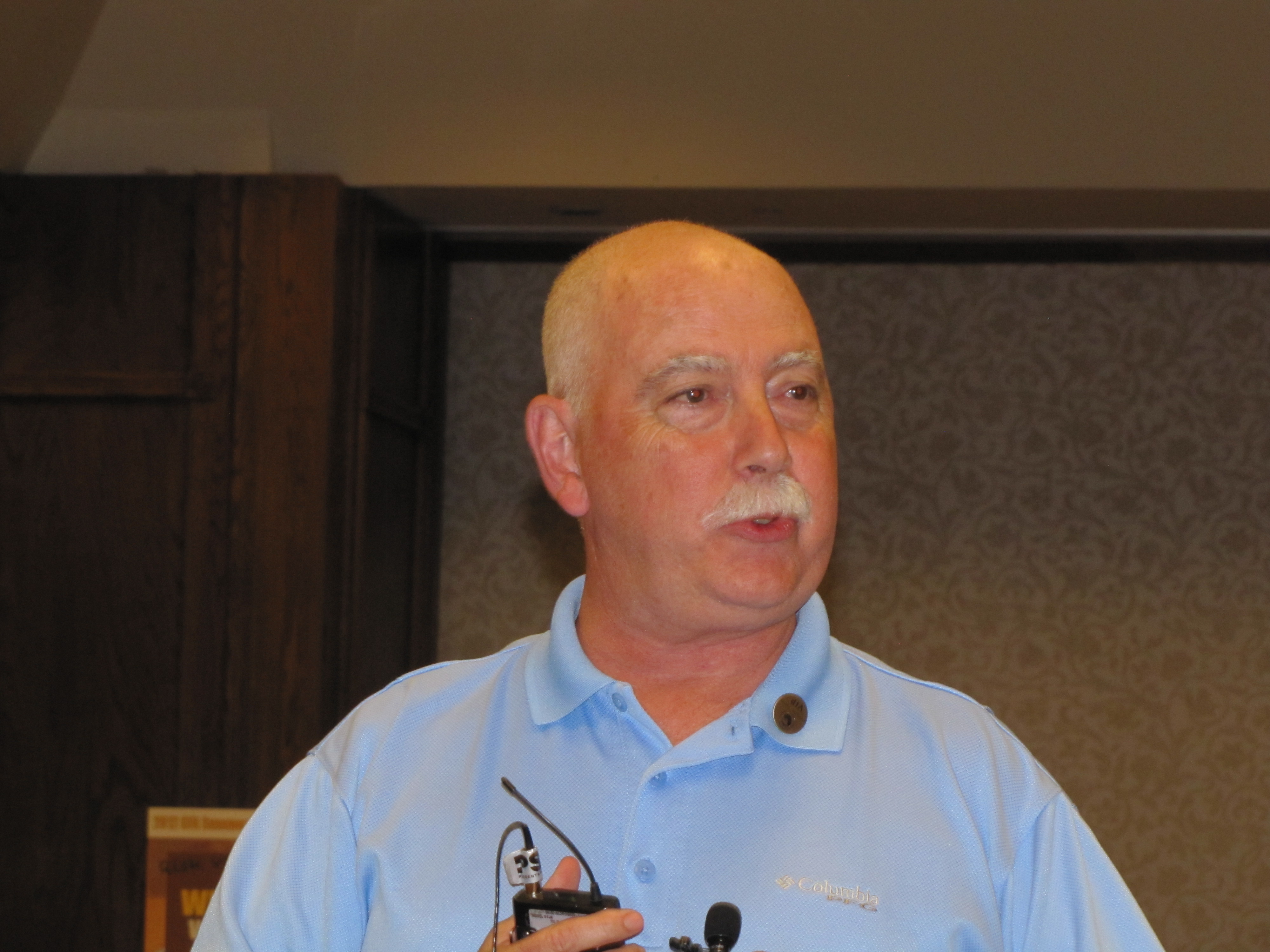
Sauter addresses attendees as Robert Sawyer Award winner regarding the history of managing this Association.
During the Annual Convention, J. Edward Sauter, current Executive Director for the Concrete Foundations Association (CFA) was awarded the Robert D. Sawyer Distinguished Service Award. The Annual Convention was held July 25-27, 2012 at the Grand Traverse Resort.
Previous recipients Barry Herbert of Herbert Construction (2009) and Scott Smith of MPW Construction Services (2010) recognized Sauter as this year’s recipient.
“Ed’s devotion to the CFA is perhaps most apparent when you look at what the organization was when he became Executive Director twenty years ago”, states Barry Herbert. “The Association was in severe disarray, money was scarce, membership was declining, and the continuing existence of the CFA was in question. His professionalism became immediately apparent, and in the next few meetings it became evident that he was the right choice for the job. Ed’s commitment and hard work had the Association back on its feet and thriving in no time.”
“I have always admired Ed’s ability and willingness to coordinate the many personalities in the CFA and, in particular, his skill with our Board,” states Scott Smith. “The membership of any construction association is full of hard-headed men and women with no lack of ego strength. If we had an award for “cat herding” Ed would win that, too! His determination and skill are the ingredients that have led to many, if not most of the current programs and achievements of the CFA.”
The Robert D. Sawyer Distinguished Service Award honors outstanding service and commitment to the CFA and the concrete foundation industry. It is the CFA’s highest honor. Unlike other awards it isn’t given out on a regular basis. It is awarded only occasionally and only to those individuals who over and over have given their time and effort to promote the poured wall industry and the CFA.
Robert “Buck” Bartley of The Bartley Corporation from Maryland, a 2002 recipient of the Sawyer Award stated, “There’s hardly a sole alive whom I admire more than Ed Sauter and hard to imagine a person more deserving of the Robert Sawyer Award. It’s doubly hard to imagine anyone more important to the residential concrete industry over the past two decades than Ed Sauter, who piloted successfully the CFA through three serious economic storms.”
Sauter has been the CFA Executive Director since 1992 taking over for then executive director, Roger Nielsen following the Summer event that year. Under Sauter’s direction, the CFA saw a four-fold increase in its annual operating budget and a three-fold increase in its membership base until this most recent recession.
“Managing an association such as the CFA through the challenges of such a deep recession has demonstrated the passion for which Ed holds his position”, states partner and Technical Director for the CFA, Jim Baty. “Not only has Ed been responsible for the growth of this Association during the good times, he has continued to demonstrate the potential to substantially grow the ‘foundation’ for the future of this organization in the face of strong adversity and to that the legacy of his leadership will be always be assured.”
Faced with declining membership, weakened event participation and declining revenue in publications, Sauter focused the CFA on tangible benefits to the contractor that could be experienced and provide significant impact to their businesses at their convenience and where they were located. For the most part, this new foundation for the Association is built on programming that doesn’t necessitate travel or event participation, though still the absolute number one benefit to belonging. Programs now developing or firmly-established to build value for the membership include a protected risk self-insurance captive; a fall protection task force and OSHA-compliant alternate plan; a multi-level certification program for the residential foundation industry; and leadership for codes and standards development.
Codes and standards shape continue to evolve as one of the biggest influences to the landscape of the construction industry. However, the practical and experienced voice of the residential concrete contractor was not being heard effectively to introduce needed change to the direction of prescriptive standards.
Over a period of two decades, and largely under Sauter’s leadership, the CFA assisted in the introduction of two new standards for residential concrete work. The first was a non-consensus, but universally applicable CFA Standard based on navigating the International Residential Code (IRC). This document achieved broader references to performance options for both designer and contractor recognizing the greater technology and mix expertise as well as the practical applications existing in the market.
The CFA Standard was a base step that led to the creation of a new residential concrete consensus standard published by the American Concrete Institute (ACI), “ACI 332: Requirements for Residential Concrete”. Following its initial publication in 2004 and subsequent updates in 2008 and 2010, this document became an allowable alternative referenced by the IRC that provided far greater design and construction options.
“Several years ago, when the American Concrete Institute decided to develop a residential standard, the committee chairman contacted Ed to let him know there were some very radical things being proposed for residential foundations–things like: anchor bolts at six inches on center, three inch maximum slump concrete and requirements that forms be left on the wall for 48 hours, to name just a few,” reflects Herbert. “Ed quickly put together a group of people who were willing to set on this new ACI committee and represent our interests. He was eventually named chairman of the committee. With his leadership, the tide was turned and we now have a document we can use to our advantage, instead of one that would have ultimately made most basements cost prohibitive and would have, almost certainly, put some of us out of business.”
Herbert and three other CFA contractor leaders, Ron Colvin of JC Concrete in Michigan, Buck Bartley and Kirby Justesen of Formco Foundations in Utah were part of the industry support brought in by Sauter to lead the creation of that new standard.
“Ed was the chief shepherd of the first ACI concrete code dedicated solely to the residential industry,” states Bartley. “His leadership and skills in achieving consensus in the ACI residential code committee were masterful, and a wonder to behold.”
Although far from done in his service to the CFA and with his mission to this industry, the selection of Sauter as this year’s recipient comes at a time when both the Association and the industry are taking a collective breath as business returns and anticipation for growth resumes. This year’s recognition honors the faithfulness, determination and confidence that Sauter has given to the CFA and in turn infused to many of the members for their own businesses.
When asked to describe Ed’s impact to him and his business, Smith stated; “I consider Ed Sauter a friend and look forward to our Association events, partly to see him. He is smart, well spoken, trustworthy and funny. We have been blessed that he chose to apply these traits and his considerable technical skill and determination toward the betterment of our Association and our industry. For the Concrete Foundation Association to have had the direct benefit of Ed’s vision, work ethic and skills for these many years has been a direct contributor to the success of the Association – and by being a member and knowing Ed – to my business as well.”
WHAT A SUMMER!
Is that your response if asked how your summer went? Were you involved in enough work to cripple your social calendar? Did your company experience the stress resulting from the deep cutbacks in personnel now tasked with a rapid expansion of work? Whether a positive statement or a stressful one, if this title mimics your reflection on the summer of 2012, you are not alone.

Equipment rodeo at the 2013 CFA Annual Convention, Grand Traverse Resort, Traverse City, Michigan

Viewing the equipment rodeo at the 2013 CFA Annual Convention, Grand Traverse Resort, Traverse City, Michigan
Throughout this recession, we have maintained that the CFA mirrors what is going on with its members. As each of you felt the market erode beneath your companies and began making the tough decisions for workforce, equipment maintenance and management compensation; so too, was the CFA at hard work to implement strategies to shore up the structure of the Association and ensure the legacy that serves as the foundation on which we are built.
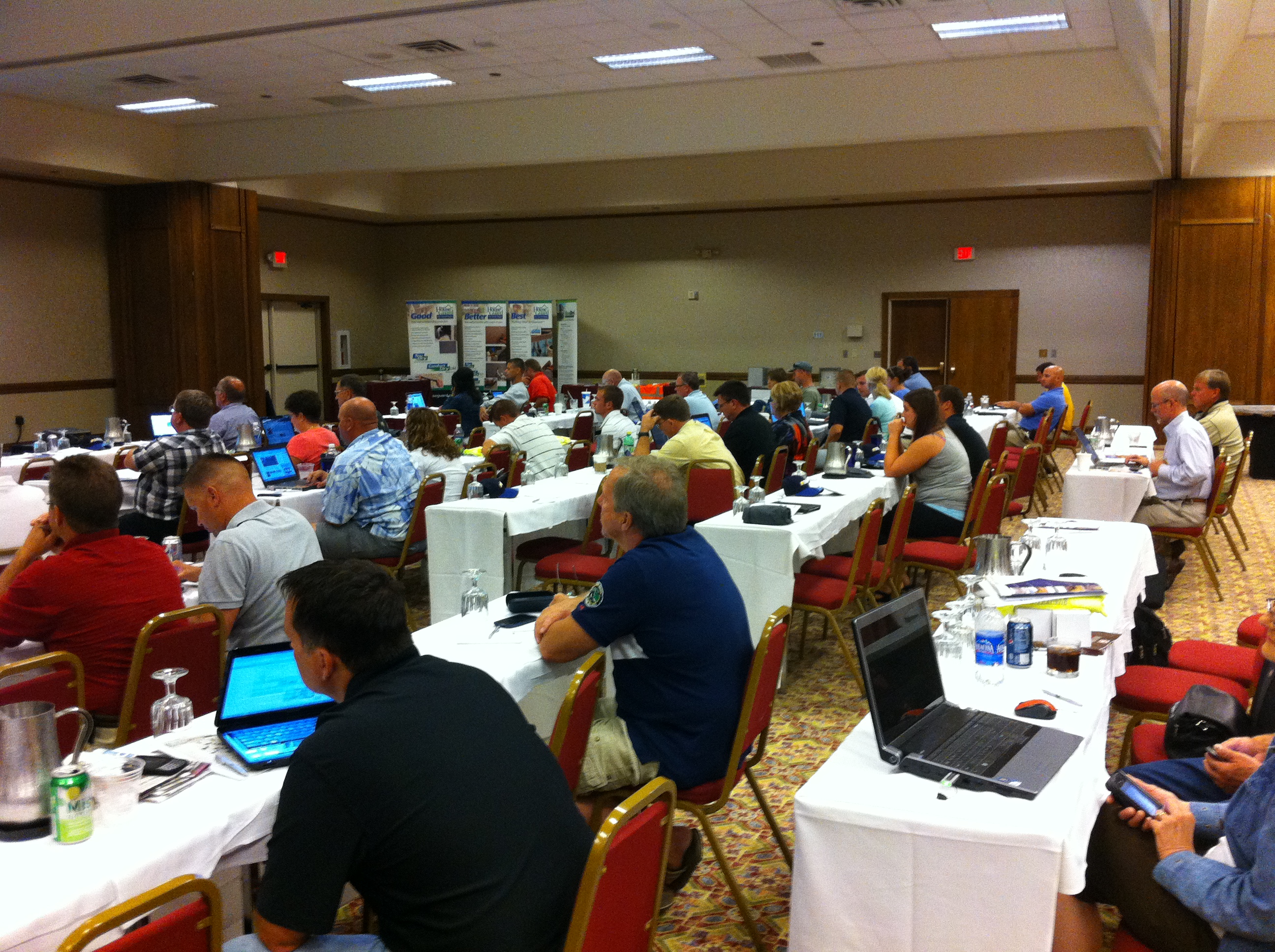
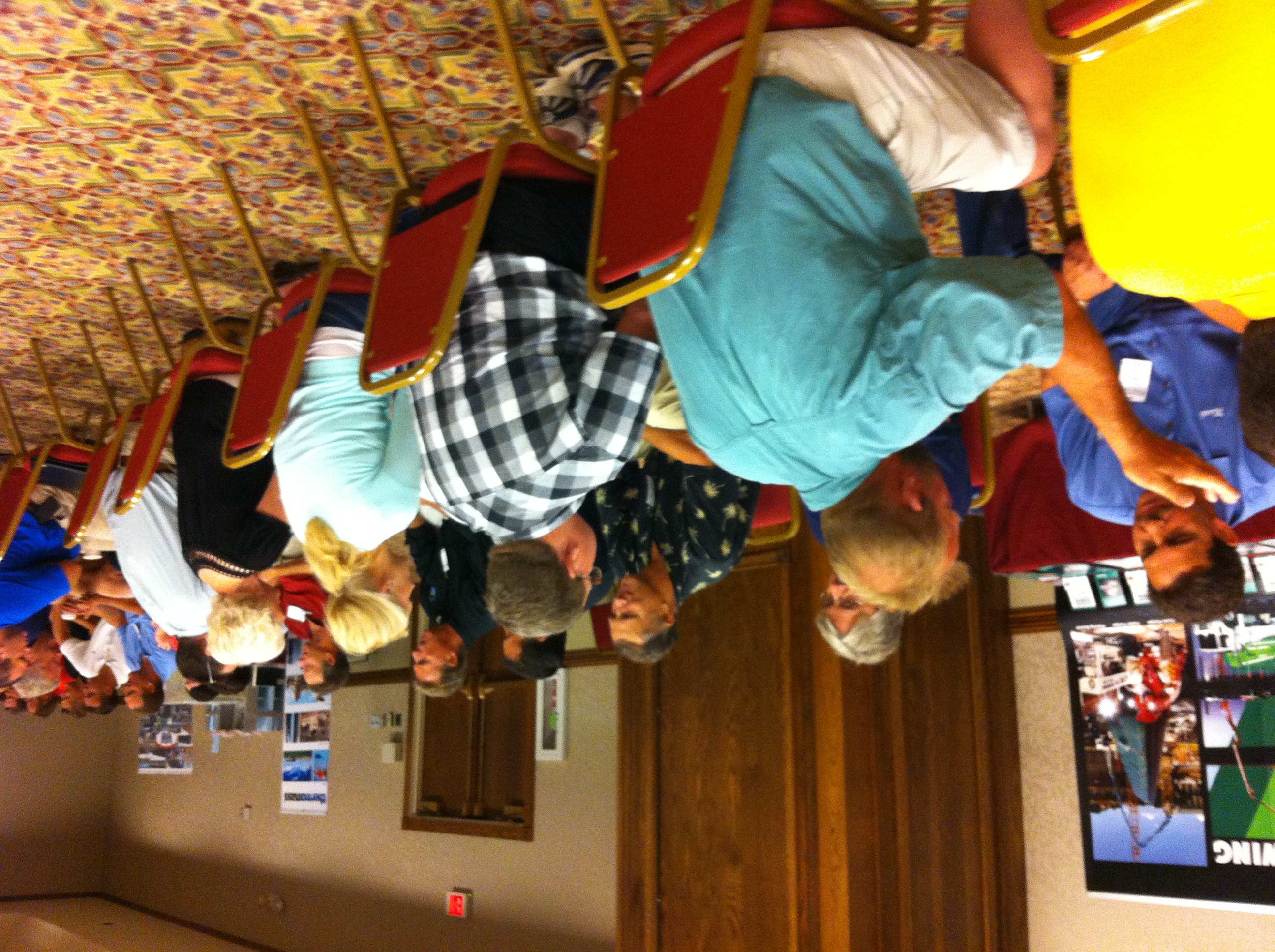
Attendees take in one of the many presentations during the two-day CFA Annual Convention at Grand Traverse Resort, Traverse City, Michigan
Then summer came and ushered in an energy that we’ve not felt for several years. The epicenter for this energy was the Grand Traverse Resort in Acme, Michigan and the CFA Annual Summer Convention. If you were not able to attend this year, and many of you were not, you will continue to have the opportunity or reaping as many of the benefits as possible. Flowing outward from the energy of this Convention is the will of the CFA Board, our committees and many other leaders of this Association to find new ways to build value and deliver support to your evolving business in this new economy.
We hope you’ve noticed some of the information that has already been presented since Convention, presented to you in the form of a new eNews series titled “Did You Know?” The DYK series has been initiated to take some of the poignant tidbits and details that members just like you have pulled from a seminar or interaction and conveyed in a way you can benefit from them whether you were there or not. Check your inbox if you don’t recall either “DYK – No Cure and Seal after September“ or “DYK – Just one employee can force you to go Union” and find out why members passed on these reflections from two key moments during Convention this year. If you didn’t receive them, contact me and I’ll get you a copy. And of course, if you have your own favorite thought or key piece of information from this summer’s Convention, please let me know so we can share it with everyone.
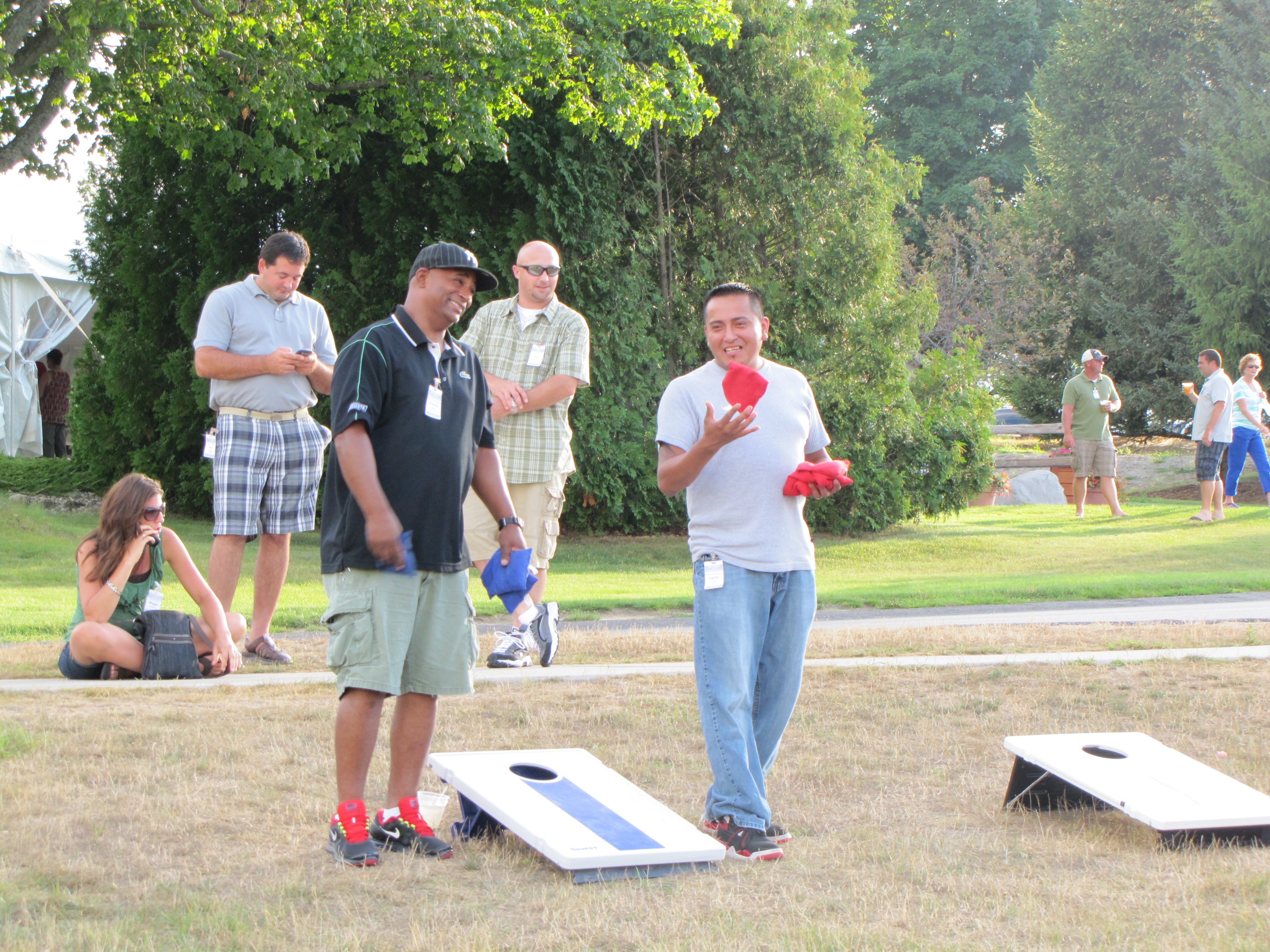
Summer Convention 2012 brought back some great memories with the way the event unfolded. National Associates this year were excited to offer an outdoor exhibit area for the first time in several years. This event was hosted just down the hill from the hotel and as you can see from some of the images, it was a fantastic statement to the area that the CFA was in town. CFA members of all ages enjoyed the event that became a CFA festival.
Convention this year also experienced a strong return of the next generation as families turned out in significant numbers. More than forty children and youth were on hand this year and this injected an energy not felt for some time into the proceedings. From the Kids Club festival atmosphere of the opening event to the playful games held during the Annual Meeting dinner, the next generation was present, made their presence known and certainly had their presence appreciated.
We hope you recall the publicity leading up and through Convention this year touting the addition of a great new event held on Day 1 of the Convention. Traditionally, families have traveled to our site and waited to open Day 1 with the evening event. This year, the CFA Board challenged the membership to take advantage of the opportunity cost by adding a day of education in what was offered as a “Slab Workshop”. Concrete slabs have been hot topic in the CFA for the past couple of years as we work hard to best understand the landscape of our member businesses. With such a significant number of members involved in residential and commercial, interior and exterior slabs on ground, this event was tailored to address may of the strongest problem areas related to this field of work. Led by industry professional, Kim Basham, attendees spent the better part of a day finding ways to “cure” their slab problems. Kim’s subject matter was complemented by presentations from Stego Industries and Forta Fiber giving a rounded opportunity to improve the quality of work produced.
As the Convention proceeded to unfold, those in attendance quickly identified the wealth of information and the intentional value of this year’s events. Presentations from CFA members Scott Smith of MPW Construction Services, Doug Herbert of Herbert Construction Company, Mary Wilson of Michel Concrete and Doug Staebler of Custom Concrete all delivered incomparable challenges to business structure, policies and procedures. These were complimented by the professional perspectives from David Whitlock of Miller & Martin, Jay Odice of Odice International and Kevin Gamin of Best Technology Strategy that challenged attendees to implement game-changers into their business affairs.
Much is yet to sort out from Convention 2012 and the full results will not be completely identified for months. Overall attendance was the highest in five years and although supported strongly from many of our National Associates, a healthy ratio of contractors was present for their business interests as well. Thanks must be given to the companies noted on these pages as sponsors of the event. Their measure of commitment is second to none. If you’re not presently supporting products from the National Associate members of this Association, you are missing the real opportunity to say thank you and express your appreciation for that commitment.
If there is one message that rings the clearest from Convention 2012, it is this…CFA Convention is your event. Your business is your responsibility and the resources you manage are precious indeed. But for one week a year, even a week in the midst of the craziness that was this year’s business cycle, you just can’t begin to imagine the opportunity and benefit that is sitting there for you to grab. Do you want or need proof? Pick up the phone and call a member of the Board of Directors that manage a company just like yours or find the name of a member you’ve been in contact with before. Chances are they’ve been there and you will be able to feel the value they’ve received in their company from the major investment of time, energy and money it took them to be at Convention…an investment they will do over and over again. See you next year?
THANK YOU EVENT SPONSORS:
Level II
- The Bilco Company
Level 1
- Schwing America, Inc.
- Irving Equipment, LLC
- SpecChem, LLC
- Putzmeister America, Inc.
Media Sponsor
- Concrete Contractor Magazine
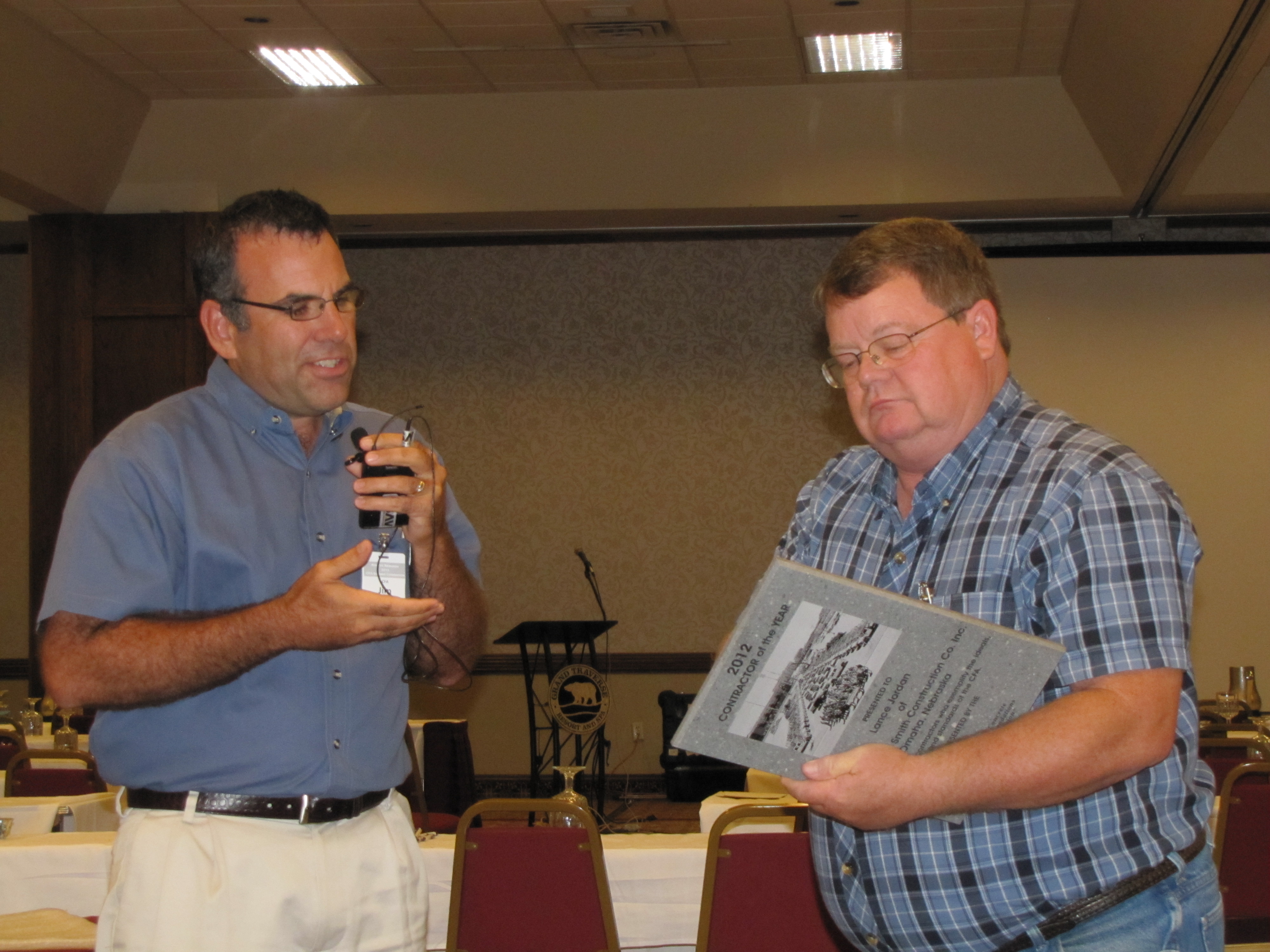
“Lance Jordan of Stephens & Smith Construction receives the Contractor of the Year plaque from Technical
Director, Jim Baty during the CFA Convention in Michigan this past July


New Beginnings
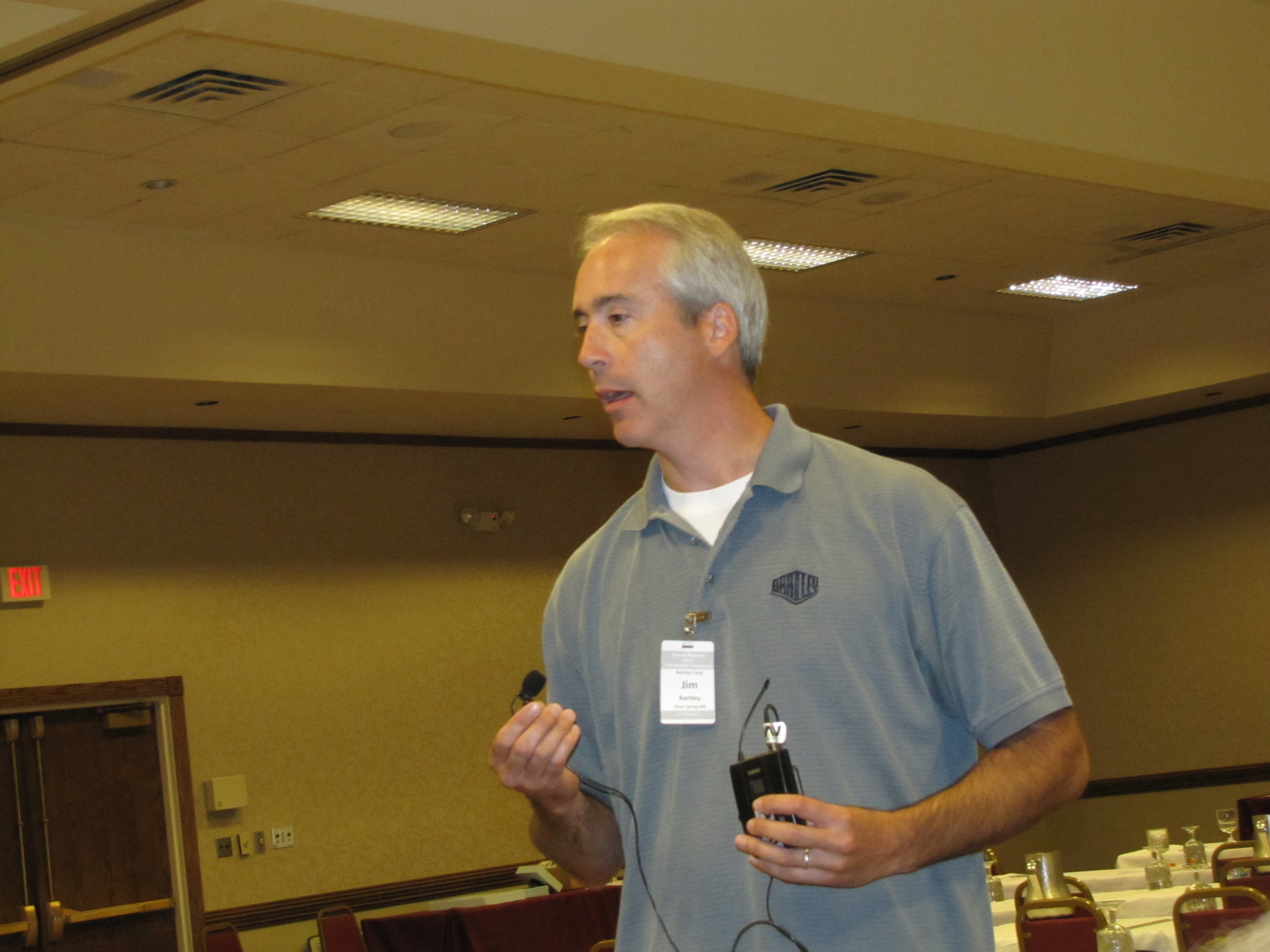
Jim Bartley addressing the Summer Convention attendees during the CFA Annual Convention in Grand Traverse Resort, Traverse City, Michigan
Dear CFA Friends,
Greetings! I am honored to serve as your new president. I seem to make a living of following “tough-acts.” Tim Parrish, our outgoing president and new chairman of the board, has been a great mentor.
Tim leads with strong spirit. His humble, inclusive, can-do attitude has been an inspiration to me. As a second generation concrete contractor, I am influenced daily by another CFA past president, my father, Buck Bartley. A true pioneer, in business and at the CFA, my father has shown me the real benefit and power of family, congregation, community, and association. From both Tim and Buck, we have our example. Working, sharing, and learning together is the power of the CFA.
Let’s harness that power of numbers. We are in a moment of rediscovery and new beginnings. As the economy ticks upward, we see members returning, and new folks discovering the CFA. My career has always been dedicated to improving what was built before me. The CFA has been my greatest tool to achieving that goal. We will do our best to expand on the great new programs of 2012 together. God knows we cannot do it alone.
A special thanks to everyone that has participated, shared, and learned with us at the CFA. May your investment of time and resources come back to you.

Jim Bartley, CFA President
Bartley Corp
Summer Meetings — What You Want
Another successful CFA Summer Convention is in the books. Attendance is picking up after several “off” years but it appears that quite a number of our members still use the event as an opportunity to get away with the family during hectic times – not everyone – but enough to make us think that this is still a good model to follow. The CFA is still comprised primarily of family-run businesses and eighty-four percent of attendees regularly bring family members with them.
We received a couple of comments (from non-attendees) asking why we have the meeting during the busiest time of the year, so we decided to conduct a survey of the general membership to see if we were still on-track in regard to timing, programming, activities, and related items for the event. There were a few surprises but, in general, we are still on track. There were 67 respondents to the survey, which most pollsters would consider highly representative of our membership. The details of the survey are published elsewhere in this magazine but some of the highlights are summarized below.
All 19 venues since I have been director were listed as possible return locations (we will be returning to the Hyatt Tamaya in 2013 as part of our attrition resolution). After this year’s venue, the two top vote getters were the Kalahari Resort in Wisconsin and the Resort at the Mountain in Mount Hood, Oregon. The latter was the site of the highest attendance we have ever had at an event with over 900 room nights (compared to 220 for the recent event). Times were better in 2002 and we won’t be going West (except for next year) for awhile, but a return might be in the offing in a few years. The two years following New Mexico will be at resorts in the Midwest and Northeast (yet to be determined), and this is born out by the preferences of our members.
The overwhelming number of respondents still like the summer period for the event with 57% preferring the Thursday/Friday dates for meetings versus the current Friday/Saturday pattern. If we are at a resort location, a date shift would allow families to spend one extra day on-site with a day of travel before returning to work.
One thing that has changed is the programming and educational events. We no longer focus on teaching people how to build walls – you all know how to do that. Our focus in recent years has been on how to run better businesses. This past year we added a day of education on slabs.
Eighty-one percent of respondents responded that we should continue the extra education day. OSHA, fall protection, codes, immigration law and a host of other topics are now covered on a regular basis.
The group was divided on whether or not we should have all-day education. We’ll likely compromise in 2013 and have one day-long and one half-day of education – in particular with an added third day.
Mark your calendars for the Hyatt Tamaya at the Santa Ana Pueblo just north of Albuquerque from July 10-13, 2013 (note the earlier dates). We already have some great program commitments and ideas. Room rates are lower than when we last stayed there in 2008. We will make it worth your while.
Ed Sauter, Executive Director, CFA
OSHA Extends Residential Construction Temporary Enforcement Measures
Extended measures include priority free onsite compliance assistance, penalty reductions, extended abatement dates and more The U.S. Department of Labor’s Occupational Safety and Health Administration
(http://www.forconstructionpros. com/company/10284135/occupationalsafetyhealthadministration)
(OSHA) will extend for three months its temporary enforcement measures (http://www.osha.gov/ doc/residential_fall_protection/ residential_guidance.html) in residential construction through December 15, 2012. The temporary enforcement measures include priority free on-site compliance assistance, penalty reductions, extended abatement dates, measures to ensure consistency, and increased outreach.
OSHA has been working closely with the industry to assist employers in complying with the new directive. Since October 1, 2011, OSHA’s On-site Consultation Projects performed more than 2,500 on-site visits, conducted 925 training sessions and delivered 438 presentations related to fall protection in residential construction (http://www.forconstructionpros. com/video/10738158/videooshasfallprotectionpoliciesforresidentialconstruction).
OSHA’s regional and area offices also conducted more than 800 outreach activities on the directive. The Agency will continue to work with employers to ensure a clear understanding of, and to facilitate compliance with, the new policy.
OSHA will also continue to develop materials to assist the industry, including a wide variety of educational and training materials to assist employers with compliance, which are available on the Web pages for residential construction (http://www.osha.gov/doc/topics/ residentialprotection/index.html) and the Fall Prevention Campaign (http://www.osha.gov/stopfalls/ index.html).
CONCRETE INDUSTRY ASSOCIATIONS PARTNER TO FORM CERTIFICATION CONSORTIUM
In an effort to increase the awareness of certification opportunities for concrete professionals, while promoting the advantages of such programs, eight concrete associations have joined forces to form the Concrete Industry Certification Consortium (CICC).
Comprised of the American Concrete Pumping Association (ACPA), Architectural Precast Association (APA), Concrete Foundations Association (CFA), Concrete Sawing and Drilling Association (CSDA), International Concrete Repair Institute (ICRI), National Precast Concrete Association (NPCA), Post-Tensioning Institute (PTI) and the Tilt-Up Concrete Association (TCA), the Concrete Industry Certification Consortium is a non-profit clearinghouse dedicated to serving those interested in improving the quality and safety of concrete construction and renovation. Through its participating associations, the Consortium seeks to increase the recognition of the concrete industry’s commitment to quality through certification and to promote and distinguish companies with a demonstrated level of competence and history of positive contribution to the industry.
The Consortium initially plans a unified marketing piece that raises awareness of the program variety offered to the industry. This will be available in electronic format by the end of August and will be available through the websites of all participating organizations. Additionally, the Consortium plans a website for unified information and links to the certified personnel directories for each program. The unified message supporting the value and importance of certification in the concrete industry will be visible throughout organizational conventions and during the World of Concrete, to be held February 4-8, 2013 in Las Vegas, Nev. where master certification certificates and the majority of these opportunities are offered.
“The Consortium idea came about during gatherings of the Small Association Group Executives (SAGE), which the participating organizations of the Consortium started several years ago,” states Ed Sauter, Executive Director for the CFA and TCA. “This networking effort has contributed to a wealth of variety and creativity.”
As a group, the associations will concentrate on providing concrete industry professionals with certification opportunities. According to Christi Collins, Executive Director of the ACPA, maintaining the strictest standards for safety in the concrete industry is crucial. “Every contractor has an obligation to provide a safe work environment for their workers and utilizing the most qualified, knowledgeable and professional personnel in their respective fields will help them achieve this assurance. Through the collaborative promotion efforts of the CICC, we are able to expand the awareness of our pump operator certification program which will go a long ways towards improving the overall quality of our industry,” said Collins.
According to, Pat O’Brien, Executive Director of CSDA, their existing company certification program for sawing and drilling contractors is the first of its kind. “Our three-tier audit program provides owners, architects, engineers, general contractors and government officials with a valuable pre-qualification tool to improve the knowledge and skills of cutting contractors and enhance their public image,” said O’Brien. “We have found it very difficult to grow the recognition of our certification program individually. Of even greater importance is the holistic effort the concrete industry, across all technologies and markets, has toward the message of quality through certification. This Consortium then was a natural fit to strengthen the combination of recognition by the design and development industries as well as the commitment to quality throughout the construction industry.”