
OSHA Whistleblower Investigations
Employers need to make sure their policies and practices do not violate the law
by Jim Rogers, jimrogers@asu.edu

The job site safety meeting is one of the most important aspects of maintaining a program where both the company’s managed safety rules are kept active as well as the methods for reporting unsafe conditions or practices.
As contractors, we are all aware of OSHA and its role in protecting the health and safety of our workforce. Many contractors send their personnel to receive training related to record keeping requirements and job site regulations; however, one area that is often overlooked relates to the laws under OSHA’s jurisdiction that protect “whistleblowers”. People generally associate this term with an employee who “turns in” an employer for unsafe practices. While this is certainly an accurate association, there are much more subtle forms of whistleblower violations that an employer may engage in, some of which may not even be recognized within the company.
The OSH Act, signed into law in 1971, created the Occupational Safety and Health Administration within the U.S. Department of Labor. The OSH Act requires employers to provide a safe and healthful workplace for all employees. This general requirement is also known as the “General Duty Clause” and all of the published OSHA standards, such as the 29 CFR 1926 Construction Industry Standards, are basically extensions of this general requirement. The Act also gives employees the right to file an OSHA complaint, the right to take part in an inspection or speak to an OSHA Compliance Officer, and the right to raise a concern or complaint about a health or safety issue. Employees must also be given reasonable access to company records regarding accident and exposure rates. There are many laws under OSHA’s jurisdiction that protect employees from discrimination or retaliation when they exercise any of these rights. In fact, OSHA enforces the whistleblower provisions of 22 statutes protecting employees who report violations of various securities laws, trucking, airline, nuclear power, pipeline, environmental, rail, public transportation, workplace safety and health, and consumer protection laws.
FIVE EMPLOYER STEPS TO WHISTLEBLOWER COMPLIANCE
- Make sure superintendents know employees have the right to file OSHA complaints.
- Create an environment that encourages reporting unsafe conditions.
- Provide proper training throughout your company on the handling of complaints.
- Institute a reporting system that is effective to the chain of command.
- Review incentive programs to ensure they don’t discourage reporting of incidents.
Classic examples of retaliation against an employee include firing them or laying them off, “blacklisting” them within the industry, demoting them or denying them a promotion or other benefits. Threats, harassment and intimidation are also considered violations of the whistleblower protection laws. While these so called classic examples may be fairly straightforward, i.e. the employee files a complaint and the employer finds out and retaliates, there are also much more subtle forms of violations that employers need to be aware of. These more subtle forms of violations include intimidation or harassment by middle managers who may not be aware of the laws, creating an overall environment that discourages the reporting of hazards, and the use of any incentive program that disciplines or assigns any sort of demerits to individuals who report injuries.
OSHA has announced stepped up investigation and enforcement in this area, so it is important for employers to make sure none of their policies or practices violates the law. The first two issues, harassment by managers who may not be aware of the laws, and having an overall environment that discourages the reporting of safety issues, can be resolved through training and policy implementation. Make sure your superintendents, foremen and crew leaders understand that all employees have these rights and instruct them that they cannot take action against employees for exercising these rights. Creating an environment that encourages the reporting of unsafe conditions can boost employee morale and it shows them that you care about them. Used as a management tool, a system like this can also help an employer be proactive in identification and abatement of hazardous conditions. Injuries to employees result in lost time, reduced productivity, lower morale, higher employee turnover, and increased workers compensation insurance costs (just to name a few).
The construction industry depends on its workforce to deliver its products and services. Creating an environment that shows these employees that you care about their health and well-being can lead to increased morale on the job site, it helps to reduce employee turnover, and helps management to identify and abate hazards before they have a chance to cause injuries.
In addition to these “human” impacts, occupational injuries, deaths and illnesses continue to have an extreme economic impact on the industry. The number of fatal and nonfatal injuries in 2007 was estimated to be more than 5,600 and almost 8,559,000, respectively, at a cost of $6 billion and $186 billion. The number of fatal and nonfatal illnesses was estimated at more than 53,000 and nearly 427,000, respectively, with cost estimates of $46 billion and $12 billion. For injuries and diseases combined, medical cost estimates were $67 billion (27% of the total), and indirect costs were almost $183 billion (73%). Injuries comprised 77 percent of the total, and diseases accounted for 23 percent. The total estimated costs were approximately $250 billion.
The medical and indirect costs of occupational injuries and illnesses are sizable, at least as large as the cost of cancer. Workers’ compensation covers less than 25 percent of these costs.1 To help create an effective environment, an employer needs to provide proper training throughout the company to ensure that managers know how to properly handle complaints and suggestions, and to ensure that its trade’s people understand both their rights and their responsibilities. In any workplace, it is often most affective to have a system of reporting that results in issues being reviewed by people outside the reporting employee’s direct chain of command. In the construction industry, this can be especially helpful.
In our industry we go to work every day on multi-employer worksites, under constantly changing job site conditions and ever increasing pressures to get the job done. When a foreman is in the middle of trying to balance safety, productivity and quality, it can be easy to inadvertently overlook the significance of a single employee’s issue or concern. It is the employer’s challenge to create a system that seeks to remove causes of concern before they arise and to then effectively handle the unforeseen situations that arise everyday on our job sites.
The improper use of incentive programs has recently come into the public view in a case filed by OSHA earlier in 2013 against BNSF Railway Company. This is a large railroad company that has been in business for decades and probably has more resources at its disposal than many general contractors, and certainly more than most trade contractors, yet they still found themselves the subject of a very serious investigation into violations of whistleblower protection laws under OSHA’s jurisdiction.
This case highlights the potential subtleties of the law and illustrates how easy it could be for an incentive program to cross the line. OSHA has provided a great deal of information on this investigation and interested employers may find it helpful to read more on OSHA’s web site at www.osha.gov (search for BNSF Accord).
As an overview, BNSF had a program in place known as its Personal Performance Index. Under this plan, an employee would accrue points for reporting on-the-job injuries. The accrual of too many points was used as a criteria in the selection of employees who would be required to undergo additional reviews and possible disciplinary actions. This program resulted, according to BNSF employees, in an environment where the reporting of on-the-job injuries was discouraged. OSHA viewed this as a direct violation of the whistleblower protection laws. By assigning points to injured employees, regardless of the root cause of the incident, the company was not only in violation of the whistleblower protection laws, but they were also missing out on the opportunity to find and fix hazardous conditions.
Management reports that inaccurately show no on-the-job injuries are virtually useless as a tool for identifying areas that need to be addressed within a company’s operations.
The OSHA investigation into BNSF’s work practices resulted in a settlement with multiple employees and the signing of an agreement between BNSF and OSHA which included major changes to work place programs and continued monitoring of the programs by OSHA to ensure future compliance.
Any company could find themselves in this situation if they are not aware of the laws and how OSHA applies it to them. Any company incentive program that discourages the reporting of injuries is viewed by OSHA as flawed and has the potential to start a probe into violations of the whistleblower protection laws.
Consider something as seemingly innocent as a program that states “if no one gets hurt for the next 60 days, everyone on the crew gets a $250 bonus – but if one person gets hurt, then no one gets bonuses and we start the 60 day clock over.” On the surface, this might seem valid. The idea is to eliminate injuries and encourage the entire crew to look out for each other; however, this plan could easily be flawed and have the undesired effect of discouraging the reporting of any workplace injuries. For example, let’s say one member of the concrete placement crew is injured on some rebar, installed by others, that was not properly capped. The foreman takes the injured worker to the emergency room where he is stitched up. The company has good health insurance for its employees and the foreman suggests that the worker just have the bill paid by his health insurance. That way the injury doesn’t have to be reported to the company, and the crew doesn’t risk losing $250 each over an injury that they all feel is someone else’s fault anyway.
All of a sudden, what seemed like a simple plan to reduce accidents has turned into:
- A potential violation of OSHA whistleblower protection laws because the employee is being discouraged from reporting an injury
- A potential workers compensation insurance fraud case (depending on the laws of your state)
- A potential disgruntled employee due to the pressure being placed on them to keep the injury a secret
- A missed opportunity for the company to identify a hazardous condition on the job site, potentially leading to repeat incidents
Late in 2012, OSHA created the Whistleblower Protection Advisory Committee and Dr. David Michaels, Assistant U.S. Secretary of Labor in charge of OSHA, made the Whistleblower Protection Program a directorate, creating the Directorate of Whistleblower Protection Programs (DWPP) and adding over 35 positions for whistleblower field staff nationwide.
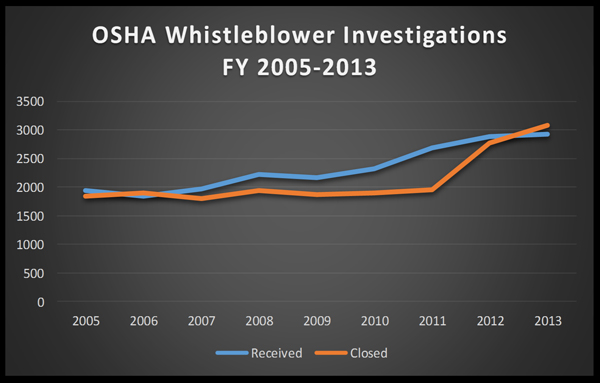
Fig. 1 – OSHA Whistleblower complaints for FY 2005-2013. Note the over 35% increase in annual cases closed in 2013 versus 2011.
The effects of these changes are illustrated in the chart in Figure 1 which shows a marked increase in the number of cases closed since the new Directorate was established. More recently, OSHA established an on-line portal that allows an individual to file a complaint over the Internet which is routed directly to the appropriate authority. With these significant changes and attention focused on enforcement, it is certainly prudent for all companies, large and small, to review their programs and policies for compliance. Make sure your incentive programs do not have unintended consequences. Educate your managers, superintendents and even foremen so they are aware of the laws. Work to create an environment that seeks to identify and eliminate potential hazards. Create a culture of safety that protects our human resources and encourages equal attention be paid to safety, productivity and quality.
ABOUT THE AUTHOR

Jim Rogers, is the Director of the OSHA Training Institute Education Center at Arizona State University, a part of the Del E. Webb School of Construction. He also teaches in the construction management program as an Associate Faculty member with courses including concrete, reinforcing, productivity and safety. Mr. Rogers has been involved in the construction industry for more than 25 years, specializing in concrete and post-tensioning. For additional information, visit http://osha.asu.edu.

Code Corner: Impact of Codes
WHAT IMPACT ARE THE CURRENT CODES, REGULATIONS , AND STANDARDS HAVING ON YOUR COMPANY?
The latest information on regulations, codes and standards that we have been tracking and working with has been prepared for your reference. What impact are these having on your company? What will be the largest hurdles in your implementation and preparation plans?
OSHA Proposed Rule to Extend Compliance Dates for Crane Operator Certification
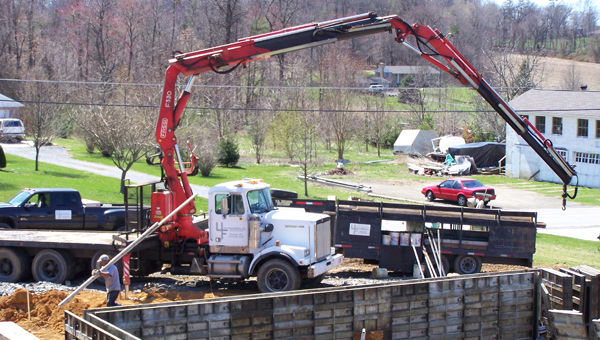
OSHA has issued a proposed rule to extend the compliance date for the crane operator certification requirement by three years, to Nov. 10, 2017. The proposal would also extend the phase-in requirement for employers to ensure that their operators are qualified to operate the equipment. OSHA issued a final standard on requirements for cranes and derricks in construction work on Aug. 9, 2010. The standard requires crane operators on construction sites to meet one of four qualification/certification options by Nov. 10, 2014. After OSHA issued the standard, a number of parties raised concerns about the
qualification/certification requirements. After conducting several public meetings, OSHA decided to extend the enforcement date so that the certification requirements do not take effect during potential rulemaking or cause disruption to the construction industry.
Comments must be submitted by March 12, 2014 and may be submitted electronically at www.regulations.gov, the Federal e-Rulemaking Portal or by facsimile or mail. See the Federal Register notice for submission details and additional information about the proposed rule.
ACI Releases Latest Version of ACI 332-14
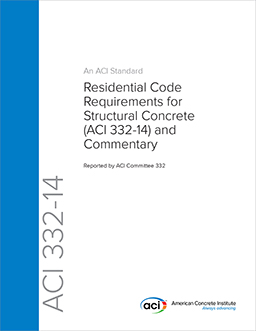 After a significant development timeline, ACI’s 332 Residential Concrete committee completed the necessary steps for publishing the latest form of this contractor-friendly code, ACI 332-14 – Code Requirements for Residential Concrete. Developed initially in 2004, this fourth cycle for the code brings forward major changes to the sections on concrete durability and prescriptive footing design while continuing to evolve other sections of the code for better reference and consistency throughout the industry.
Concrete durability has been governed in prior code editions in a similar fashion to that of the International Residential Code. With the 2014 edition, however, the committee significantly updated its direction by achieving a concrete durability section more similar to that of ACI 318. This updated section now considers the full range of durability issues for concrete including sulfate exposure, exposure to de-icing solutions and much more. An extensive commentary section has been authored to assist in the selection and direction of the critical exposure issues and the resulting minimum concrete mixture design requirements to be considered.
Prescriptive footing design was also dramatically overhauled in this version of the code to bring it more in relationship to the method of designing foundation walls. An expanded set of footing tables introduces greater selection for the user and reference to a broader range of variables. The user will find the footing sizes and prescriptive requirements for steel to be in step with the International Residential Code but with improved functionality and broader selection criteria.
PUBLIC COMMENT PERIOD ON PROPOSED WORKPLACE INJURY TRACKING RULE CLOSES ON MARCH 10
OSHA has announced that the comment period on the proposed rule to improve workplace safety and health through improved tracking of workplace injuries and illnesses will close on March 10, 2014. The comment period was originally scheduled to close March 8. However, this date falls on a Saturday. OSHA will accept comments submitted March 10 as timely submittals.
The proposed rule would amend OSHA’s record keeping regulations to add requirements for the electronic submission of injury and illness information that employers are already required to keep. Comments may be submitted electronically at www.regulations.gov, the Federal eRulemaking Portal or by mail or facsimile. See the Federal Register notice for more details (Docket No. OSHA-2013-0023).
AMERICAN CONCRETE INSTITUTE ANNOUNCES THE REORGANIZED ACI 318-14
 ACI’s 318 committee is finalizing a completely reorganized ACI 318-14: Building Code Requirements for Structural Concrete. ACI 318 is one of the most essential and valuable standards with respect to the design of concrete structures, and is published every three years. Scheduled for publication in late 2014, the reorganized 318-14 is organized from an engineer’s perspective. By focusing on member design, ACI 318 requirements will flow more intuitively and have fewer cross-references. Significant highlights include: o Greater ease of use; o Improved logic and flow of information; o Member-based organization to quickly locate relevant code information; o Construction requirements centralized in one chapter. “ACI is proud and excited to announce the reorganized ACI 318-14 will be published later this year,” said Randall W. Poston, Ph.D., P.E., S.E., Chair, ACI Committee 318. “This first major reorganization of ACI 318 since 1971 represents nearly a decade of work and will feature improved language and style consistency, more expansive use of tables and charts and be organized so that engineers have increased confidence they have satisfied all necessary code requirements.” This revolutionary work for the general concrete building code should make its impact promptly on the market. The member design concept will be quite familiar to contractors and designers involved through the CFA and experienced with ACI 332 as this is the format selected for that code from its inception in 2004. More information on this code and the remaining process to prepare it for publication can be found at ACI’s new-look website, www.concrete.org.
FMCSA Finalizes Rule to Shut Down Carriers Based on Patterns of Safety Violations
The Federal Motor Carrier Safety Administration will soon have the ability to shut down carriers based on past violations by the company’s executives.
The latest step in a long crusade to prevent shut-down carriers from reforming as new companies, the Federal Motor Carrier Safety Administration has amended regulations to allow it to shut down carriers if they are run by repeated violators.
FMCSA has had the ability to deny Operating Authority to carriers with a management staff that has been connected to shut-down carriers for more than a year. This increases that power. Previously, FMCSA needed to catch the deception during the process of issuing an Operating Authority. Now, they can shut down the carrier after it has gone into operation.
Chameleon Carriers
The so-called ‘Chameleon Carriers’ have been a thorn in the side of FMCSA for a long time. The agency has come under repeated criticism from Congress for failing to prevent such blatant disregard for the rules.
Essentially, before FMCSA began actively fighting it, if a carrier was hit with too many violations and started to get attention from the FMCSA they would close the business. Alternatively, their violations would actually pile up to the point where FMCSA would shut them down. The company would then reform under a new name and a new DOT number.
The company would be effectively identical: same drivers, same managers, same vehicles.
Pre-CSA, FMCSA did not have the resources to track and monitor this behavior. Unfortunately, chameleon carriers — unsurprisingly — cause a disproportionate number of accidents.
MAP-21
The 2012 Transportation Spending Bill, known as MAP-21 required that FMCSA put new systems in place to prevent abuse. Last year, FMCSA administrator Anne Ferro testified to Congress that these rules were on the way.
New rules, written to comply with the requirements of MAP-21 have been rolled out in stages. When the rules announced this week go into effect, FMCSA will have the following powers concerning chameleon carriers:
- Prevent carriers from obtaining operating authority if they share a significant proportion of management with a previously shut down carrier.
- Prevent carriers from obtaining operating authority if they use vehicles from a previously shut down carrier.
- Shut down a carrier for failing to disclose that officers were in control of a previously shut down carrier.
- Revoke Operating Authority from a carrier if they share a significant proportion of management with a previously shut down carrier. (This is effectively an unappealable shut down order)
Timeline
The Final Rule was published in the Federal Register on January 22. It will become effective on February 21. While it will be an effective tool to wipe out chameleon carriers, the new rule shouldn’t affect compliant carriers in any way.
Industry Input
The rule has a lot of support from within the industry as chameleon carriers are an annoyance at best and a danger at worst for compliant carriers. By violating regulations, chameleon carriers are able to undercut their law-abiding competitors on price. They also cause accidents as their vehicles are often dangerously, poorly maintained.
The response to chameleon carrier accidents by officials and state and Federal governments is to increase enforcement for everyone. This has given the industry a strong desire to be rid of this problem.
The rules, however, were tweaked in response to industry input during the rulemaking process. Many felt the original rules were too vague and gave FMCSA the ability to enforce them too broadly. FMCSA clarified the Final Rule in response to these concerns.
FOR MORE INFORMATION
For more information, contact Ryan Fagen or Matt Wrobel of Foley Carrier Services, LLC – A BirdDog Company
Colt Gateway, South Armory 140 Huyshope Avenue, 2nd Floor Hartford, CT 06106 Direct: (860) 815-0735 email: Ryan.Fagen@foleyservices.com, or Matt.Wrobel@foleyservices.comThe 2014 CFA Grand Project of the Year: A Madison Gardenesque
Another great year of project submittals demonstrating some of the most incredible construction feats is in the books.
A record number of votes recorded on the show floor at the World of Concrete in Las Vegas this past January and a strong online voting contingent evaluated the seven projects vying to be named a CFA Project of the Year.
This program continues to gain momentum throughout the industry, as companies look more and more to identify their strengths and talents to their market. At the same time, many companies want an opportunity to share lessons learned and have begun to identify with the advantage this program provides to do just that.
In this issue of Concrete Facts we have the privilege of introducing you to this year’s overall grand winner. This project received the highest rating across the board for all projects submitted and achieved a near perfect rating across all ballots cast.
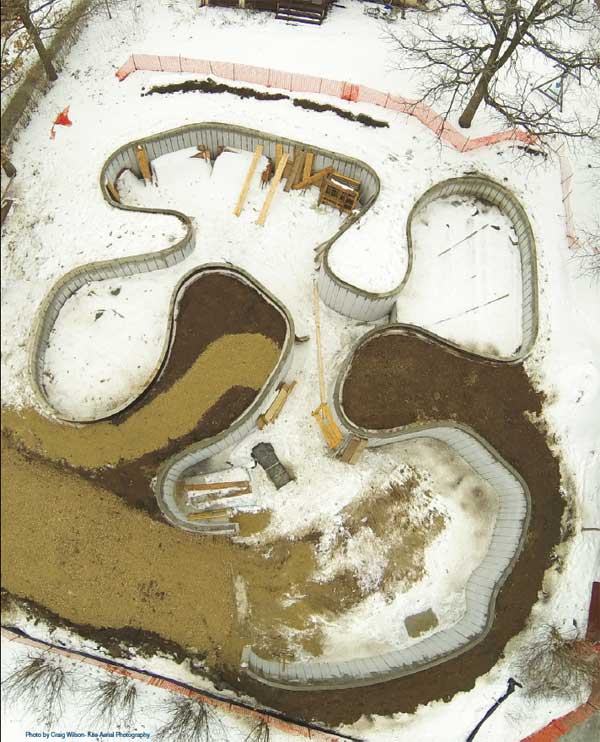
Aerial view by Craig Wilson, Kite Aerial Photography
What do you see when you look at this project? From World of Concrete, the overwhelming number of guesses was “one crazy looking swimming pool, right?” While this certainly would have been one crazy swimming pool…in Madison, Wisconsin, it is an even more amazing foundation wall for a new private residence.
CFA member and the contractor responsible for this quality foundation was Hottmann Construction Co., Inc. of Dane, Wisconsin. Ed Sauter, Executive Director for the CFA took some time to speak with Mike Thole, project manager for Hottmann, during the busy week at World of Concrete to better understand this amazing project.
Ed: Mike, thanks for taking some time to speak with me on this project. We’ve had hundreds of people through this booth this week that just can’t believe what you have accomplished. What can you tell us about this foundation?
Mike: The pictures of the curves in this house explain this better than any words. The longest “straight” wall was 15-feet, occurring at the garage doors. The foundation itself is somewhat modest in size compared to many of the projects seen in this competition at just under 3,000 square feet. Size didn’t really matter though as the real challenge for this project was the serpentine walls that we had to figure out how to form without the typical segmented approach using filler panels. That would never have worked in the first place as there wouldn’t have been enough fillers in our county to accomplish this feat.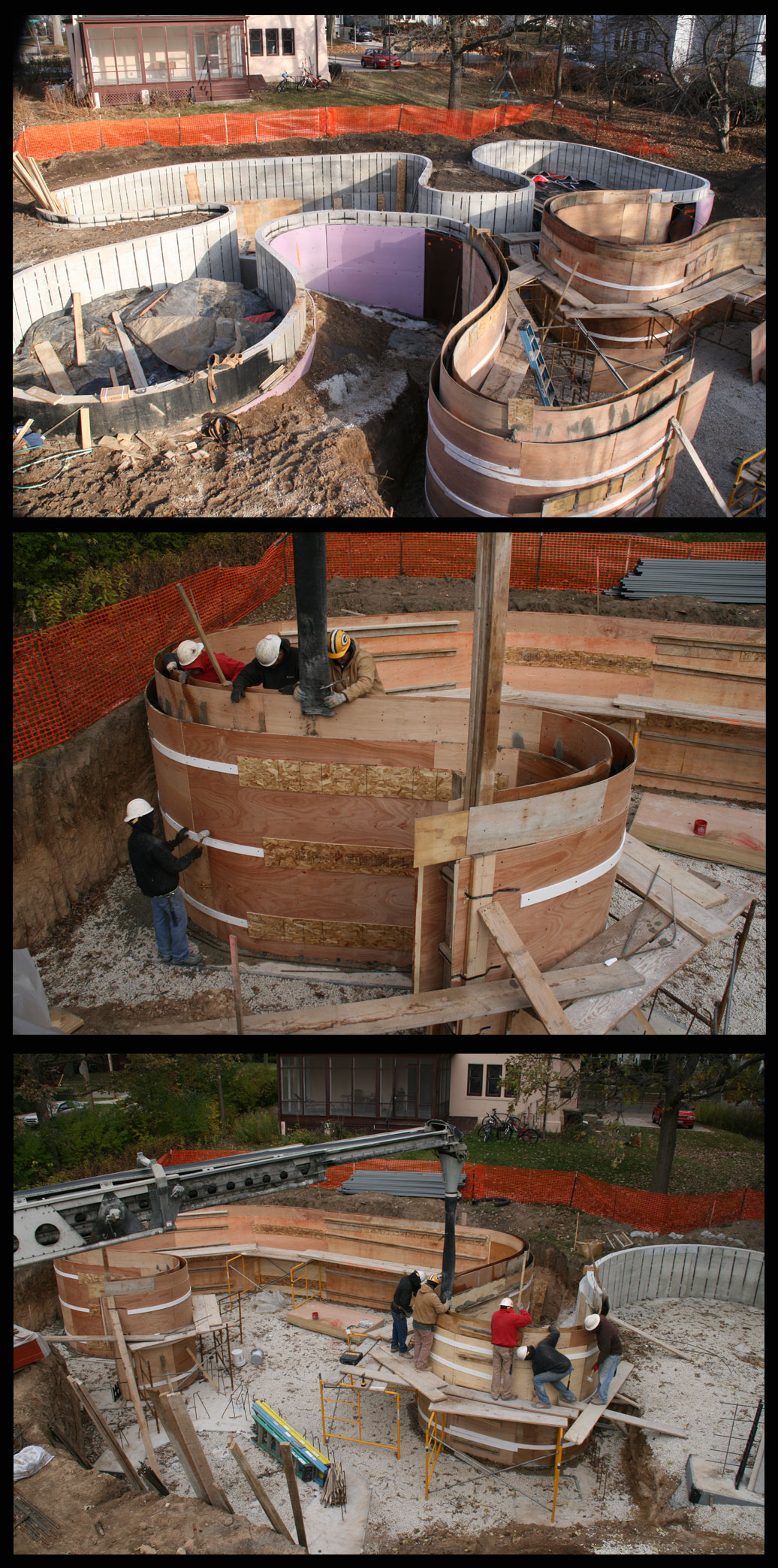
Ed: The photos certainly do tell an unbelievable story here. The first question in everyone’s mind, after “what the…”, has to be wondering how you accomplished the forming for this wall. What can you tell us about it?
Mike: We stumbled across the Spider Tie company and accessed their expertise to design a forming system that could achieve the complexity of the irregular serpentine shape without risk of form pressure failure. They were extremely important to this project. The system allowed us to create even flowing curves in the foundation, as well as a plumb wall. We have done several curved wall projects in the past, but most of them had 15 to 20 feet of curved walls at the most.
Ed: So not only were you applying your construction experience to such an irregular form, you were also cutting your teeth on a new forming system. How did that work?
Mike: There was no precedence for this type of curved wall project in our company, so estimating was an educated guess with our management team. The major complexities were the shape, as well as a forming system that consisted of three (3) layers of 1/4” Luan plywood as the forms. We had to develop confidence that 3/4” total thickness of Luan plywood was going to withstand the pressures of the concrete being poured into the forms, and not blowout. As you can see, the scrutiny that we applied along with finally the faith that it would turn out resulted in a very high-quality product that both owner and architect were quite pleased with.
Ed: I’m sure there were some choice moments of reflection for the architect. How were you able to even begin to accomplish the task of translating this form to the site?
Mike: The shape was handled by transferring the plan into our Trimble LM-80 to lay the project out on the site. We had the luxury then of setting as many points as we thought was necessary to achieve the form. First with the footings and then with the walls, this gave us incredible accuracy and confidence in the preparation for the final product as well as our ability to maintain plumb walls. It is pretty safe to say that “squareness” wasn’t a real concern here.
Ed: We can see the adaptability of the forming system to the walls but what about the footings? How were you able to conform to shape and maintain the performance of the footing system?
Mike: One of the difficulties with the footings on this project was the Architect’s demand that the Form-A-Drain System was used to form the footings. We all know that this is a fairly rigid system, so creating curves like this required cutting the Form-A-Drain often and mitering the joints together to make these curves work. It was a very tedious process that perhaps entailed as much labor and time as any part.
Ed: What other complexities did the wall design provide for your team?
Mike: If the wall configurations were not crazy enough, the entire project also has brick ledge round it. The curves prevented the use of a traditional blocking system. Using the Spider Tie system, we were able to move the outside form six (6) inches inward and maintain its support to produce the brick ledge areas that ranged in height from 12 to 54 inches down from the top of wall.
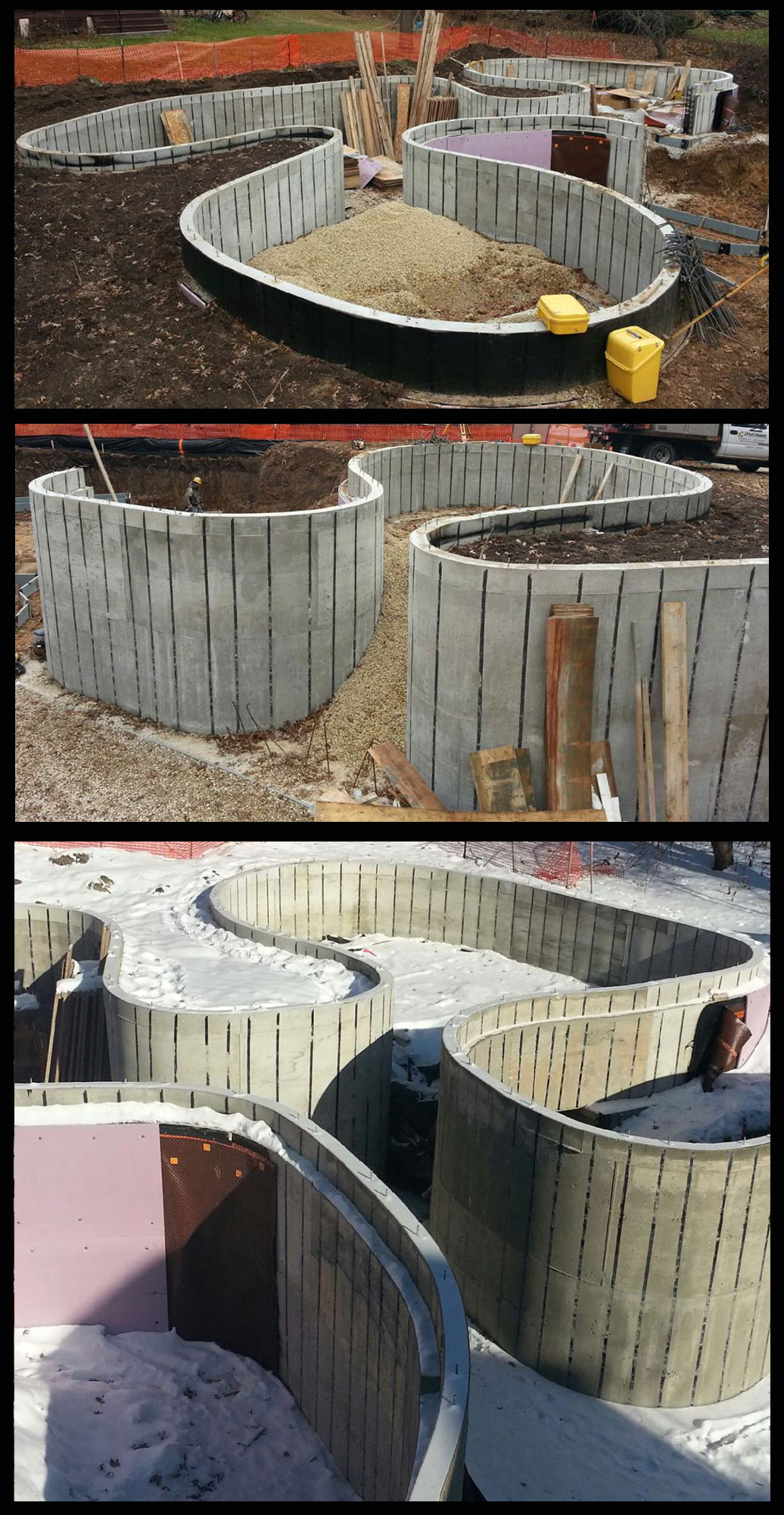 Ed: These are amazing images to view. Tell me about the location for this project. Many stopping by the booth this week expect this to be a lakehouse foundation once they are convinced it isn’t a swimming pool. Yet, it seems pretty clear this is more of an urban setting.
Mike: Yeah, the location was definitely another issue that we had to deal with in this project. The house is located in a well established, 100 year-old neighborhood in downtown Madison, WI. The lot size was so tight that it required us to complete the foundation in stages so the excavator could use dirt from digging the next section of house to backfill the area of the house that we had recently poured. This extended our time significantly and complicated supporting sections of the foundation early on, as well as then requiring construction joints throughout.
Ed: I also understand that your expertise, or rather the experience you gained through the two sets of layout continued to be beneficial for the project even after you were through with the concrete portion.
Mike: We developed a pretty good relationship with the general contractor and it was quickly apparent that a real hurdle would be encountered in trying to fabricate the sill plates. So, we took our Trimble LM-80, to the general contractor’s parking lot, laid the house out, and sprayed the layout with clear paint. This allowed the framing contractor to create jigs to follow the layout in the parking lot. He used these jigs, to create laminated sill plates, as well as laminated top and bottom plates for the framed walls above our concrete.
Ed: That is definitely amazing that your expertise extended through your scope of work and not only decreased their stress and increased their efficiency but perhaps even solved a seemingly unsolvable problem for them. This project is true concrete artistry at work.
Mike: Thanks very much. While no one can truly feel comfortable with how they come out on projects like this, we are very proud to have been selected as the foundation contractor and are pleased with the final product as well as the relationship building that was achieved through the effort. The project started out with two competing GC’s, both using us as the contractor of choice for the concrete package and in the end, the references they gave for us ensured that we would have a chance to set a new standard for our company and perhaps the industry.
This project is one of four projects winning coveted CFA Projects of the Year for 2014. Stay tuned in future issues of this magazine for some of the stories and photos from the other three projects, winning in the categories of Single-Family Residences under 2,000 sq.ft.; over 5,000 sq.ft. and Multi-Family/Commercial.
The full complement of this awards program can be viewed online at http://www.cfawalls.org/awards/project/index.html or by visiting the CFA’s website and selecting CFA Awards from the menu.
The CFA’s Projects of the Year is a free program open year-round to its members. To participate, a form is available for download at the address above, by emailing Jim Baty, Managing Director for the CFA, or by contacting CFA headquarters at 866-232-9255.
What the builder has to say:
Gary Feldt
Feldt Construction Co., Inc. 400 Venture Court, Suite 111 Verona, WisconsinThoughts from Gary: While we have constructed numerous houses with curved walls, they almost always have consistent and limited numbers of concentric radii. This home is obviously totally different with perhaps as many as fifty radii or more, a freeformed plan with very challenging dimensions and relationships. The success of this project was in large part due to Hottmann’s ability to shoot all of the stake points with their robotic layout equipment. Their company does virtually all of our work and we are very familiar with their staff and quality.
What the architect has to say:
Eric Richey
Thomas Phifer and Partners 180 Varick Street New York, New YorkThoughts from Eric: We are pleased with the way this project turning out. We were initially inspired by undulating masonry landscape walls that we observed in the US and Europe. These constructions were typically meant to separate properties but often incorporated a lyrical expression in their fabrication. Our initial visits to the site were during the summer months and the site was very lush, almost gardenesque and it was our intention to try and integrate or connect the program to this rich landscape. The program of a typical home can be organized as a series spaces. Our desire was to extract the sequential experience of these spaces and ground these spaces independently to the landscape. A byproduct of this decision making maximized the amount of natural daylight and views into each space of the house.
The shape is expressed by the foundation images and defined the spaces much like organic garden walls. Our desire to connect the house to nature and maintain the garden-like quality of the site was well received by the surrounding community. The contractor team of Feldt Construction Company and Hottmann Construction made this happen.
We anticipated communication challenges and extra work to translate the design to the built reality. Their experience, however, took our final concept and applied it through layout technology to an actual plan that really was pretty close to our expectations. The ability to then repeat this process from the foundation through the vertical walls, sill plates and top plates to the roof condition has been instrumental in the completion of this concept. Craftsmanship is timeless.
What the owner has to say:
The owner, John, was asked for a reflection on the structure:
For more than a century, the garden of two residences. The architecture is intended to represent this legacy simply and humbly. The house in essence is a garden wall.
One hundred years ago, when University Heights was a “streetcar” suburb of Madison, a garden wall could have sat here.
As the neighborhood grew and filled in, we wanted to reimagine how part of its face could be transformed into a home grounded in neighborhood history, aspiring to the best, progressive architecture of today, and faithful to the eternal spirit of the site itself.
Moving Towards Profitability – CFA’s Annual Convention 2014
The largest gathering of residential cast-in-place contractors in the country!
Convention Theme: Moving Towards Profitability
When: July 31 – Aug 2, 2014
Where: Kalahari Resort, Sandusky, Ohio
A focus on industry education and networking, an emphasis on a great family experience.
SCHEDULE
A jam-packed education and networking event. The schedule-at-a-glance is:
Wednesday, July 30
Insurance Captive …………. 8 am-Noon
Board of Directors …………. 1-5 pm
Thursday, July 31
Exhibitor Set-Up…………….. 8 am-5 pm
Codes & Standards………… 8 am-5 pm
Kick-Off Bash………………… 6-9 pm
Friday, August 1
Annual Meeting…………….. 8-8:30 am
Speed Networking…………. 8:30-9:15 am
Builder Contracts……………. 9:15-10:15 am
Concrete vs. Asphalt……….. 10:15-11:15 am
Cold Weather Slabs……….. 11:15 am-12:15 pm
Lunch w/ Exhibits…………… 12:15-1:30 pm
Buying/Owning Pumps……. 1:30-2:30 pm
Employer Laws………………. 2:30-3:30 pm
Pump Safety Standard…….. 3:30-4:30 pm
Evening Gala……………….. 6-9:00 pm
Saturday, August 2
Lessons Learned…………….. 7:00-8:15 am
Certification Exam………….. 8-10:00 am
Drug-Testing Program………. 8:15-9:00 am
Marketing 201……………… 9-10:00 am
Break………………………….. 10:00-10:15 am
Madison Project…………….. 10:15-11:00 am
Boom Truck Finance……….. 11:00-11:45 am
Pricing Collusions…………… Noon-1:30 pm
Fun Day at Cedar Point……. 2:30-7:30 pm
Informal Social……………… 7:30 pm-Close
More information and details available at www.cfawalls.org or by calling 866-232-9255
The Greatest Gathering
An opportunity awaits you this summer (yes summer will arrive). It is the greatest gathering in the world of your peers in the residential foundation industry. Perhaps the hardest thing to visualize is the impact traveling to a convention can have on your daily business and we have certainly fielded that response numerous times. Yet, hundreds of times we have experienced the opposite as companies have found this to be an opportunity to meet new contractors, renew old friendships, and to find out what is working and what is not from a sharing and caring peer group with similar interests, challenges, and goals. I am, of course, referring to the CFA’s Annual Summer Convention.
The vast amount of knowledge that can be gained by one-on-one or small group face-to-face exchanges can easily get lost in this fast paced electronic era. Tweets, email, and web pages convey only the basic information. They do not offer the opportunity for relationship building, for interaction, to see the expression on the face or interpret the meaning of a change in voice inflection or volume. They do not allow the depth of understanding and type of relationships that can be made by meeting someone only known by their voice or their email address. Only face-to face interaction can give you that level of relationship.
I urge you to try making a commitment this year to attend Convention. Whether you are a CFA member or an industry professional reading this invitation, come learn from others and share your knowledge. It will be your most valuable investment this year and will return dividends well beyond the cost of attending.
While it can be, you need not spend time away from your family. The CFA has long been focused on the positive aspects of business + family with many multigenerational companies. This year, the event will be held in the upper Midwest at the Kalahari Resort in Sandusky, Ohio, a playground for families during your time off (or while you are learning) and at a location within driving distance of a strong percentage of the traditional residential foundation industry.
While the location entices you to a vacation atmosphere, it is the event itself that delivers the punch with top notch and relevant education from experts and peers. Equipment, such as concrete pumps, telebelts, truck cranes and rebar manipulation will reappear this year with the technology show always provided. The first day of education will be focused on the latest concrete codes & standards through the leadership of industry voice, Brent Anderson. We have provided a synopsis of the education schedule in this edition of our magazine and a short form of our registration for you to make the decision sooner than later.
While there might be bigger gatherings, there are none more focused on methods and ways to make your businesses more profitable. Make the effort, take the time and invest a small amount of resources for your business. As several of our past attendees have remarked: “If you don’t learn enough to pay for attendance several times over, you simply weren’t paying attention.”

CFA Executive Director
Ed Sauter, esauter@cfawalls.org
The CFA Young…The CFA Experienced
Dear CFA Friends,
I am glad to see old man winter give way to spring! Spring is my favorite season because it brings optimism and new energy, which is critical for our businesses. My father and mentor, Buck Bartley, always says,
“Make your changes in the winter so they are ready come spring.”
The change of seasons reminds me of the evolution of our foundation business. In the past 24 years, I have seen a steady cycle of young, ambitious men and women do great work under the tutelage of wise, battle-tested leaders. The young bring technology, outward thinking, enthusiasm, and ambition. The experienced provide the framework for success. They teach, advise, and channel the new energy and ideas using their expertise and knowledge. Both are essential to our success.
Over the same 24 years, I have had the pleasure of witnessing a similar model of success for the CFA. I see twenty-somethings in seminars drinking in information; thirty-year olds shaking up the status quo; mid-lifers leading the day to day; and the wise-and-wonderful teaching, and sharing their wealth of knowledge. The amazing thing about the CFA is that you can witness the entire spectrum of energy and expertise at one meeting! Companies bring members of all ages and specialties. The process of learning and evolving is supercharged. Three days of intense education and networking at a CFA Summer Convention can infuse your business with knowledge and ideas that would take years to obtain elsewhere.
Some of our wise, old heads have gone, but their lessons carry on. It has been an honor to know and learn from the likes of Gary Bromley and Bill Esker. The CFA is here for us thanks to the vision of its founding generation. It has been my pleasure, to use this incredible resource that we have been given to make our business the best it can be. It will be a privilege to serve as a mentor for new members coming in. I hope I can give one-tenth of what I have received from the CFA.
See you this summer!
CFA Board President

CFA President
Jim Bartley, jim@bartleycorp.com
Bartley Corporation
Structura Technologies Introduces MonoKast Wall Systems
Structura Technologies is pleased to announce the introduction of MonoKast Precast Wall Systems™.
MonoKast™ is a pre-engineered modular precast concrete wall system with applications in residential construction. 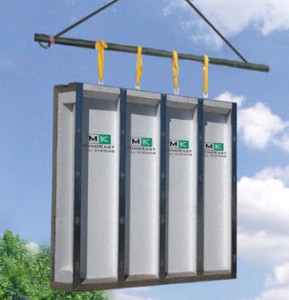 MonoKast™ panels are insulated to meet the latest energy standards now being enforced in many markets. MonoKast™ technology is licensed to local precast concrete suppliers and poured concrete foundation installers. Structura Technologies is a building systems technology and services provider founded in 1996. Structura is a member of the WF Group – with 58 years of successful history in building systems in 50 countries. For more information contact:
CFA Announces 2014 Annual Convention Theme and Education Schedule
Moving Toward Profitability
Mt. Vernon, Iowa (March 12, 2014) – The Concrete Foundations Association (CFA) – a non-profit industry representing cast-in-place contractors and the recognized authority for residential concrete industry – has announced the theme for their 2014 Annual Convention.
To be held at the Kalahari Resort in Sandusky, Ohio, the Annual Convention is the largest concentrated gathering for cast-in-place contractors in North America. Over two and a half days, attendees will network with professional peers, be introduced to the latest technologies influencing the industry and receive a wealth of educational opportunities.
In response to today’s improving economy, the theme “Moving Toward Profitability” was selected. The theme also represents the challenge of becoming and staying profitable in today’s market. According to Jim Baty, CFA Managing Director, a recent study of residential concrete professionals concluded that being profitable is a challenge in the industry, largely stemming from recession-era prices, despite material increases and higher demand. Additionally, the workforce isn’t as productive as it was pre-recession due to attrition and lower concerns for schedule.
“It is very clear that we don’t have to worry as much about finding work,” said Doug Herbert, president of Herbert Construction and a member of the CFA Board of Directors. “However, the problem now is that we have to figure out how to make money on these jobs that we’re doing. Our sales are up, but our profits don’t follow suit as they had in the pre-recession years.”
To help contractors move toward a stronger position of profitability, the CFA will be offering a very strong education track for this year’s event. The schedule is as follows:
- Thursday, July 31 will be a full day related the current concrete codes and standards impacting the industry. From ACI 332’s Code Requirements for Residential Concrete to the 2012 International Energy Conservation Code, the day will be led by one of the leading residential concrete engineers, Brent Anderson.
- Friday, Aug. 1 will offer such business topics as Inequitable Builder Contracts, Winning with Concrete vs. Asphalt Pavements, Legal Traps for Employers, Who Pays? – The New Pump Safety Standard, and Investing in Concrete Pumps for Profit. This day is devoted to employer issues that offer new business strategies and risk management for your company. In addition, attendees will be introduced to the latest research for the concrete industry dealing with cold weather performance of slabs-on-ground.
- Sat., Aug. 2 will conclude the event with an opportunity for individuals to sit for the ACI/CFA Residential Foundation Technician exam as well as continuing to focus on key management issues dealing with insurance, marketing, drug-testing and financing equipment. Two feature presentations will offer attendees a look at the CFA’s 2014 Overall Grand Project Award recipient and an informative session on the very real risks of accidental price collusion in meeting environments.
“Each year, the CFA establishes one event that will benefit every company operating in the cast-in-place concrete industry,” states Ed Sauter, Executive Director for the CFA. “There is a lot of anticipation for what will take place this year as we return to a regional location in the heart of the concrete foundation industry as well as our CFA members. This educational track is loaded and there are several big surprises planned for the environment in which you will participate.”
Registration is now available for this major industry event at www.cfawalls.org; by emailing CFA Managing Director, Jim Baty at jbaty@cfawalls.org; or by contacting CFA Headquarters at 866-232-9255. A room rate of $162 has been secured for most attendees.
About the CFA
The CFA was established in 1974 for the purpose of improving the quality and acceptance of cast-in-place concrete foundations. Since that time, the CFA has transitioned to a network where foundation contractors can focus on building better businesses and improving the recognition of performance in codes and standards.
The CFA represents the interests of its members and the industry on several code and regulatory bodies, such as ACI 332 the American Concrete Institute’s committee responsible for the creation of the “Residential Concrete Standard” and the International Residential Code (IRC) as well as concentrated efforts with the National Association of Home Builders (NAHB) and Portland Cement Association (PCA). The CFA produces industry-shaping documents including the CFA Standard for Residential Poured Foundations and the CFA Cold Weather Research Report. For more information about CFA, please visit www.cfawalls.org.
Resilient (Concrete) Homes by Bill Palmer
Concrete Construction editor Bill Palmer opens back up the discussion of the future of concrete homes that benefit the consumer with the most resilient of performances in his February 21 blog post.
Excerpt
We’ve been talking about concrete homes for many years, but they never seem to have really clicked with home buyers. Maybe that’s about to change. During the World of Concrete’s Concrete Homes Luncheon and Forum, sponsored by the Portland Cement Association (PCA), Hanley Wood’s chief economist, Jonathan Smoke, presented the results of a study of home buying in areas at the greatest risk of damage due to natural disasters such as high wind loads and severe seismic activity. Using data generated by studies of key metropolitan areas, Smoke forecasts that 73% of single-family starts in 2014 will be located in these areas.
Read the entire blog post and a link to an editorial by Concrete Producer editor, Rick Yelton, on the market segment growth for concrete homes.
Research the CFA’s Concrete Homes Council website for more information and connection with concrete professionals building these homes with removable concrete forms.
CFA Member: Prinsco, Inc. Recognized by Hanley Wood as MIP
“2014 Most Innovative Products Award” Winners Announced
Washington, D.C., February, 2014 — The votes are in and winners selected for the “2014 Most Innovative Products (MIP) Award” program.
Held annually at Hanley Wood’s World of Concrete, the MIP Award program showcases many of the products exhibited. The MIP award program allows attendees and audiences of Concrete Construction, Masonry Construction, and The Concrete Producer an opportunity to vote for the products they judge as innovative. A panel of industry experts, many of whom serve on the World of Concrete Educational Advisory Board, reviewed and selected MIP Award winners. The editors of Concrete Construction, Masonry Construction, and The Concrete Producer reviewed and selected the products based on the innovation they bring to the industry.
This year’s products were grouped into eight categories. Information about each entry is available online at www.votemip.com.
2014 MIP Awards go to:
Business Tools and Software
Industry Choice: Weblock, About Time Technologies
Experts’ Choice: Construction Software for Project Collaboration, Viewpoint Construction Software
Editors’ Choice: The NexTraq GPS Fleet Tracking Solution, NexTraq
Concrete Construction Equipment
Industry Choice: OMNEX 2-Way Remote Control with Color LCD Display, Eaton/OMNEX
Experts’ Choice: Nano-Lok Edge Self Retracting Lifeline, Capital Safety
Editors’ Choice: Porta-Pit, Washout Watchdog
Concrete Construction Materials
Industry Choice: DUROCK EcoCap Self-Leveling Underlayment, USG Corp
Experts’ Choice: Hilti HIT-Hy 200 Adhesive Anchor System, Hilti, Inc.
Editors’ Choice: E-ZBar, E-ZBar
Decorative Concrete Materials and Equipment
Industry Choice: KRazor EDGE, KutRite
Experts’ Choice: StarSeal PS Ultra Stain, Vexcon Chemicals
Editors’ Choice: One Piece 7 1/4″ Cantilevered Step Liner, Butterfield Color, Inc.
Demolition, Repair Tools, and Materials
Industry Choice: Track-O Mini-Dozer M-27, Movex Innovation
Experts’ Choice: PAM_DEK, RNP Industries, Inc

Formwork
Industry Choice: Prinsco PROFORM, Prinsco Inc
Experts’ Choice: C.O.R.K. Concrete Opening Repair Kit, Construction Midwest, Inc.
General Tools and Equipment
Industry Choice: D-1800, BW Manufacturing
Experts’ Choice: PB184BAT, Packer Brothers
Editors’ Choice: BN Hydro Hoe, BN Products
Masonry Materials and Equipment
Industry Choice: Greenstar BLOX, Mason Greenstar
Experts’ Choice: Bosch Mortar Knife, Robert Bosch Tool Corporation
Editors’ Choice: PC912 Dust Control Power Cutter, iQ Power Tools
About Hanley Wood
Hanley Wood, LLC is the premier media, information and marketing services company serving the residential, commercial design and construction industries. Through its operating platforms, the company produces award-winning digital and print publications, e-Newsletters, websites, marquee trade shows and events, market intelligence data and custom marketing solutions. The company also is North America’s leading publisher of home plans.