
40 Years of Evolution Another Milestone
The CFA will celebrate its 40th year of service to the residential concrete foundation industry at this year’s Summer Convention in Sandusky, Ohio. I have been with the CFA for just over half of that time. During that period, a lot has happened to the nation; the concrete industry; technology; our member businesses, and the Association. We have been through a terrorist attack; the biggest recession since the Great Depression; and a technology revolution that has no end in sight.
There have been changes in the CFA and its members during that period. Many of our family-owned member companies are in their second generation and some poised to enter their third generation. Membership has grown, retracted, and that growth has been renewed. We lost over half our members but we are now on our way back, as are the CFA members who survived (unfortunately not all did).
Residential Concrete now has its own standard (or code) within ACI as well is a CFA-developed standard. Contractors are now represented “at the table” where codes and standards are developed.
On the industry side, concrete, the material that forms the basis of our businesses, has evolved. While still comprised of the same basic constituents, superplastisizers, water reducing agents, and a host of other admixtures make concrete better, greener, and more cost effective.
Equipment utilized by CFA members has revolutionized placement of forms and concrete. “Lugging” forms into a hole has been replaced with boom trucks; concrete no longer placed with a wheel barrow, it is now conveyed or pumped.
Then there is technology. Cell phones, then smart phones, tablets, laptops, the Internet and all of the advancements made possible with these and other technologies. Ordering, scheduling, estimating, communications, drawing and visualization – all improved with technology. The total station, a device that a few pioneering members made a standard in our industry, is now common on nearly every job site.
One thing that has not changed however, is the dedication of our members and staff to make their businesses and products the best in the industry. This wouldn’t be possible without the dedication of our members and their willingness to share ideas and learn from the experiences of others.
This is why we ask you to join us July 31-August 2 at the Kalahari Resort in Sandusky, Ohio. Help us celebrate 40 years of service to the industry and participate in what is still the primary value of membership – networking with your peers.
Ed Sauter esauter@cfawalls.orgThis Experience Has Served Me
Isn’t it enjoyable to see good people do good work? We are blessed to have a strong team of impressive individuals at our foundation company. Our team has a nice blend of people in different stages of their lives, and their careers. To be successful, we need a mix of new learners, skilled workers, coordinators, leaders and mentors. Young starters bring untarnished energy and enthusiasm…and some healthy competition. Skilled workers and craftsmen are the athletes that we need to succeed. Leaders and coordinators put them in the right position and optimize the process. Mentors give us vision, guidance and a moral compass.
I have had the pleasure of witnessing similar attributes at the CFA. As a kid, I saw the passion and excitement of the “poured wall pioneers.” When I entered the work force, the CFA became my “concrete college” with rooms full of experts at my disposal. Our company has grown using lots of CFA ideas, and it has been my pleasure to share our experiences with others.
“Serving” on the board and as CFA President doesn’t sound quite right, as the experience has served me. Yes, we have done what we could to add value to our members and advance our industry, but sorry folks…I have to admit that I have taken more than I have given. This has surprised me as I’ve looked back on the experience.
So let me share the secret. Getting involved isn’t really a sacrifice—it’s a benefit. Being active doesn’t really cost you time—it makes you more efficient and productive. Travelling to meet doesn’t really cost you money—it gives you moneysaving ideas.
It is no secret that our industry needs more young starters. Perhaps my next role in my company and at the CFA will be to encourage and share with the younger generation. But I have a feeling I will still get more out of it then what I put in.
See you in Sandusky!
Jim Bartley, Bartley Corp jim@bartleycorp.comVisible Pour Lines – Are They A Problem?
This article was originally written for and published in Concrete Contractor magazine by ForConstructionPros.com on May 16, 2014.
What to do when customers worry the pour line is a crack in their new concrete.
Question: A recent project we were completing was held up when our homeowner ventured to the site to see the concrete work we had just unveiled during stripping of the forms. Across one wall was a visible line we commonly know to be a pour line, but immediately the concern was “my foundation is already cracked,” what can we do to reassure our customer? – Concrete contractor from Indiana
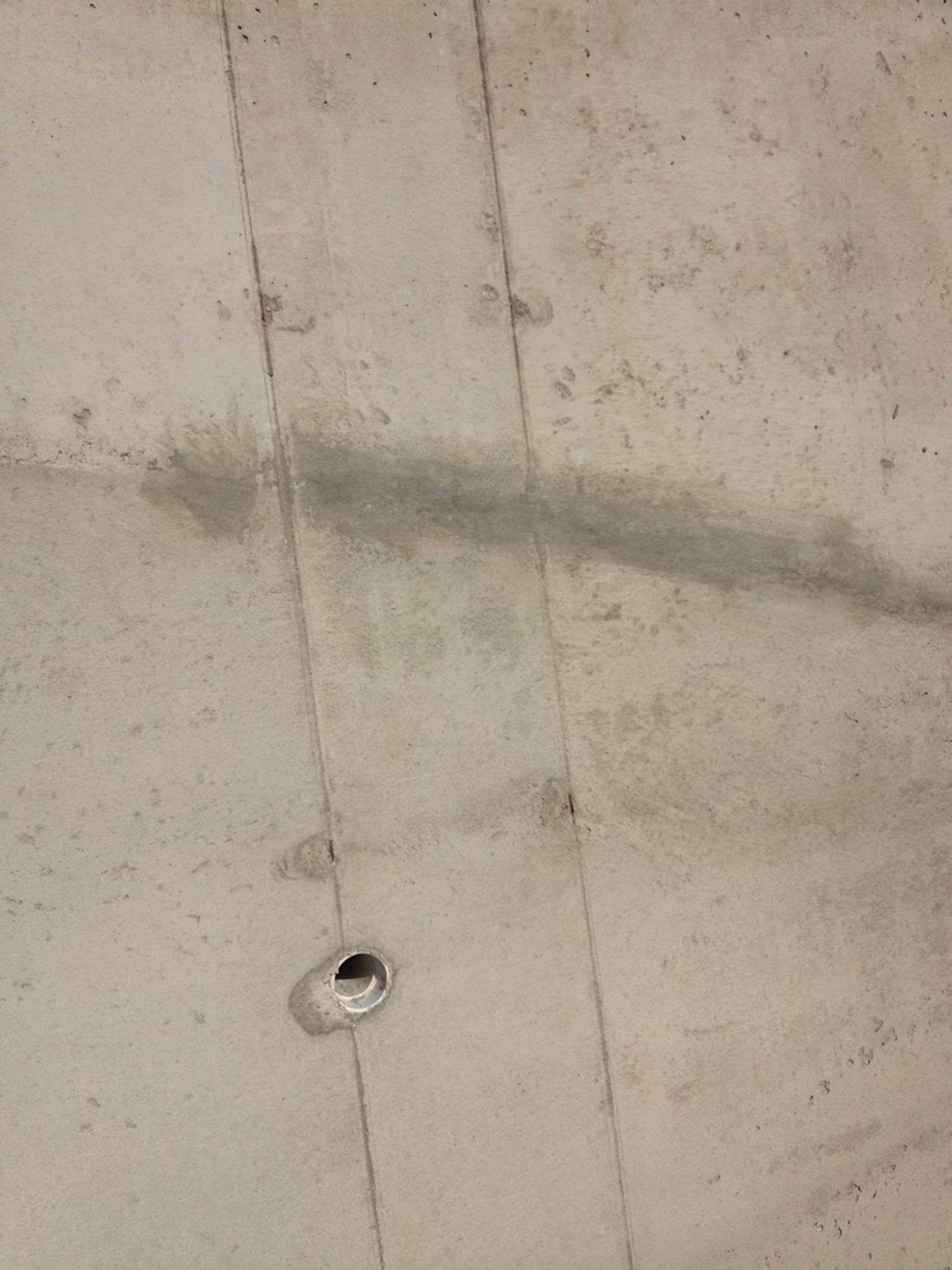
Answer: We will agree that this is a very common inquiry that we receive from the market. Occasionally the contractor defending their work brings it to our attention and sometimes it is by the customer looking for third party assistance, in either challenging the work or relieving their concern. Regardless of the purpose or direction for the inquiry, the reality is that blemishes and visible record of concrete placement is a natural part of the cast-in-place process, particularly when higher aesthetic standards or specifications are not set for the project.
A Change in Load
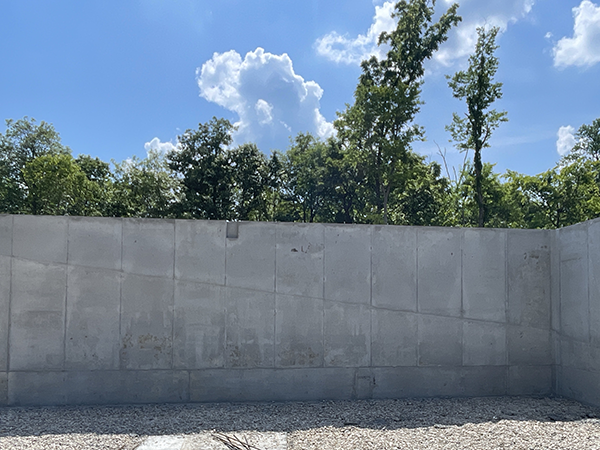
The vast majority of the occurrences for these diagonal lines in a cast-in-place are the indication of a change in concrete load during placement. When a contractor is placing concrete in vertical formwork, regardless of the placement mechanism (e.g. concrete pump, conveyor or direct chute), the truck placing the concrete will run dry and a change is made. Concrete trucks traditionally carry between 7 and 10 cubic yards of concrete while an average 3,200 square-foot house foundation requires between 50 and 60 cubic yards of concrete.
Most residential lots have considerable restrictions on the movement of vehicles due to lot lines and other traffic congestion, therefore only one truck at a time is able to deliver its load. When one finishes and moves out, the next moves in and placement resumes.
Depending on the amount of time between starting and stopping, the concrete in the forms has already been vibrated by the crew waiting on the placement to resume. As the new load is placed, the contractor will resume vibrating the fresh concrete but may not extend the vibrators fully between the previous placement and the new concrete. This results in what the industry refers to as a “pour line” or a slight variation of color or texture that may indicate a natural color variation in the concrete, a different rate of compaction or vibration and most likely the difference in hydration stage of the fresh concrete.
Concrete begins hydrating the moment mixing begins of the cementitious particles and water. There are multiple stages or benchmarks for the hydration process that range from mixing to initial set, final set to design strength, etc. The contractor should fully recognize the stages of workability and to make certain that initial set is not reached between placements.
When Cold Joints Appear
If this happens, rather than a “pour line” between concrete placements, a “cold joint” will occur. A cold joint is where the previous placement hardens prior to the receipt of the next placement and the result may be a reduction of the monolithic behavior for the concrete element, in this case a foundation wall.
Professional concrete contractors can easily identify if the concern for a cold joint is present and can plan to remediate the problem should that occur before they start the next placement. However, should a serious concern exist for a cold joint over a pour line, there are non-destructive methods to core and examine the concrete before making the final determination of the best way to proceed.
Wall sections that have cold joints and steel reinforcement are likely to still perform adequately due to the combination of shear transfer across the joint due to the steel reinforcement bars and the coefficient of friction at the rough joint. An engineer may also review the joint if sufficient concern exists.
Check the Guide
ACI 309.2R-98 – Identification and Control of Visible Effects of Consolidation on Formed Concrete Surfaces (American Concrete Institute, www.concrete.org) can be a useful guide to a complete description of the presence of these diagonal lines. From section 2.5 of this document:
“Placing concrete too slowly may allow workability to be lost and can produce layer lines or cold joints due to improper consolidation. Undervibration is far more common than overvibration and may be caused by the following: 4. Failure of the vibrator to penetrate into the preceding layer.”
The question is a good one to start the conversation between contractor and customer on the quality of their wall and the performance issues that the owner will be responsible to maintain. While the diagonal pour line is very infrequently a cause for concern for any issue of performance, especially for walls receiving dampproofing and/or waterproofing treatments, the discussion of the long-term maintenance goals for proper grade and foundation care will lead to decades of proven value and performance.
Want to know more? Contact CFA Managing Director, Jim Baty at 319-895-6940 or by email at jbaty@cfaconcretepros.org. The Concrete Foundations Association is a national association for professionals with the mission to support the cast-in-place contractor as the voice and recognized authority for the residential concrete industry. ACI 332 is the Residential Concrete committee for the American Concrete Institute and as a code committee is seeking professionals from all aspects of this industry with an interest in participating in the development of expanding and strengthening this concrete code.
Exciting Business Opportunity Available for Enthusiastic Self Starter
Exciting Business Opportunity Available for Enthusiastic Self Starter

Responsibilities:
• Work personally with concrete contractors and dealers.
• Manage current and new business, demonstrating how your customers can reduce costs and grow their business.
Duties:
• Develop long-term personal relationships with contractors
• Demonstrate how/why Western Forms systems can yield the highest return on investment of any comparable system.
Qualifications:
• Bachelor’s degree, and/or equivalent experience
• Self-motivated, independent, and ready to travel
• 5-10 year’s sales/technical experience in construction related industry preferred
• Currently living or willing to live in the Northeast
Excellent compensation and benefits package available.
Email resume to: jobs@westernforms.com
Precise Forms Announces Retirement of Vice President, Jim Crain
After 45 years of industry service, Crain sets sights on a new future
June 11, 2014 – Bates City, Missouri
Precise Forms, Inc., manufacturer of aluminum cast-in-place concrete forming products and accessories, proudly announces changes to its leadership with the retirement of long-time Vice President of Sales & Marketing, Jim Crain.

Jim Crain, Vice President of Sales for Precise Forms retires after 45 years of industry service.
“It is with excitement that I’m taking on a different phase in my life,” states Crain. “I have been in the poured wall industry since the late 1960’s and have seen many changes not only in methods and processes but have seen many second generations take over the family businesses. It has been a true pleasure meeting and working alongside many of the CFA members over the years dating back to the PCWCA days and the original founding group. My involvement with the CFA has provided so very many benefits and educational issues to me personally as well as Precise Forms, Inc. I could not imagine my professional career without the CFA.”
Effective this past April, Jim officially retired from 45 years of service to the industry with Precise to pursue interests in special isolated projects for the company. Precise has named Mike Pickell, mpickell@preciseforms.com, as the new Vice President of Sales for the company. He will serve in all capacities for Precise Forms that Jim had previously been known throughout the industry for providing. This includes the CFA and its members in their interests and needs for removable forming.
As for Jim…”I will continue working full time for the remainder of 2014 and then take a greatly reduced role starting January 1, 2015 on special projects.”
When asked about his reflections of his involvement with the CFA and the 40 years of history that has been logged together, Jim offered, “I want to express my deep appreciation and gratitude to the CFA and its members for the kind consideration that was granted me over the decades. It has been a wonderful journey and I have met the most interesting and quality people in my 45 plus years in the poured wall industry. Thank you all from the bottom of my heart.”
About Precise Forms
Precise Forms has been manufacturing aluminum concrete forms since 1967. As a leader in the concrete form manufacturing industry, Precise has set the highest quality standards for concrete form production. In the early years Precise produced concrete forms primarily for footings and basements. Since then, Precise has expanded to meet market demands such as precast concrete, concrete homes, commercial, international development, as well as any other concrete form design that has been required.
Today, Precise is adding valuable technologies to partner with its proven forming technologies. These include HelixTM Micro-Rebar and the EASI-WALL System for insulating concrete foundation walls. For more information on Precise and the company’s full line of products and services, visit www.preciseforms.com or contact their sales department at info@preciseforms.com.
Precise Forms, Inc.
201 North Spruce, Bates City, MO. 64011
800-537-0706 (toll-free phone) | 1-816-690-3400 (local phone) | 1-816-690-0080 (fax)
CFA Foundation Fundamentals
Positive Drainage…Curing Compound…Fluid Pressure? What were those words the foundation contractor used during our meeting yesterday? Construction projects, like so many other business endeavors, are not without communication problems between parties. Many are associated with terminology that is common to the contractor, yet distinctly foreign to the customer or owner.
Although the following list of frequently used terms is not exclusive to the foundation construction industry, these terms are certainly used often in that arena. Understanding them increases your ability to communicate with the foundation contractor and allows for a more satisfying project. By taking the time to learn some basic terms, you ensure your needs are met.
Admixture
Concrete is composed of water, aggregates and cement. Materials other than these, generally liquid and not considered reinforcing, that are added to the mix before or during mixing are considered admixtures.
Backfill
Material, such as gravel or soil, placed in an excavated space, generally around a foundation or retaining wall.
Bulkhead
A partition in formwork blocking fresh concrete from a section of the form, such as at a construction joint or wall end.
Concrete, reinforced
Concrete that contains deformed steel reinforcement and is designed on the basis that the two materials act together in resisting forces.
Concrete, unreinforced
Concrete that does not contain reinforcement for structural purposes. It is also referred to as “plain” structural concrete. Such concrete may include horizontal reinforcement that is placed to reduce temperature and shrinkage cracks.
Curing compound
A liquid that coats the surface of newly placed concrete to retard the loss of water or reflect heat, providing an opportunity for the concrete to develop its properties in a favorable temperature and moisture environment.
Dampproofing
A treatment of concrete to retard the passage or absorption of water or water vapor. Examples include tar or polyethylene sheeting.
Equivalent fluid pressure
The pressure applied to a construction from granular-like materials, such as soils, exhibited as a fluid-like force. The applicable equivalent fluid pressure varies for each type of soil.
Expansive soil
A soil that changes in volume due to variation in moisture content.
Flat wall
A conventionally formed concrete wall with flat surfaces.
Footing
A structural element that transfers loads directly to the soil.
Foundation
The structural elements through which the load of a structure is transferred to the earth. Foundation wall The structural element of a foundation that transfers the load of a structure to the footing or soil. A foundation wall includes basement and stem walls.
Hydrostatic pressure
The force exhibited as a live load, applied by water acting on a surface.
Joint
A physical separation in concrete, including cracks, intentionally made or forced to occur at specified locations.
Joint, contraction
A groove in a concrete structure, either formed, sawed, or tooled, to create a weakened place to regulate the location of cracking resulting from the dimensional change of different parts of the structure. (Also known as a control joint).
Joint, isolation
A separation between two individual components of a concrete structure, usually a vertical plane, designed to interfere with the performance of the structure, yet allow movement in three directions and avoid the formation of cracks else where in concrete.
Keyway
A recess or groove in one placement of concrete, which is filled with concrete of the next placement giving shear strength to the joint.
Lateral Pressure
The force exerted in a horizontal direction on a structural member.
Positive drainage
Grading used to control and direct the flow of water around and away from a structure.
Slab-on-ground
A slab which is unreinforced or reinforced and continuously supported by ground, and whose total loading, when uniformly distributed, would impart a pressure to the grade or soil that is less than 50 percent of the allowable bearing capacity thereof.
Slump
A measure of consistency for freshly mixed concrete determined by measuring the amount of drop in a molded specimen of concrete immediately after removal of the slump cone.
Subgrade
Soil prepared and compacted to support a structure or a pavement system.
Unbalanced fill
The difference in height between the exterior and interior finish ground levels. Where an interior concrete slab is provided, the unbalanced backfill is measured from the exterior finish ground level to the top of the interior concrete slab.
Waterproofing Material
A long-term protection treatment to prevent hydrostatic water intrusion. Examples include elastomeric membrane or drainage with a bonded, crack-bridging coating or sheet; or an unbonded, elastic or semi-rigid sheet system.
Final Thought
Too often, miscommunication occurs between homeowners and foundation professionals because of a misunderstanding of terms. With a clear understanding of each others’ language, everyone clearly comprehends the project’s goal and objectives. Learning this language from the project onset creates a vehicle for clear communication. Open lines of communication begin when everyone is speaking the same language, and is the first step to ensuring a successful project.
OSHA’s National Safety Stand-Down for Fall Prevention
OSHA is promoting a national Safety Stand-Down during the week of June 2-6, 2014 in an effort to raise awareness among employers and workers in the construction industry about the hazards of falls. The Concrete Foundation Association (CFA), www.cfawalls.org, fully supports the program and strongly encourages all of its member companies to participate in this awareness event.
Fatalities caused by falls from elevation continue to be a leading cause of death for construction workers, accounting for over a third of all construction fatalities recorded in 2012. The majority of those deaths were preventable.
The Safety Stand-Down is a voluntary pause during the workday to allow dedicated time for employers and employees to focus on recognizing hazards and preventing falls. The time can include toolbox or tailgate talks, safety presentations, or discussions on specific topics like ladder safety, scaffolding safety and the proper use of aerial platforms. The meeting provides information to workers about hazards, protective methods, and the company’s safety policies, goals and expectations. The program is a part of OSHA’s fall prevention campaign to plan, provide and train – three simple steps to prevent falls. This should be included as part of a Stand-Down discussion.
The CFA has produced an extensive alternate fall protection training and implementation plan for its members. The content for this AFPP, compliant with section 1926.502 (k), can be obtained by contacting Jim Baty, Managing Director for the Concrete Foundations Association or by calling 866-CFA-WALL.
Falls are preventable incidents that you can address when you plan, provide and train. Take this opportunity and join many others in this National Safety Stand-Down. Don’t wait, sign up today, plan your event and improve safety on your work site.
Learn more about the Safety Stand-Down on OSHA web site, www.osha.gov/StopFallsStandDown/index.html. Managers are encouraged to plan a stand-down that works best for their workplace anytime during the week of June 2-6, 2014.
Responsibilities for all personnel on a concrete pour are now specified in ASME B30-2014
The American National Standard for material placement system safety is ASME B30.27.
(Material placement systems are concrete pumps and concrete conveyors.)
ASME has released B30.27-2014. It is currently available as an electronic download and as a printed booklet. The date of issuance was March 26, 2014. It becomes effective one year after the date of issuance.
The major changes in B30.27-2014 versus the 2009 edition are the addition of translation requirements for companies importing equipment into the United States from other countries, and the addition of responsibilities for all personnel when a material placement system is used on a concrete pour, from the general contractor to the concrete mixer truck driver and everybody in between.
The responsibilities section was adapted for use in B30.27 from the B30.5-2011 (mobile cranes) standard, which has been in effect since January 2012. The reason for the responsibility delineation is to give everyone involved in a concrete pour the knowledge needed to complete the pour safely. If specialized training is required, it is shown. Expectations of setup locations are spelled out. What an operator should know, and the items a contractor should consider when ordering a machine are listed. The only way everyone can go home safely after the pour is if everyone knows their piece of the safety puzzle and works to accomplish it.
ASME B30.27-2014 contains information that should be of interest to everyone involved with concrete pumping or concrete conveying. It is advisable to obtain a copy and implement any changes necessary to ensure compliance with the specifications. It is assumed that the specifications will be used by regulatory (OSHA) and legal entities (attorneys) as a benchmark against which the players on a concrete pour will be judged.

B30.27 is republished on a five-year cycle. The 2009 version of B30.27 became active in June, 2010 and will be in effect until March 26, 2015. The 2014 version will remain in effect until one year after the next revision is published.
Copies can be obtained from the American Society of Mechanical Engineers (ASME). Go to http://www.asme.org/ use the ‘codes and standards’ link; then enter B30.27 into the ‘keywords’ field or direct to the information page here. The standard is also available from Global and other standards retailers. Because of severe restrictions placed on the .pdf version (one user, no printing), I recommend the paper version.
Questions or requests for interpretation regarding the ASME standard should be addressed to:
Secretary of the B30 committee, ASME, Three Park Avenue, New York, NY 10016-5990.
Contractor’s Footing-Form Innovation Becomes a Competitive Advantage
Published by Concrete Contractor Magazine, April 23, 2014In the early 1990s Barry Herbert, then president of Otsego, Mich.,-based concrete contractor Herbert Construction Co., learned an alternative method for forming footings. Barry spoke with Ron Colvin, a concrete contractor from Berrien Springs, Mich. about footing construction. The two had become friends through their membership with the Concrete Foundations Association of North America (CFA). Colvin had eliminated the typical two-by-four construction of footing forms.
My father Barry, my brother Mike, and I, visited Colvin. He showed us a couple of his job sites where we saw the forming system in action. The system used thin-gauge metal forms instead of wood. The forms were simple to set up and prepare for concrete placement. Once the concrete was placed, the forms were easily removed and ready to be used again.
We decided to implement the system in our own company. We hired a steel company to cut and bend the metal and set about teaching our field crews to use the system. It was easy to learn and simple to use, which shortened the learning curve.
Marketing Corner: Building Your New Marketing Program
Q&A WITH NORTHERN CONCRETE
Leveraging digital media and relationships may be about as far from your mindset as a concrete contractor as is venturing into new market such as high-rise core construction. The complex world of Google, Yahoo, facebook, LinkedIn, twitter, instagram, Pinterest and a host of others has for many turned competent and savvy business minds away from what is potentially the most significant frontier for your business.
Consider this, today’s Millennium generation is learning at breakneck pace and is applying their skills at any moment in a multiplicity of ways. In order to reach them and reach them effectively, your company must begin to consider the best ways to make your information both relevant and convenient. Starting now can make a significant impact on both the learning curve and the leadership that you evidence to the industry.
The real problem, however, is that like any business model modification, there are great risks at stake. Risks that involve hiring new staff or identifying staff resources that can be reallocated or redirected. Risks that consist of what information should you present, how much information should you offer and who should you be targeting. These are not uncommon to any other business element that you have investigated in the past, they just become perceptibly uncomfortable due to how big the environment for decision making is and how seemingly uncontrolled the audience may be.
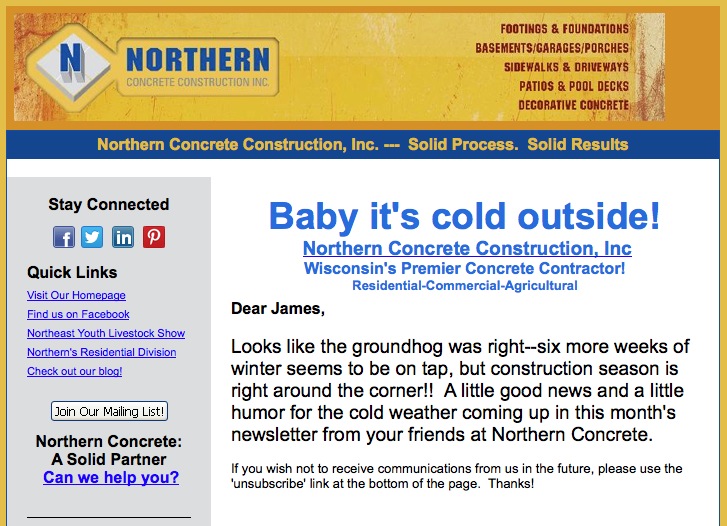
In this edition’s look at current marketing strategies, CFA Managing Director, Jim Baty sits down with Matt Kapinos of Northern Concrete to take a look at their digital marketing program and the use of effective monthly email newsletters.
Their ‘Solid Process. Solid Results.’ newsletter is a strong collection of industry news, feedback on influences affecting their market and often a dose of light-heartedness that helps their customers become more engaged with them as an information resource.
CFA: Good afternoon, Matt. Thanks for taking the time to discuss some of these questions I have for our readers about your monthly electronic newsletter. I’m really enjoying receiving this each month.
Matt: Thanks for the opportunity. I’m glad you like the newsletter. It has been a fun product for us to pursue as we look for new ways to create lasting relationships and reliability for our customers.
CFA: How long has your company been producing an electronic monthly newsletter?
Matt: We started early last year, but were fairly intermittent. I have committed to one per month to the commercial, agricultural, and residential market segments, and one to anyone related to education to help promote careers in construction. This means I’m now producing four newsletters so in a pretty short timeframe we have identified the effectiveness of this communication tool to our markets.
CFA: That is fantastic. I’m surprised by the big jump in commitment your company has made. Before going electronic, were you producing any kind of a printed newsletter or other regular communication?
Matt: No, not to my knowledge. We had never really spent much time thinking about communicating on a regular basis to our potential market and active customer base related to areas of interest and things our company is doing.
CFA: With four separate newsletters across those markets, there must be variation in the recipients and the distribution of your information. How would you describe the distribution list that receives your communication (i.e. regional size, customer demographics, etc.)?
Matt: Yes, to say the least. Our residential market is northeast Wisconsin. That consists of about 230 recipients and is comprised primarily of residential builders. The commercial market for us is primarily Wisconsin and perhaps a few outside the state. This group again consists of about 230, including design build firms, general contractors, architects, etc. Our agricultural market consists primarily of dairy producers in northeast Wisconsin. There are some key contacts from around the state as well and that list has about 250 recipients. Our educational market is small, but growing at about 75 recipients. Here we focus on including technical education instructors, teachers, administrators etc.
CFA: That is quite a variety and yet surprising similarities between the different markets and the size of the respective customer bases. I would imagine it has taken a fair amount of time to develop them. I’m curious for our readers if you have any examples of good feedback you have received from anyone receiving the product?
Matt: We have had great feedback from the educators. They like that someone is interested in promoting non-college careers as a viable choice for young people. That newsletter offers them a chance to look inside our market and identify skill sets and employment needs of the market we serve. Regarding our residential product, we have had at least one builder request a quote from our email marketing, a potential customer we had not been doing business with prior to identifying them through this marketing effort.
CFA: Would you say the responses indicate your information appears safe and of interest to your readership?
Matt: Definitely. We try to use it less as a direct call to action…a “send us your project to bid” piece, and more as a subtle reminder of our company. That is why very little of the content says BUY FROM US. We work hard to keep more information related to the industry, the economy in general, trends, current events, and usually a little something funny at the end just to leave people with a smile.
CFA: Yes, we had a good laugh ourselves when your last issue provided tweets about cold weather from #PolarVortex. One of my favorites…”@JohnnyWalsh – It’s so cold outside, my hearing aids didn’t start this morning.”

CFA: Do you have a particular story of a relationship improved or a customer gained from these communications?
Matt: We’re still working on that builder I just mentioned but otherwise, no, not directly. I can tell you that our open rates—the percentage of people we send to who open our emails– is typically high 30s into the 40’s. Being that we just started in earnest in the last couple of months, I would say I hope to have some better examples of this type of thing next year about this time.
CFA: Okay, Matt, the big question really is, how much staff time would you estimate you have in this monthly communication product?
Matt: Obviously, we have committed to this type of marketing and this effort to produce a great deal of information to our key markets. I would say we probably have a good 10-12 hours per month in producing four of these newsletters. I am getting faster and more efficient. I would say that will come down.
CFA: That really isn’t that bad at all, at least not from my perspective. It helps that you are accessing and organizing thoughts from other resources and pulling together information that may be quite scattered. Matt, thanks so much for spending some time with us and most importantly, for stepping out and providing this leadership effort for other companies across the residential market.
Matt: My pleasure. Thanks for asking us about our product. It is good to interface with readers and we like networking with other companies, particularly those relationships we have begun to find in your Association. In case anyone is interested, MyMarketingCafe.com did an article on our digital/social media footprint that we were pretty pleased with. Access it at http://www.mymarketingcafe.com/ digital-marketing-success-how-oneconcrete- company-does-it/
CFA: Super. We’ll enjoy taking a look and when this article hits our website, that link will be active for anyone to visit the online version of Concrete Facts found at www. cfawalls.org for a quicker way to get to the information as well as returning to the information when it becomes of interest as a reminder.
Northern Concrete maintains a weekly blog on their site accessible directly from http://www.northernconcreteinc. com/blog/. You can get a feel for where a lot of their content comes from and begin to identify ways of integrating a similar solution into your business. CFA members can check out a new discussion thread in our LinkedIn ‘CFA Members’ group where we will be finding out more from others testing the waters or maturing in their approach to digital marketing.
Does your company have a monthly newsletter? Is it in print or electronic? Would you like to share some of the insights you’ve gained from initiating such an effort? We’d like to chat with you about it and make it an opportunity for others in this professional network to learn from as well.
Contact Information: Jim Baty, CFA Managing Director, jbaty@cfawalls.org | 866-232-9255 Matt Kapinos, Northern Concrete, mattk@northernconcreteinc.com | 920-863-3043 x223