6 Mistakes Concrete Contractors Make When Hiring People
By Doug Herbert
As spring arrives, so do the opportunities for concrete contractors to do more work. We emerge from our winter slumber to finally see more bidding activity and orders from customers.
Before we know it, we will be sweating it out in June, wondering how to find enough laborers to get all the work done. There will be opportunities to make more money, but finding the right people will be the biggest obstacle to higher profits and company growth.
To ensure that you can capitalize on profitable projects and increase your market share, avoid these six mistakes when trying to hire good employees.
Mistake #1
Poor Strategy for Finding New People
Most contractors rely on referrals from current employees and Craigslist ads to find new employees. When what you have been doing isn’t giving you the results you want, it is time to develop a better strategy. In addition to asking yourself what you have done in the past to attract new hires, ask what you haven’t yet tried.
There are multiple low-cost ways of attracting laborers to your company. The more of these you do simultaneously, the more people you will attract.
Mistake #2
Hiring Anyone Who Walks Through the Door
When you have four weeks’ worth of work to do in the next two weeks, it can be difficult to resist the urge to hire anyone that walks through your door. Don’t do it! Much like deciding to go to a third bar in the same night, you will regret it in the morning. Hiring the wrong person can cause a lot of headaches at best, and a lawsuit at worst.
It is better to wait for a better candidate to hire later than it is to hire the wrong person today. Be sure you have a formal method for screening and qualifying those who apply at your company. And, importantly, follow that method for every person, every time.
Mistake #3
Throwing Them to the Wolves on Their First Day
Even experienced tradesmen need to get up to speed with your company and how you “do things around here.” General laborers with little experience in construction will have that deer-in-the-headlights experience if they go out with a crew immediately.
A new hire’s first day of employment should involve an onboarding process that includes an orientation to the company procedures. This can be performed by someone in your office, or by a shop foreman, if you have one. The new employee can work at the shop or yard for the rest of the day and be ready to go with a crew on their second day. When you put them on an established crew on their first day, you are asking them to run before walking.
Mistake #4:
No Training of New Hires
You have probably seen this on social media – Controller: What if we train our people and they leave? CEO: What if we don’t and they stay? That’s important to remember. But when you are just trying to get enough guys on the job site to keep your customer from screaming at you (again), it can be tough to think about a structured training program.
Training, though, comes in all shapes and sizes. For starters, assign a veteran on your crew to teach the rookie the ropes. On your rain days, keep the guys at the shop for two hours and teach them how to read plans, figure out what fillers are needed at a corner, or how to line a wall. Any amount of training will pay for itself many times over.
Mistake #5:
Not Finding Out if They Are Right for Your Company
When we hire someone, we expect that they will work out well at our company. We send them on their way and then move on to a hundred other things we need to do that day. But what if they aren’t right for our company? What if they are incredibly lazy? What if they are a pain in the butt to be around?
Be sure to follow up with your foremen early and often about the new hires. If they are not a good fit, you can try moving them to another crew. If that doesn’t work, fire them quickly yet gently and suggest they apply at your competitor’s company. It is better to be a man short than to have one that causes a lot of problems.
Mistake #6:
No Retention Strategy
You can have a great hiring process and bring in a bunch of new people, but if you don’t keep the good ones, you will be miserable – along with everyone else around you. The entire company is affected when you lose good employees. Develop a strategy of identifying good people. Then, recognize and reward them for their behavior in front of everyone. Thank people publicly for doing the things you want repeated. Announce employment anniversaries and other milestones.
Exceptional employees are ambitious. Talk with them about the possibilities for advancement at your company. Make sure they know you see them as valuable. Retain the people that are profitable for your business.
Improve Your Hiring and Retention Systems
Finding the right people is often the biggest challenge for concrete contractors. If you are better at it than others in your area, you will have a competitive advantage and be more profitable.
Make a plan to fix these six hiring and retention mistakes before you need to hire people. Enlist the help of others in your company to tackle these areas. If you wait until your workload is full and you really need the workers, everyone else in your company will be too busy to do it well. Do it now while there is still time.
Finding a Concrete Housing Authority
By David Pfanmiller, CONCRETE HOUSING INSIGHT
It does not take long in any conversation around the concrete industry for the focus to turn toward the concrete house. Invariably, someone will ask the question, “Why is it that we aren’t building houses out of concrete here in the U.S.? I mean, look at Europe – they’ve been doing it for centuries!” While it is debatable what the difference is between production house-building and building a home, there is no denying that a gap exists between intuition (or intellect) and economy (or practice). In some respects, the answer is, “Well, it is because we’ve always done it this way,” and, “Frankly, I’m not sure where I would turn to to begin the process.” What has been needed for some time is a resource for truly engaging in the thought process of building a concrete house and then moving toward building concrete houses. It is for this specific purpose of delivering insight into the concrete housing market that our company, Concrete Housing Insight, has been formed.
In 1992, I became involved in a concrete construction company that worked hard to build up our market in Raleigh, NC. From 1992 to 2000, one of our biggest issues we faced was that of optimizing the use of our forming systems, equipment, and the skilled labor force we had developed. After several years, we found ourselves looking for alternatives. Our interest turning to concrete homes coincided with some technological advances in ledger, deck and shoring components from the panel manufacturers.
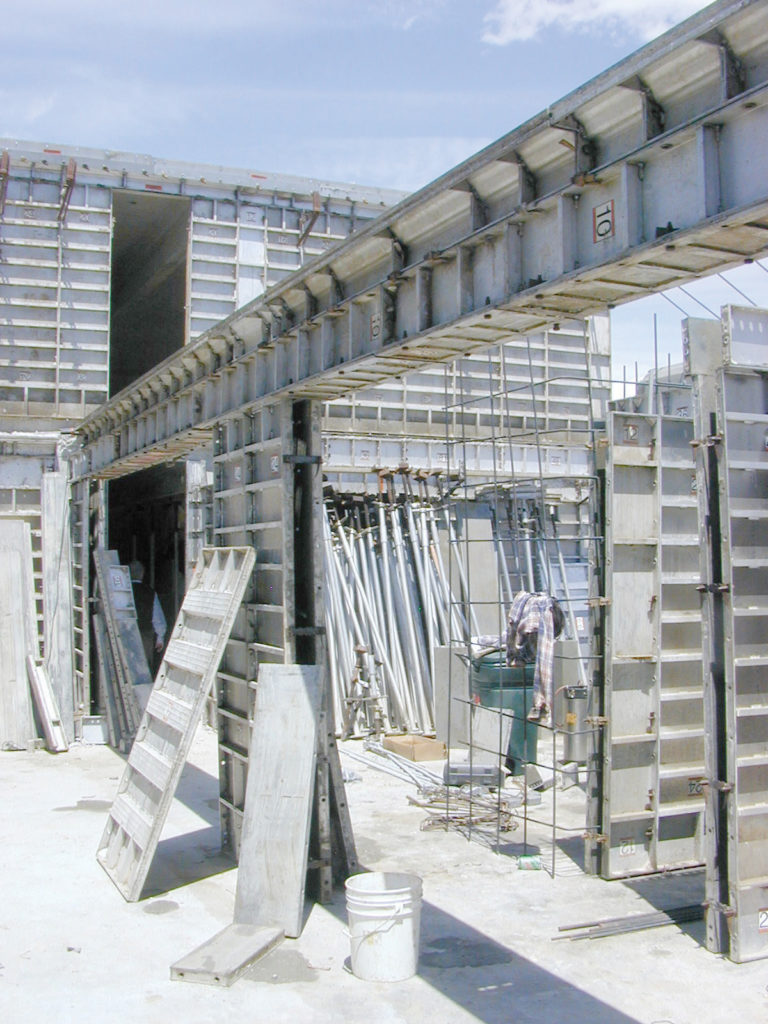
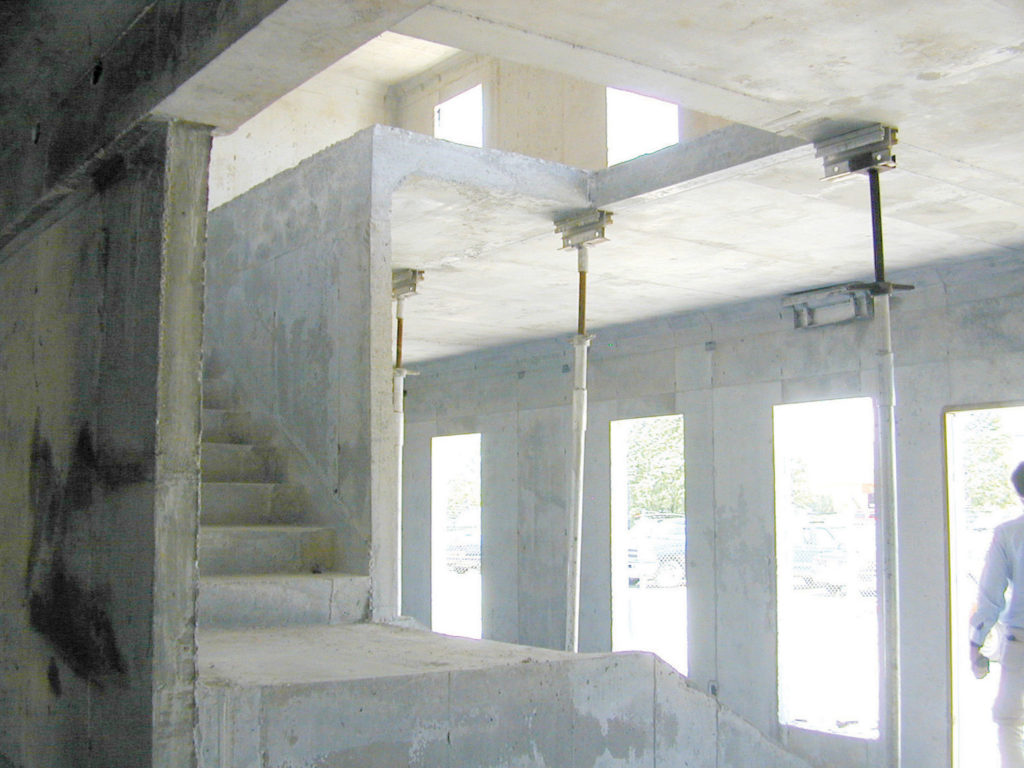
We began building concrete houses and did so from 2000 to 2008. We started things off with a prototype duplex in Raleigh, North Carolina. We followed that with several two-story units and some custom residential buildings on Topsail Island in North Carolina, followed by building in the Gulfport/Biloxi area in Mississippi before we finally attracted a key account to begin building custom homes in the Raleigh area. In retrospect, we did a lot of things right; but we also made some mistakes. I would like to share what I learned during this period and introduce an option that now exists to assist others as they venture into the concrete housing industry.
Before we engaged the market, we developed a business plan. This plan was essential for our leadership to touch and feel the vision, which initially appeared to have a rather large upside but definitely had some risk. The plan began with developing strategic partnerships with major homebuilders. If we could become a major sub-contractor to them, we would then be able to use our trustworthiness and reliability to help them transition to a concept of all-concrete housing.

Next, we had to develop a strong basis for selling. What were the tangible benefits we could rely on for a concrete house that would make a difference to the homeowner? Research through the Portland Cement Association indicated that a definite gap existed in the marketplace between what the builder thought the homeowner would want (or appreciate) and what the homeowner thought was valuable – that is, valuable enough to increase the cost of housing. Therefore, we began to identify the physical properties of concrete that we believed would be the main draw.
• Thermal Mass
• Air Quality/Tightness
• Energy Efficiency (Insulation Capability)
• Green Footprint
Our first action in the plan was to build a prototype duplex in Raleigh. We received great support from Ross Worley and Carl Engelken of Wall Ties & Forms, Inc. of Kansas City, Kansas. Our primary form inventory was of their line, and much of the new technology we were seeking had been added to their catalog.

We successfully completed the project and engaged Advanced Energy Corporation to test the structure and monitor the energy usage. The thermal performance (Energy Efficiency) was off the chart. So, immediately we knew we had to promote the energy findings.
Unfortunately, we quickly began to find there was not enough strength in the residential market around us to support the upgrade to an all-concrete system based on thermal performance alone. So, we stepped back and reevaluated the plan, the system and the marketing. We concluded that we needed to highlight the structure’s natural strength and storm resistance. In the southeast, storm resistance had more market punch than energy efficiency. Homes were exposed to hurricanes and tornadoes throughout the year, and in recent years some very large weather events had been witnessed. If we could prove shelter strength, that would be a tangible bonus to the market.
We decided to put our structures in harm’s way. Hurricane Fran had damaged much of the North Carolina coast about a year prior. Looking at the available real estate, we chose Topsail Island as a natural location to construct our first marketable concrete homes. Topsail Island is located approximately 25 miles north of Wilmington, North Carolina, between Wilmington and Morehead City. It is accessible by only two state roads, one entering at the middle and the other one at the north end. Much of the island has a low elevation and is vulnerable to storm surge and flooding.
Here on Topsail, we built several duplexes and custom single-family homes. The designs featured a structural elevated slab approach where the concrete slab was supported by reinforced concrete columns that were typically 12 to 14 feet tall. The foundation structure lifted the finished floor elevation above the minimum required by the U.S. Corp of Engineers and created a walk-up feel. The structural slab supported two levels of the all-concrete home. We topped it off with a concrete “lid” (or attic floor) and then built a sacrificial wood-framed roof to fit in with the local architecture.
Shortly thereafter, we had an opportunity to build single-family homes in Biloxi and Gulfport, Mississippi after Hurricane Katrina. The models on Topsail proved of interest and marketable, and with recent storms ravaging these additional coastal markets, concrete would surely become the desirable construction form. We had not planned, however, on the restraints to our approach that we would soon find. For starters, the storm surge flooding and wind damage from Katrina were so devastating that many residents were too scared to rebuild. Their fear, along with the extremely slow insurance settlements, created an environment in which it was difficult to build our business. In short, the initial homes were attractive and proved their value, but the PTSD they were going through and the lack of cash flow due to the severity of insurance claims prevented any real estate development. We determined that this would linger for some time.
Not long after, the economic recession that started in 2008 forced us to pull back our operations. We did so, and we concentrated once again on Raleigh. During this period, we were able to significantly increase the awareness of cast-in-place concrete housing and commercial properties. Our timing, unfortunately, proved to be not quite right to make a lasting run. We found that building cost would always be our biggest challenge when facing the formidable combination of a cost-sensitive builder and a homeowner or developer who valued surfaces and details over structure and performance… or so it seemed.
Today, as I review my lessons learned, I see that eight out of ten go back to costs in one way or another. In reality, there is not much we can do about the hard cost of constructing with concrete. It is what it is. Our challenge remains to convince our clients that the value of their concrete structure exceeds the cost. This is where Concrete Housing Insight can best be realized today.
A lot has changed in the last 10 to 15 years in the housing market. Global warming’s effects are increasingly noticeable. Hurricanes and tornadoes are fiercer and more prevalent than ever before. High-profile climates are witnessing vast water shortages, and the drier conditions are resulting in torrid wild fires. Simply put, more of our population is now living in “harm’s way,” and they have a need to protect themselves. Additionally, our target housing market now includes the millennial generation who bring a fresh architectural perspective to the marketplace.
About Concrete Housing Insight:
Our company, Concrete Housing Insight, offers consulting services that support the concrete contractor, real estate developer, and individual homeowner during the entire project delivery cycle (land acquisition, financing, planning, permitting, preconstruction, construction and post-construction). Our main objective is to create, develop and direct a project delivery team that can provide the insight and direction needed to give you an edge in the concrete housing market.

Please reach out and let’s discuss how we can help you stimulate your involvement in cast-in-place concrete homes.
For more information: Contact us at Concrete Housing Insight by visiting our website, www.concretehousinginsight.com or sending inquiries to David Pfanmiller.
My Key to Success -Tim Upton
CONTRACTOR OF THE YEAR, 2018
By Lindsey Bloomquist
The Contractor of the Year, presented annually by the Concrete Foundations Association (CFA), demonstrates the service, technology and knowledge needed to advance the use of poured wall construction. The recipient is acknowledged for unselfish commitment to peers, to the association and to the industry, both at their market level and on a national scale. This year’s Contractor of the Year was awarded to Tim Upton of Upton Construction, Inc. out of Gretna, Nebraska.
With little to no experience in poured walls, Upton’s journey began alongside three partners in 1998. “We all had various construction and concrete experience, but not with poured foundations,” said Upton. “The day our shipment of Western Forms arrived, I was humbled and intimidated, to say the least.”
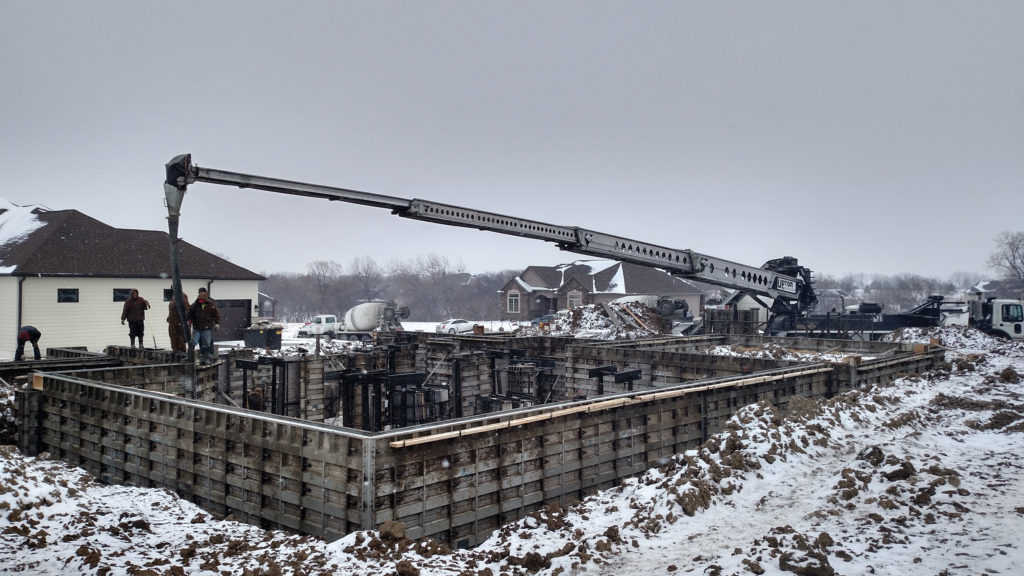
From the beginning of his poured wall career, Upton had an unparalleled amount of respect for the trade. His passion and determination would not only allow him to start his own business, but also would be instrumental in overcoming challenges that could have been detrimental to his business, as well as to his life.
“We were successful and learned a lot along the way together,” said Upton. “Thankful for all my new knowledge and experience, I chose to start my own adventure in business in 2004.”
Upton started with one set of forms stacked on trailers and a skid loader to move them around. He quickly added more forms and a boom truck, and business progressed at a healthy pace. On October 27, 2007, Upton’s life was unexpectedly turned upside-down.
“While out archery-hunting deer, I suffered from a ruptured brain aneurysm followed by two strokes,” said Upton. “After two weeks in a coma, I awoke to paralysis of my right side and cognitive deficiencies. I then spent a month in the hospital and underwent rehab for my ‘new normal life.’”
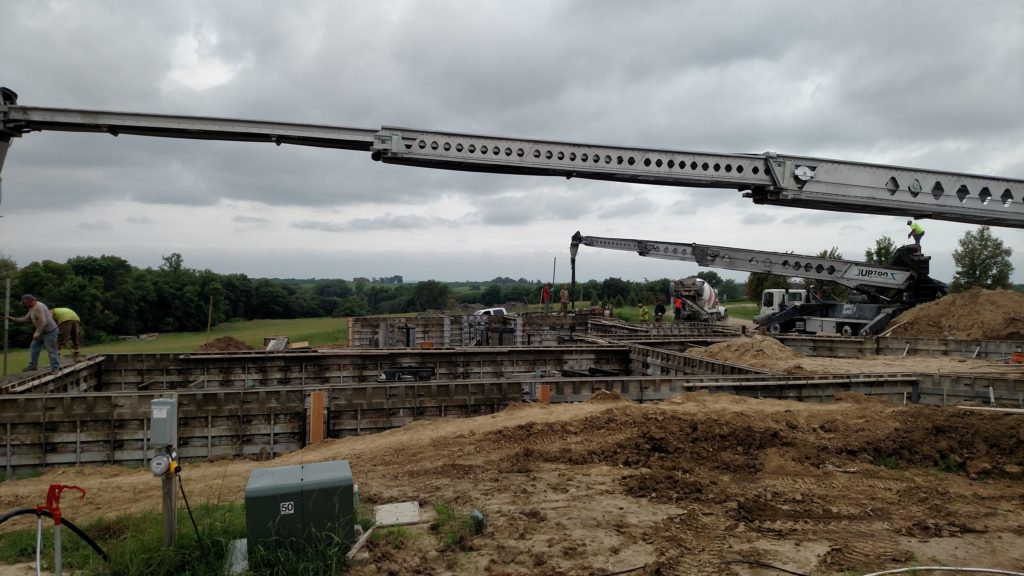
Unbeknown to Upton, this challenge was going to transform his outlook on life and change the way he looked at his own business. With the help of family, his team, and even competitors, Upton’s business was able to stay on track despite his absence. “I feel that EVERY company has dedicated and hard-working team members,” said Upton. “However, I am certain that we overachieve, day in and day out.”
Upton’s “new normal” required him to look at his business differently. “My new situation forced me to become a better businessman,” said Upton. “To this day, I am still hindered by right-side fine-motor skills and vision. I can no longer perform some of the physical aspects of the footings or walls as well. Before my aneurysm, I was out working side by side with my guys day in and day out, but this involuntarily required me to become more engaged with the business side of things, and I was able to see my company in a new light.”
Upon Upton’s recovery, he gratefully returned to his business and began introducing new tools, new equipment and new perks for his employees. “This is the key to success,” he said. “This is hard work – keep your team engaged and interested. Always be teaching and coaching.” One of Upton’s favorite quotes is: “The customer is not number one; they are number two, right behind your employees.” He strongly believes that a team-first mentality will show through their performance and work, and the customers will, ultimately, win.
This mentality emphasizes the importance of coaching and teaching work skills and ethics even more. “It is about a mindset that is not really talked about, but felt company wide,” said Upton. “We are always trying to think outside the box, innovating and shifting personnel throughout every day to maximize our efforts.”
Upton has been an active member of the CFA since 2011. Taking advantage of the numerous association resources has allowed Upton Construction, Inc. to excel in the forefront of the industry. Through education and invaluable strength and support from his peers, Upton continues to lead his company with pride, gratitude and respect. “We’ve been thriving every year since,” said Upton. “It seems every year is a record year. We are constantly learning, adding manpower, equipment and ideas to get us to that next level, and I’m thankful that we have the resources and the right team to effectively manage our growth.”
Past recipients of the Contractor of the Year award have been active, dedicated and well-known members of the association; Upton is no exception. The outlook he has on life and business has not gone unrecognized. Upton’s reputation goes far beyond this recognition, and greatly validates why he was named this year’s Contractor of the Year.
“Doing things the way they have always been done does little to help grow or improve, and Tim Upton knows that,” said an anonymous, longtime CFA member. “He is constantly looking for ways to improve his efficiency, quality, customer service, employee relationships, as well as advances in the industry.”
Upton’s team-first mentality is not only recognized within his company, but has been well-known and even contagious among the association. “Whether Tim is on the job or not, his crew gets along because he creates a positive environment in the workplace,” said anonymous. “He is quick to joke around with them and gives them space to be independent leaders. When Tim is on the job, he is right there helping and asking what else needs to be done.”
The work environment Upton has created extends far beyond the job site. Upton Construction, Inc. has a break room that includes a kitchenette, full bath, washer and dryer, and lockers for the crew. “This is just another small example of how he thinks about others,” said anonymous. “He makes sure they have the opportunity to leave their work outside of their home.”
Although Upton’s journey was not easy, it positioned him to put his energy into becoming a better businessman and an even better leader. “In the long run, I am thankful for what these challenges have taught me,” said Upton. “But I do not recommend it to anyone! My best advice, either personally or in business, is to always be coaching. As they say, ‘Don’t run people under the bus, get them on with you.’”
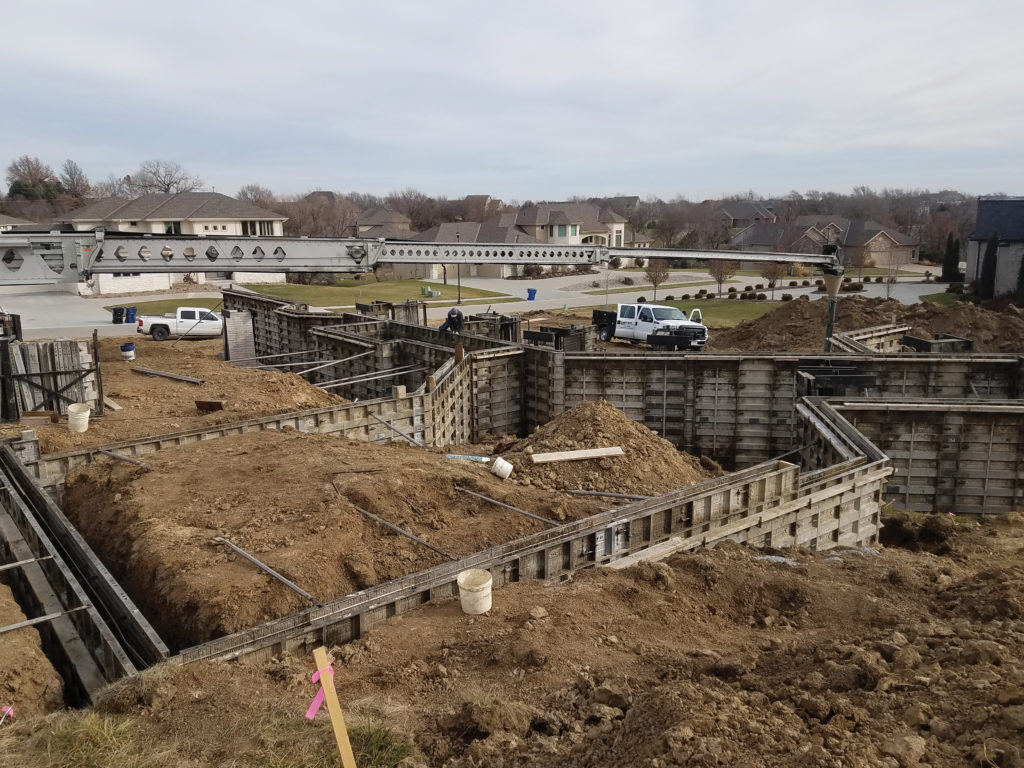
Tim was awarded the CFA’s prestigious Contractor of the Year in Midway, Utah during Concrete Foundations Convention 2018, where he was an attendance. On behalf of the CFA staff, membership and board of directors: congratulations, Tim!
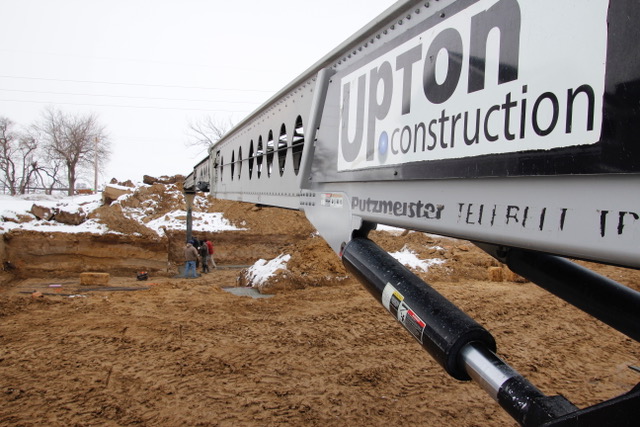
For a full list of past Contractor of the Year recipients and to submit an award nomination, please visit www.cfaconcretepro.org.
Mark Lentzkow Becomes Content and Brand Manager for the Concrete Foundations Association

Mount Vernon, Iowa— The Concrete Foundations Association (CFA), the voice and recognized authority for the cast-in-place concrete industry, is managed by the firm Sauter, Baty & Bloomquist, Inc. (SB2). SB2 was established by the former executive director for the CFA, Ed Sauter, along with his partner, James Baty, the current executive director. SB2 has added Mark Lentzkow to their staff to serve association clients as content and brand manager. Mark’s addition comes during additional transitions that are happening with Sauter fully retiring at the end of 2018.
“Mark brings an exceptional eye for consistency and freshness across all our media,” states Baty. “The working relationship we’ve had with Mark as a consultant over the past few years has made an indelible imprint on the professionalism of our resources, and we look forward to the continuation as he begins managing our entire production.”
Lentzkow graduated from the University of Northern Iowa after attending Minneapolis College of Art and Design & the University of Iowa.
“For the past two years, I have been working for the CFA behind the scenes on a part-time/freelance basis,” said Lentzkow. “I use your stories, your ads and your photos to create an impression – an impression that will promote your business in the best, most positive and professional manner,” said Lentzkow. “I look forward to working directly with our members, getting to know their businesses, and promoting them throughout the entire network.”
Lentzkow joined the SB2 staff with CFA headquarters located in Mount Vernon, Iowa and will continue to reside in Peoria, Illinois. He can be reached at mlentzkow@cfaconcretepros.org.
How to Remove Concrete Buildup
By Destry Kenning, Forming Market Segment Manager,
Nox-Crete Products Group
We have reached the end of this series, and this final article is timely, as this time of year many contractors are burdened with hardened concrete buildup on their forms. The hardened concrete makes forms heavier and can lead to more buildup. Stripping the forms takes a long time, and if the forms do not strip easily, they can be damaged in the stripping process. The buildup affects the resulting wall appearance, and this can lead to a whole new set of problems.
In the last article we reviewed what causes concrete buildup on forms. You do not necessarily need to understand what causes buildup in order to remove it, but if you remove the buildup without understanding what caused it then you may find yourself with the burden of buildup immediately following your solution for removal.
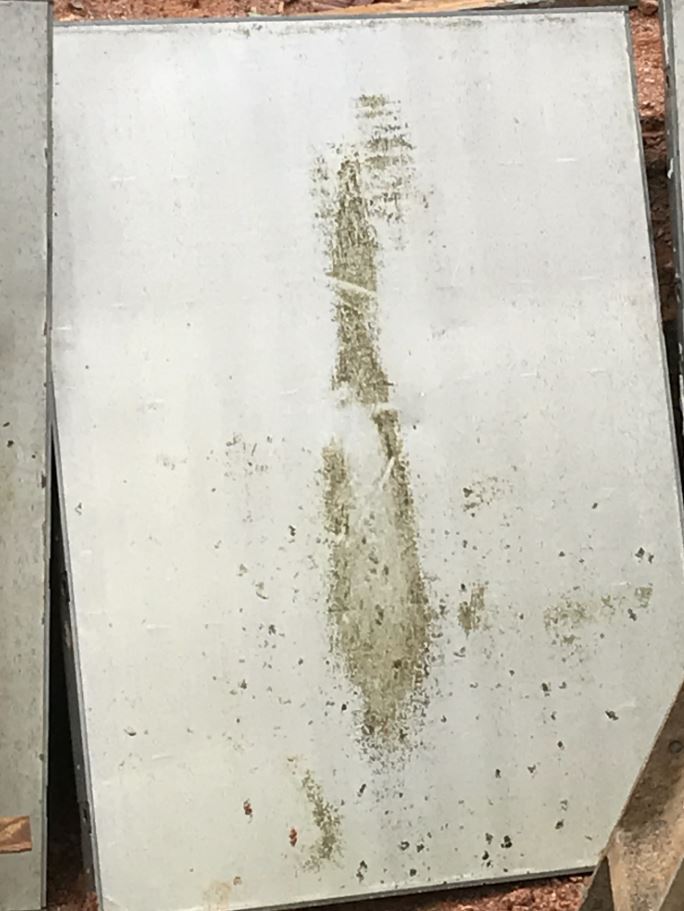
You can physically remove the buildup or you can chemically remove it. Each of these processes can be accomplished by taking the forms completely out of service and removing the buildup in its entirety, or by removing the buildup on an incremental basis between pours.
There are several methods for physically removing the buildup, including chipping away with a hammer and chisel, grinding, using a rotary brush wheel or drum, or blasting the buildup with water or another abrasive blast medium. Complete physical removal requires taking the forms out of service for an extended period of time. Once the forms are cleaned, if they are aluminum, they must be re-seasoned.
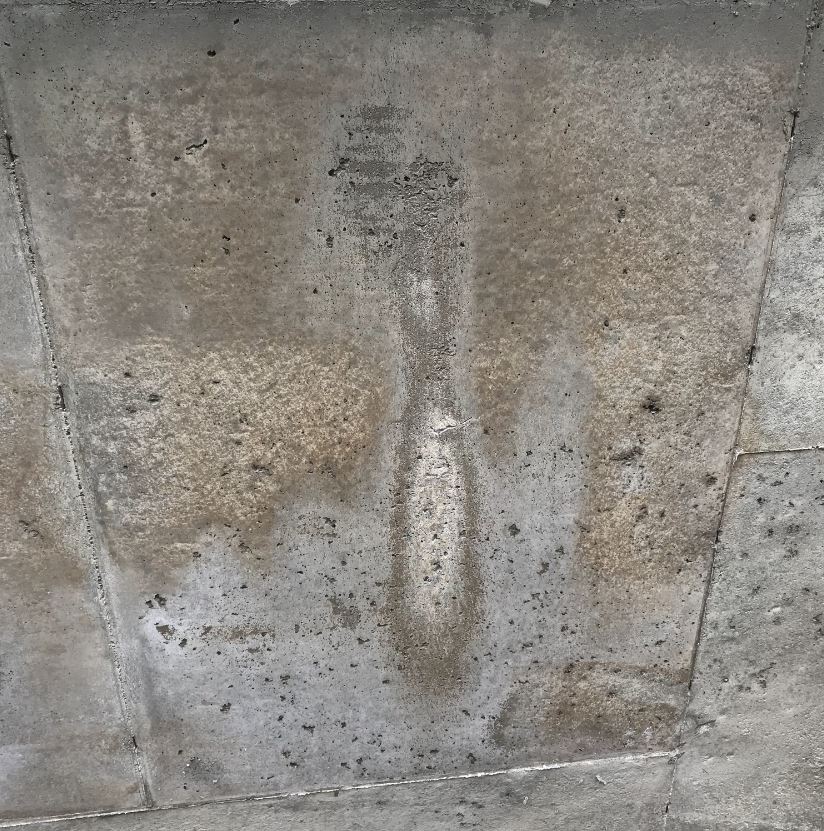
The use of a hammer and chisel to remove buildup is simply not a good choice, as it can damage the forms and leave visible deformations in the resulting concrete.
Grinding can yield a similar result, as it damages the forms and leaves grinder marks that become visible in the resulting concrete.
Rotary brushes can be effective if the correct bristle composition is used, but this method is typically slow and not effective on anything other than very light buildup.
Physically removing the concrete buildup from form surfaces with water or abrasive blast media is the most common method for metal forms (aluminum and steel); and although it is the most expensive method, it is usually 100 percent effective. However, some types of blast media can pit or etch the forms, which can enhance the adhesion of any future buildup that might occur. In addition to the high cost, this process requires the re-seasoning of aluminum forms, not to mention the loss of productivity while the forms are out of service.
Using any of these removal processes on plywood forms could potentially damage or remove the thin overlays on the form surfaces. Although concrete cannot chemically bond to overlaid plywood forms like it can on aluminum forms, it still has the capability to physically bond to the overlays. While the physical bonds are not as strong as chemical bonds, extra care needs to be exercised in the removal of buildup, due to the delicacy of the overlay laminate surfaces.
There are a myriad of processes for chemical removal, some of which are quite effective, while others are essentially ineffective on buildup – especially when the buildup is saturated with form oil or form oil reaction products.
Form oil and form oil reaction products interfere with the chemical cleaner’s ability to dissolve the buildup and, consequently, they must be removed with some type of a detergent prior to applying the chemical cleaner. Some proprietary products have a built-in detergent to eliminate the need for pre-cleaning.
This form oil needs to be removed with a detergent prior to acid cleaning, unless the acid-cleaning product contains a detergent.
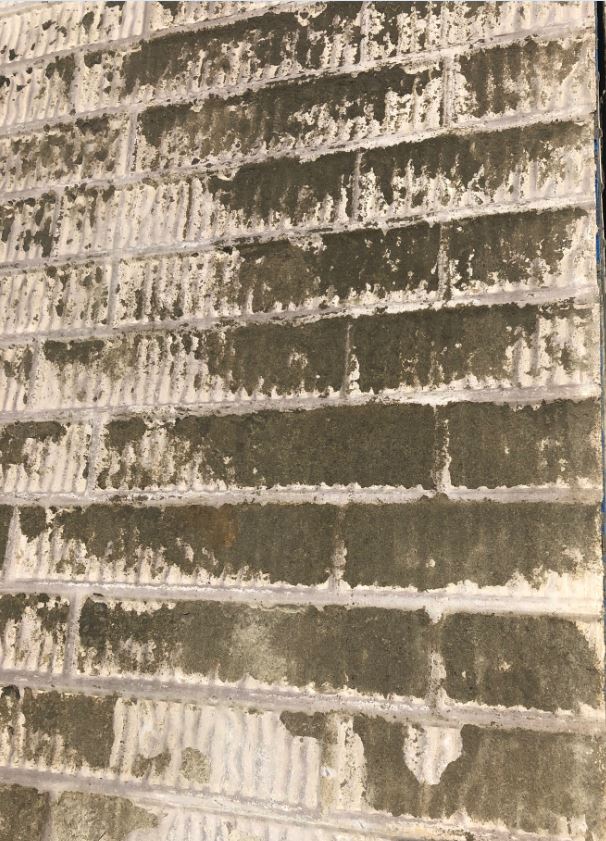
Nearly all chemical removal processes utilize some type of acid to break down the buildup. Harsh mineral acids, such as hydrochloric acid (also known as muriatic acid in a diluted state), are very effective at removing the buildup, but will also remove the seasoning and are even capable of dissolving the aluminum. Because mineral acids are potentially harmful to the aluminum, extreme caution should be exercised to avoid permanent form damage.
Other, more proprietary products utilize organic acids that are still quite effective at removing buildup, but will not remove the seasoning or damage the aluminum. The downside of all acids, mineral and organic, is that their performance is largely driven
by form and air temperatures. None of these chemicals can be used at temperatures below freezing, and their performance is greatly reduced at temperatures between freezing and 50° F (10° C). For maximum performance, these products should be used in warm weather without direct sunlight exposure, which can dry out applied films before they have a chance to dissolve the concrete. Generally, all of these chemical cleaners require some degree of scrubbing and pressure washing for full effectiveness. These products are typically not cost- or performance-effective on buildup that is thicker than 0.125 inches (3.18 mm).
Lastly, there are a few chemical products available that not only function as release agents, but also as buildup removers. These products are highly reactive form-release agents that can soften and ultimately eliminate hardened buildup through repeated use, as long as you have addressed what is causing the buildup. It is best to apply this type of product to the buildup as quickly after the forms are removed as possible. This will give the product the most amount of time to soften old buildup and will prevent any new buildup from continuing to harden. Correct use of a form release agent will help eliminate buildup over multiple pours; however, it is possible to get new buildup faster than you remove the existing buildup, or to continue to develop buildup on other areas of the forms, if you do not properly address what is causing it.
As discussed in an earlier article in this series, most contractors are applying the release agent to the forms from the top of the forms – after the forms are set. This will reduce the effectiveness of the form release agent/build-up remover, and your results will be limited until your process is corrected. All clean form surface areas need light applications, and areas with buildup require heavier applications that effectively saturate the buildup. Low viscosity form release agents are most effective because they can penetrate buildup much better than thicker, or higher-viscosity, products.
Form release agents will be the most effective way to deal with buildup on plywood forms, but again, if you are unsure what is causing the buildup, then there may be no added benefit to using a product of this type. Concrete sticking to the plywood overlays can ultimately lead to the overlays sticking to the concrete upon form removal, so it is crucial to correct the cause, remove the buildup, and proceed with a process that will maximize the life of your forms.
Due to their highly reactive nature, form release agents require careful application procedures and rates.
In the end, the degree of concrete buildup, the weather conditions, how much time you have to get the forms cleaned, and how much you can afford to spend for clean-up will govern your decision on how to proceed.
Letter From the Director

Spring Will Arrive!
“I am done with winter!” I’ve heard this statement throughout my community, noticed it in most conversations with members and others that use us for our information resources, and seen it plastered across news and social media. Yet, I’m reminded that we have only had six weeks of it. While short, it has been intense, depending on where you are located.
What does post-2019 winter look like? It is filled with a plethora of opportunity. I don’t think there is anything I enjoy more than talking about opportunity – perhaps dreaming up more ways to create opportunity. In this issue of the magazine, we are presenting the entire industry with information on a new resource, Concrete Housing Insight. This is the project of a new CFA consulting member and a name many may recall, David Pfanmiller. With the returning interest, we are now able to pair passion and experience to that interest and help you find a way to truly deliver impactful and effective concrete housing. If you have been struggling to answer the question of how to do it or, even, if you can do it, Concrete Housing Insight is the partner you will want to reach out to.
I’m also passionate about your story. For members, you were recently introduced to our Contractor of the Month campaign and what is happening at Atkins Brothers Concrete Wall, Inc. in Beavercreek, Ohio (who were our first Contractor of the Month). This issue of the magazine features the inspiring story from our Contractor of the Year 2018, Tim Upton of Upton Poured Walls. I am anxious for you to read it and compare it to your walk. You each have a story to tell, and this industry has been built upon story after story of contractors who have persevered, overcome, endured and conquered their giants.
As we begin to see winter turn toward the hope of spring, we also anticipate the success of some of our educational projects. Cranes 101 will be conducting our first Crane Operator Certification Course in Tiffin, Ohio at the headquarters of Irving Equipment (March 13-15), and Euclid Chemical will be hosting the next Rocky Geans Construction Business School (RGCBS-Cleveland, April 4-5). Between those two events lies ACI’s Fall Convention in Quebec City, where the CFA Board of Directors will be meeting and finalizing plans with me on the spectacular Concrete Foundations Convention 2019 in Denver, Colorado (July 25-27). There are, simply, more and more opportunities coming every day.
But still, for most of the contractors in this space, opportunities that are event-based are hard to accommodate. Whether it is time or travel dollars, there are tough decisions to make. That is why CFA continues to create opportunities within the scope of our resources. Our new North American affinity program with Business AdvantEdge offers any CFA member the chance to drive generous discounts in everyday purchasing and services. These savings provide a way for you to set your vision on CFA membership and to engage with our events, places and networks. This will, in turn introduce you to broad solutions and strategies that will help you continue to make your business the best it can be.
Opportunities – that’s what the CFA is about. Pick up the phone or get out your keyboard and make it happen!
MARK LENTZKOW BECOMES CONTENT AND BRAND MANAGER FOR THE CONCRETE FOUNDATIONS ASSOCIATION
Mount Vernon, Iowa— The Concrete Foundations Association (CFA), the voice and recognized authority for the cast-in-place concrete industry, is managed by the firm Sauter, Baty & Bloomquist, Inc. (SB2). Established by former Executive Director for the CFA, Ed Sauter along with partner James Baty, current Executive Director, SB2 has added Mark Lentzkow to their staff to serve association clients as content and brand manager. Mark’s addition comes during additional transitions with Sauter fully retiring at the end of 2018.
“Mark brings an exceptional eye for consistency and freshness across all our media,” said Baty. “The working relationship we’ve had with Mark as a consultant over the past few years has made an indelible imprint on the professionalism of our resources and we look forward to the continuation as he begins managing our entire production.”
Lentzkow graduated from the University of Northern Iowa after attending the University of Iowa and Minneapolis College of Art and Design.
Lentzkow joined the SB2 staff with CFA headquarters located in Mount Vernon, Iowa and will continue to reside in Peoria, Illinois. He can be reached at mlentzkow@cfaconcretepros.org where interested member companies for advertising in Concrete Facts can find out more information and communicate on opportunities, timing for issues and more.
“For the past two years I have been working for the CFA behind the scenes on a part-time/freelance basis,” said Lentzkow. “I use your stories, your ads and your photos to create an impression, an impression that will promote your business in the best, most positive and professional manner,” said Lentzkow. “I look forward to working directly with our members, getting to know their business, and promoting them through out the entire network.”
The CFA is a voluntary, nonprofit association that brings together concrete contractors and professionals nationwide to improve the quality of cast-in-place concrete walls and foundations. The CFA provides promotional materials, educational seminars and networking opportunities to its members and the industry. CFA also works on behalf of its members and the entire industry to develop support and influence code bodies. For more information about CFA, please visit www.cfaconcretepros.org or call (319) 895-6940.
Responding to an OSHA Inspection (Part 1)
By Mark A. Lies II & Elizabeth Leifel Ash
Editor’s note: This is the first part of a multiple-part series offering advice on interactions with an increasing level of OSHA inspection activity. Perhaps the number-one inquiry received right now at CFA headquarters is for advice on how to handle these inspections and, at times, the citations that result. Remember, no matter how prepared you believe your company to be or how infrequent this issue comes to you, with the rising number of critical safety issues found in the new regulations – such as fall protection, silica and now crane operator certification – it is only a matter of time before these conversations come to you. CFA is an advocate for the concrete contractor in all of these situations.
INTRODUCTION
Fortunately, most employers will likely never be involved in an OSHA inspection. For those employers who do become involved, however, the initial response can range from mere annoyance to sheer panic. Unfortunately, if the employer does not respond appropriately from the outset, there is a potential for waiving important legal rights, civil citations, and, if there has been a fatality, potential criminal liability. This article (Part One) will identify a general strategy that can be utilized at the outset of the inspection. Subsequent articles will discuss recommendations to implement once the inspection has commenced.

OUTSET OF INSPECTION
When OSHA seeks to conduct an inspection, it must have legal probable cause to do so. Thus, when the inspector arrives and announces his or her intent to conduct an investigation, the employer representative should be prepared to ask the inspector for his credentials and then inquire as to the basis for the inspection, before agreeing to allow the inspection to proceed. Typically, the inspector will inform the employer representative that he is there because:
- There has been a written employee complaint filed alleging a hazard.
- There has been an accident (since the employer must notify OSHA of an accident within eight hours of an employee fatality, or of three or more employees getting injured in one incident and requiring medical treatment).
- The agency has selected the employer for an inspection based upon a program developed by the agency to address or target a specific workplace hazard (e.g. lead, asbestos, forklifts).
The compliance officer is required to inform the employer as to the basis for the inspection. In the event that it involves an employee complaint, the employee representative should ask for, and is entitled to receive, a copy of the written complaint (without the name of the complaining employee). Likewise, the employer representative should ask for information on the specific programmed inspection that the inspector is relying upon. Once this information is provided, again, before deciding whether to allow the inspection, it is critical for the on-site employer representative to immediately contact senior management, as well as legal counsel, particularly if there has been an accident involving personal injury or significant property damage. The senior management can then discuss whether or not to allow the inspection, who the employer will select for its inspection, who the employer will select for its walk-around team, and what the scope of the inspection will be at the site. The employer representative should inform the inspector that this contact is occurring and that the employer will respond in a timely fashion as to whether it will voluntarily (without a search warrant) allow the inspection. The inspector is required to wait a “reasonable time period” before commencing the inspection, to allow these communications, where senior management and the employer can designate walk-around representatives.
EVALUATING PROBABLE CAUSE
The employer’s senior management, now confronted with the potential inspection and the basis for it (i.e. employee complaint, accident, programmed inspection), must decide whether to allow the inspection, and they must decide this in a timely manner. In deciding, management should consider the following matters:
Employee Complaint
- Is the complaint valid?
- Does it identify the correct workplace, employer or equipment?
- Does it identify a hazard that does, in fact, exist at the worksite?
Accident
- Did an accident involving the employer, in fact, occur?
- Is the accident scene still in existence, or have the conditions changed? (Note: If the accident involved a fatality, the scene is considered immediately “frozen” and cannot be changed until OSHA commences its inspection and “releases” the site. The only exceptions are to allow the employer to shut down equipment that may be hazardous to employees; to respond to a hazardous materials incident, such as a spill or release; or to remove human bodily remains resulting from the accident.)
Programmed Inspection
- Does the employer fall within the criteria for the programmed inspection (i.e. does the hazard exist at the workplace)?
- Does the employer have another basis to challenge its selection under the program criteria (e.g. its accident, injury or illness statistical data fall below the criteria for authorizing the agency to conduct a programmed inspection and thus the employer should be exempted from the inspection)?
The process of evaluating the foregoing inspection bases should include the employer’s safety and health professionals; senior operations personnel; and, particularly when there has been a fatality, serious personal injury or significant property damage, legal counsel.
SCOPE OF INSPECTION
Assuming that the employer has decided to allow an inspection on a voluntary basis (the employer also has the option to demand a search warrant from the agency, which is a technical legal decision that must involve legal counsel), the next issue will involve the scope of the inspection – that is, where will the inspector be permitted to go at the worksite and what operations will the inspector be allowed to view. This determination is also critical. If the employer allows the inspector broader access than would be allowed to evaluate the “hazards” identified in the employee complaint, the “accident” site area, or hazards that are outside the scope of the hazard referenced in programmed inspection, then the employer is subject to citations for anything that the inspector observes. This is because the employer voluntarily allowed a broader inspection to occur. Whatever the inspector observes during the walk around that is in plain view is subject to citation.
Of necessity, this employer determination is on a case-by-case basis, considering the differing worksite operations and the bases for the agency’s inspection. Once this determination has been made by management, which should occur expeditiously, it will be necessary to communicate this determination to the inspector. This way, the employer and inspector can reach an informal agreement, if possible, regarding the scope of the inspection.
CONCLUSION
The on-site employer representative must immediately initiate the employer’s assessment of the bases for the proposed inspection. This initial work must involve appropriate senior management and legal counsel in the proper circumstances. Unless the employer has preplanned for this contingency with the onsite representative initially interfacing with the inspector as indicated above, the employer’s ability to control the inspection will be lost through confusion and indecision.
About the author:
Mark A. Lies, II is a labor and employment law attorney and partner with Seyfarth Shaw LLP, located at 233 S. Wacker Drive, Suite 8000, Chicago, Illinois 60603. He can be reached by phone at 312-460-5877 or by email at mlies@seyfarth.com. He specializes in occupational safety and health law, related employment law, and personal injury litigation.

Casting Residential Foundation Walls in Cold Weather
By James R Baty II, F.ACI, Executive Director
During a recent CFA event, conversation took place regarding the research significance undertaken by the Association at the start of this new millennium – research that was, in most respects, the first of its kind. What plagued the industry at that time was scrutiny that concrete placed during conditions deemed as “cold weather” was in conflict with the then-current codes. As a current reader of Concrete Facts, it is probable that such research is new to you, considering this magazine has only been a free-subscription resource to the marketplace for about five years. And yet, this research is repeatedly lifted to our attention as having an instrumental role in regional progress for the acceptance of quality control measures for cold weather concrete. Therefore, we are revisiting this topic here, at the onset of the cold-weather season (though many have already been at it for a month), complete with updated references.

In 2004, a research task force developed by the Concrete Foundation Association (CFA) completed a three-year effort to better understand the performance of residential concrete foundation walls cast during extreme cold-weather conditions. This research began with moderate cold-weather impacts investigated in laboratory conditions and finished with actual extreme cold-weather job site conditions. The purpose of this research was to provide the industry with rationale practices to maintain concrete quality with budget sensitivity.
Before this research, concrete technology and, more importantly, cold-weather guidance and standards (as they related to cold weather) were largely founded on the premise that concrete freezes early on in temperature decline and ceases to gain strength once frozen. At that time, it was felt that nearly every contractor negatively impacted residential concrete by adding water. The purpose of adding water during cold weather was assumed to be solely to make it easier for contractors to work, or perhaps to improve the concrete flow throughout the formwork, weakening the concrete enough to be of structural concern. Some documented cases resulted in surface deficiencies and long-term durability impact to the aesthetics of the concrete surface. Residential concrete foundation walls, however, have always demonstrated higher-than-expected strength. While misuse of water was the primary concerning focus for cold-weather concreting, many other misconceptions and influences contributed to the larger diagnosis that there are definitely times that are “too cold to pour.” This began to come to a head as key industry guides and standards, such as ACI 306, evolved to be far too restrictive. This regulatory tightening happened despite significant empirical evidence and experienced construction practice that supported far less restrictive measures. As a result, prior to the completion of this research (and perhaps even still today), building officials and inspectors routinely shut down foundation projects, or practically shut them down by requiring heroic measures to cure in-place concrete. The judgments made by such officials are based on a narrow interpretation of theory versus practice and a lack of available information as to what is really important.
The research premise put forth by the CFA recognized the great number of variables that affect the performance of concrete in cold temperatures. These variables include mass-to-surface-area ratio, protection from evaporation, limited exposure to wind effects (below grade), forming system and admixtures. This more complex picture gives evidence that regulations governing concrete pours in cold weather should be performance-based with the ability to predict, respond and monitor the achievable concrete quality as more than a function of the weather forecast.
Even today, in some regions, residential foundation contractors find either local codes or mindsets so restrictive during winter months that the residential market’s economy is significantly jeopardized. Restrictive requirements included tenting and heating, full blanketing, curing protection until achieving full design strength, and prohibiting or altering placements in temperatures as high as 50 F. While there are preparation and equipment limitations in some markets for the production and delivery of higher-target concrete temperatures, cold-weather concrete is a broad topic that needs to be more fully understood and embraced.
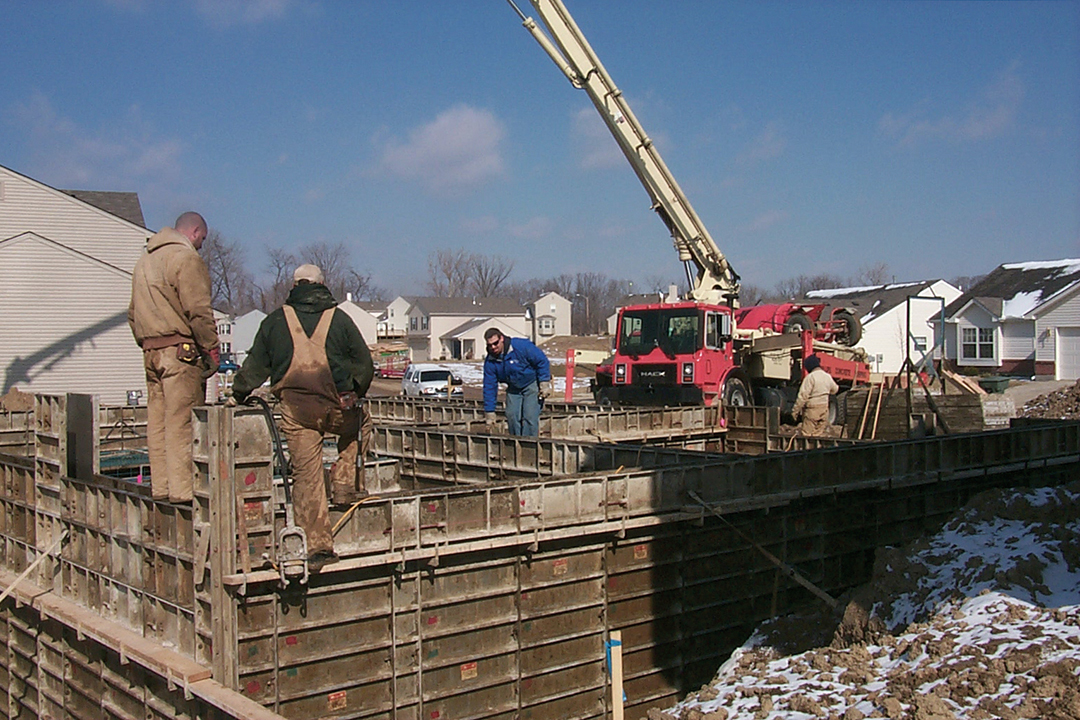
An encouraging fact to know as a contractor in the industry is that reliable research has changed many mindsets and code requirements. Not only do contractors continue to report much greater ease of cold-weather foundation efforts, but they also report greater concrete durability and many self-imposed practices that are improving both the concrete work and the concrete quality. While the information the rest of this article presents is largely from the completion of the 2004 research, it remains important for each contractor active in the residential industry to be mindful of entering a new season of cold weather and knowing where to go for support and third-party assurance.
The Research Project
The interests of residential contractors and the economy of residential concrete during the winter months motivated the CFA to initiate a substantial research project designed to:
- Identify the actual performance of concrete at low temperatures.
- Provide information that would help differentiate between excessive measures and concerns outlined in building codes.
- Recommend intelligent or common-sense practices to be followed.
The goal of the research program was to provide “real world” data about mixes that contractors regularly use, the performance of those mixes at a variety of target temperatures, and what economical modifications should be made to achieve improved performances and results. Due to the realization that variability in concrete exists throughout the U.S. market, the research results were intended to allow contractors to adapt mix designs for regional differences. The complex research came in multiple phases that systematically addressed misconceptions and then showed the viability of the contractor and ready-mix producer working more closely together while contributing sound evidence to prove performance.
The Research Stages
Phase 1 – Following regional surveys, the research committee selected 36 representative mix designs to be tested under laboratory conditions. Concrete mixes were tested in a laboratory provided by Master Builders (now BASF) at 30 F and 50 F ambient conditions. These temperatures were implemented to more closely represent target temperatures being reported by the market as weather predictions when inspectors would begin targeting job sites for delays.
Phase 2 – Full-scale field research studies were then initiated under sub-freezing conditions using a selected sub-set of the original 36 mixes that represented the broadest economic array. All mixes were designed with 6 percent air-entrainment and a slump of 6-inches. All mix components were stored at 60 degrees Fahrenheit prior to batching. By the end of the project, more than 20 cubic yards of concrete had been batched and tested in more than 850 cylinders and 12 wall samples.
Phase 3 – Finally, further results for field data were gathered from 180 core samples taken at varying intervals from the wall samples. These cores were subjected to both compression and petrographic tests to determine the impact of the extreme weather conditions on strength and durability.
Throughout the program, the research implemented maturity testing, which is the science of predicting concrete’s strength gain over time given the mixture’s components and the placement’s temperature profile. The research matrix (fig. 1) produced from Phase 1 shows 44 maturity curves derived from the 36 mix designs subjected to 30 F and 50 F temperatures. Throughout the research, probes monitored representative cylinders and all wall samples, tracking both internal concrete and ambient temperatures.
Phase I – Testing in the Laboratory
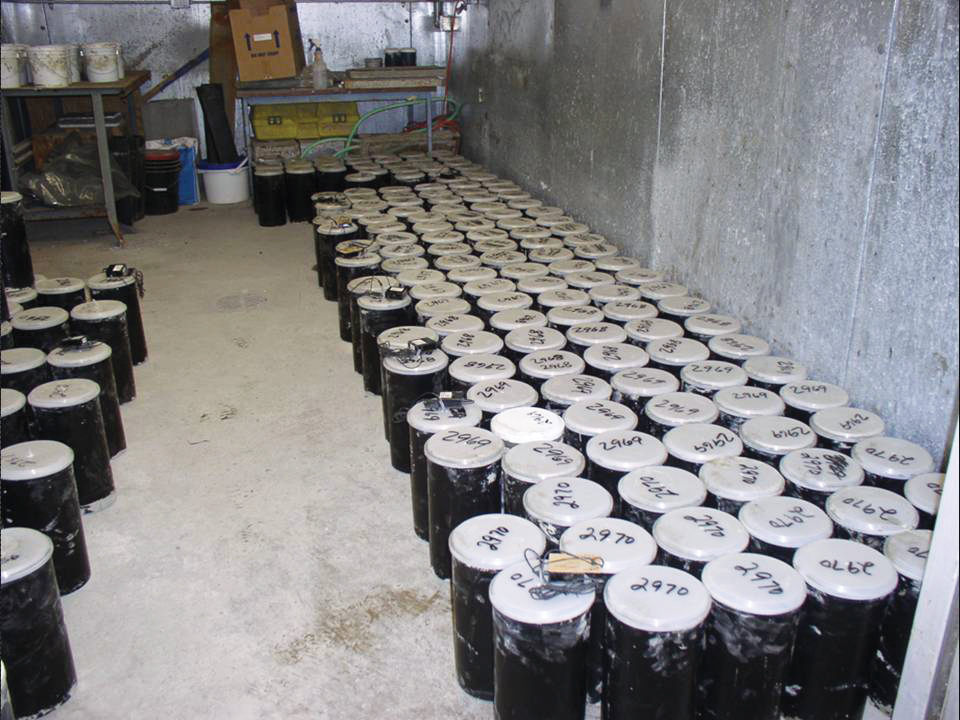
To develop a thorough understanding of the strength gain for the various mixtures, 6-by-12-inch cylinders were cast and placed into a refrigerated (50 F) or frozen (30 F) chamber. Cylinders cured at these temperatures were then tested for compressive strength at 1, 2, 3, 7, 14 and 28 days and compared to their maturity curves. This phase consisted of 660 cylinders (fig. 2). The cement for the mixes consisted of either Type I or Type III, with content as low as 5-sack (470 pounds) and as high as 6.5-sack (611 pounds). Because admixtures can contribute to strength gain, especially at lower temperatures, the addition of 1 percent and 2 percent calcium chloride, mid-range water reducers (MRWR), and a non-chloride accelerator (NCR) were also tested.
Phase II – Testing in the Field
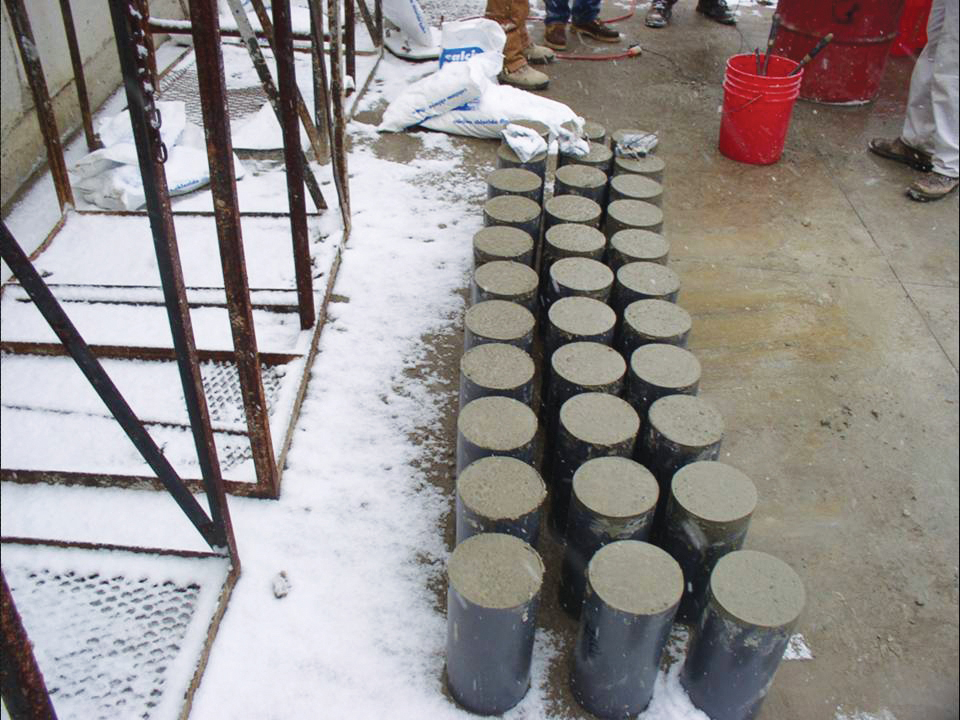
Phase II brought about field research following closely upon the completion of the Phase I Laboratory research. In this phase, actual eight-inch walls were formed eight feet high in modified job site conditions. The walls were only six-foot-wide segments, and instead of being placed in an excavation, they were formed in a simulated excavation environment in Medina, Ohio, in the yard of Osborne-Medina Ready Mix. The concrete mixes selected from Phase I (fig. 3) represented the most favorable combination of performance and economy.
Figure 3 – Field Research: Phase I Mixes Selected for Phase II
| Mix | Cement Qty. | Cement Type | Admixture |
| 3 | 5-sack | I | 2% Calcium* |
| 8 | 5.5-sack | I | 2% Calcium* |
| 13 | 6-sack | I | 2% Calcium* |
| 24 | 5-sack | III | 1% Calcium* |
| 29 | 5.5-sack | III | 1% Calcium* |
| 34 | 6-sack | III | 1% Calcium* |
*ACI 332-14 permits the use of up to two percent calcium chloride by cementitious weight (one percent by water-soluble chloride ion), provided steel reinforcement is not required for structural performance. Steel reinforcement intended for temperature and shrinkage crack control, such as horizontal or re-entrant corner steel, is not considered structural by definition.
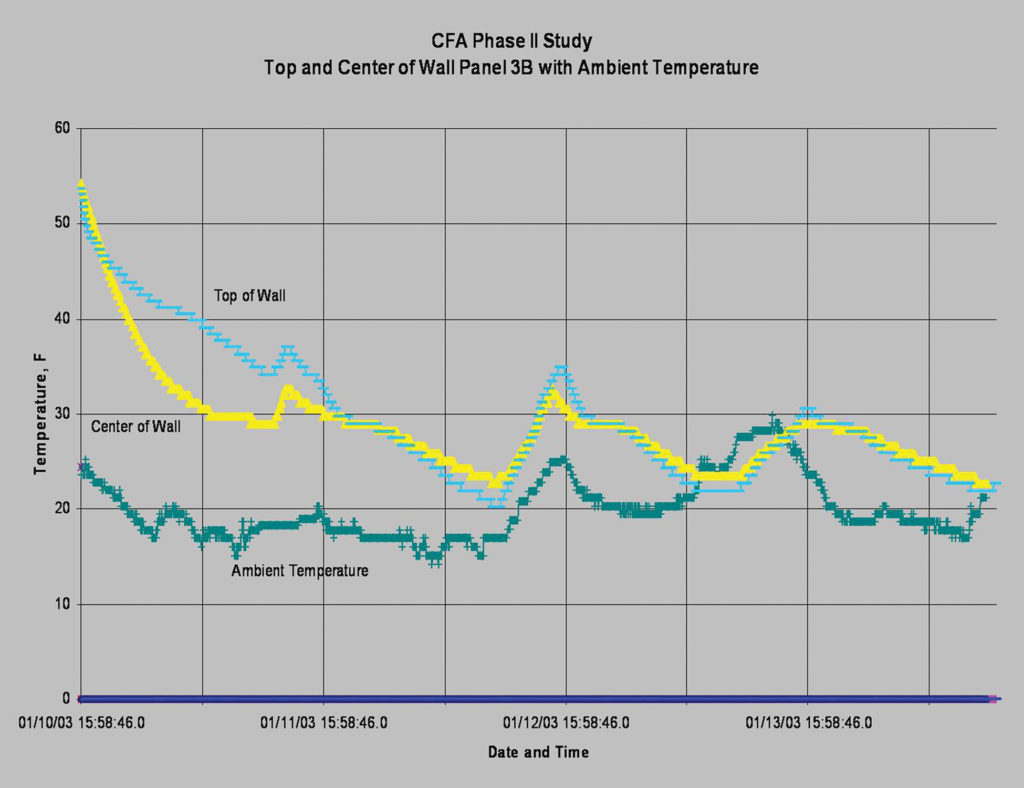
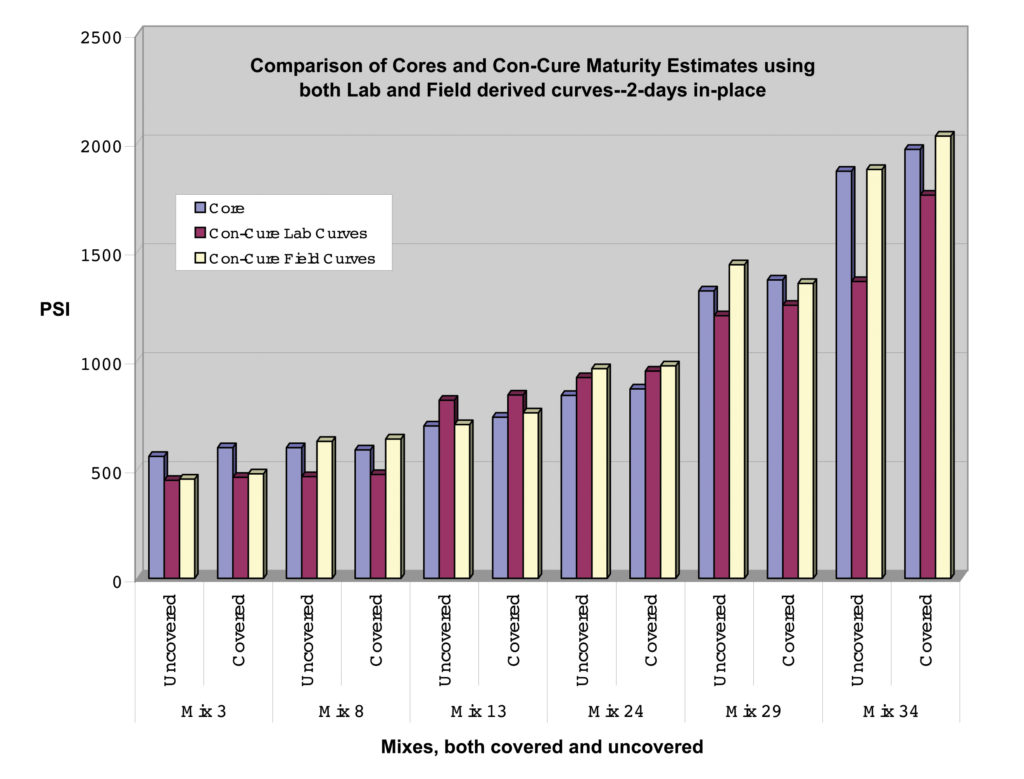
Each mix was tested in an uncovered wall segment as well as in a segment covered with a six-foot blanket capping the top (fig. 4). Wall forms were removed from all segments after 24 hours, as were the blankets of the covered walls. Both internal and ambient temperatures were monitored for the walls, as was a full set of test cylinders from each mix. Once the wall forms were removed, cores were taken and tested along with cylinders at 1, 2, 3, 7, 14 and 28 days. Conditions at placement were 26 F, with snowfall. The temperature remained below freezing for 21 days, with an average temperature in the low teens and a low temperature recording of -19 F. The opportunity to record the strength gain of the full-scale walls at such favorable research temperatures was an added bonus.
Phase III – Petrographic Testing
The final phase of the research project was petrographic examination of the cores taken from the field segments. Each mix type and location (covered versus uncovered for the first 24 hours) was subjected to petrography to determine the impact any freezing condition may have on the concrete. While there was definitive evidence that the range of mixes were affected by an initial set freezing, the typical freeze/thaw cycle that the samples were subjected to failed to produce continued deterioration. The behavior of all samples was such that the lab technician could not determine whether the samples were indicative of winter behavior or summer behavior.
Results from the Testing
The data resulting from the three-phase project reinforces the more generally applied ability to predict strength gains in concrete exposed to cold weather conditions. Additionally, the data supports the idea that concrete’s foundation-wall environment is naturally protected from the detrimental impact of freezing. Most importantly, the research evidenced that maturity resumes for concrete when internal temperatures rise above freezing.
There are many more results and recommendations established by this research effort. The research continues to inform practical, effective and intelligent decisions for professional foundation contractors throughout North America. It has made a significant impact in the industry, now referenced by ACI 332 (and, by reference, the IRC) and by the ACI 306 Guide to Cold Weather Concrete. Since its publication, ACI 306 is now in its third revision and no longer presents cold weather as requiring protection below 40 F. The guide presents a conversation about protection and a decision-making process that encompasses many of the research results validated through this project.
CFA now offers two important resources relative to this research. The first is a 72-page research report with complete details on the mix designs, each phase test parameters and the recorded performance from each component. It is available from the CFA through online resources or by contacting our headquarters. This research report has also become part of the technical resources that form the basis of the ACI/CFA Residential Foundation Technician Certification. A condensed technical reference sheet is also available as a great communication tool for the principal findings is publicly available from the CFA website under Resources and can influence the conversation as well as confirm some of the more frequent practices influenced by the research.
Determine What Is Next
Should you be interested in a more interactive discussion of these research findings, CFA members have access to a free online webinar held periodically throughout the year. Additionally, you can listen to a podcast that will soon be added to “Behind the Mic” – an audio-format discussion of great topics. Contact us for the details on the schedule, or visit our website for more information on registering for one of these.
What Causes Concrete Build-up on Forms
Part 3 of a 4-Part Series By Destry Kenning, Forming Market Segment Manager, Nox-Crete Products Group
Just about all concrete-forming contractors will tell you that one of the challenges they face on job sites is keeping their forms clean, or, more specifically, preventing concrete buildup on the working faces of their forms.
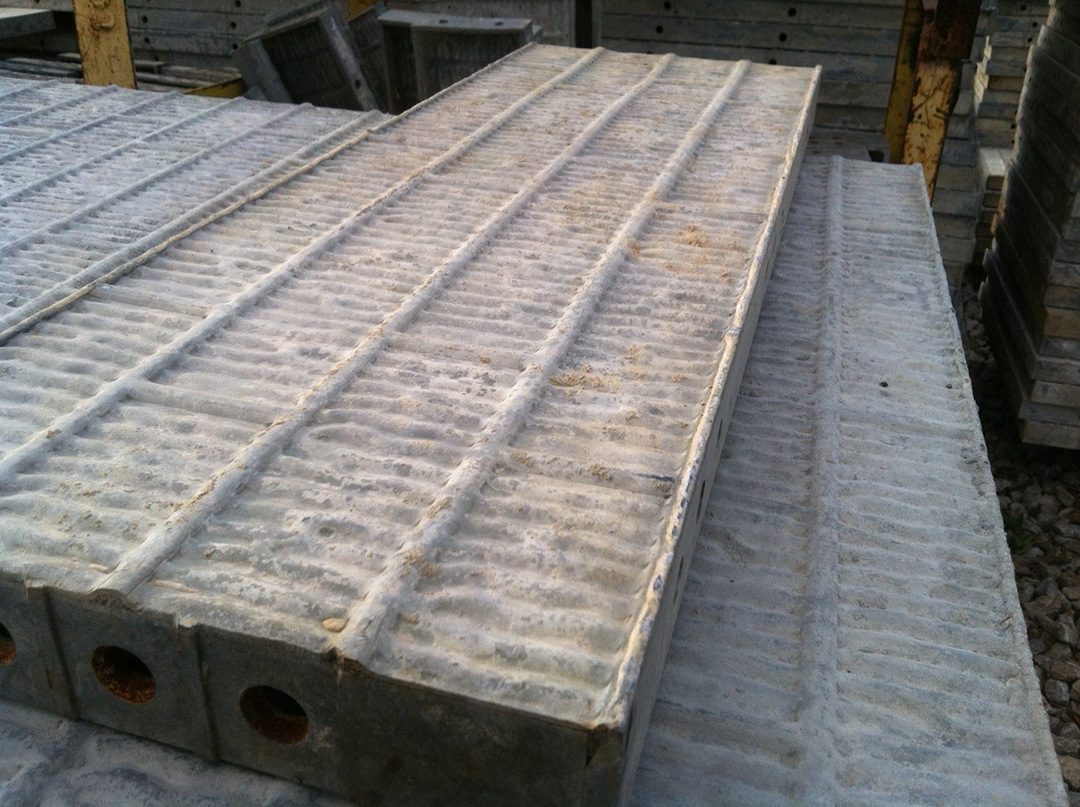
Theoretically, if you cover the forms with a good coat of a quality form release agent prior to placing concrete against them, you should never have to worry about concrete buildup, right?
Any experienced wall-forming contractor will tell you that projects never seem to work out that way. While contractors hate having the concrete buildup on their forms, they have, in many cases, simply learned to live with it.
Thankfully, the process of inevitable buildup does not need to be this way.
In this article, the focus will be on why concrete buildup occurs. In a subsequent and final article in this series, the focus will be on how to eliminate the buildup when it does occur.
The primary causes of concrete buildup include:
- Unseasoned or improperly seasoned aluminum forms
- Poor-quality form release agent
- Insufficient amount of form release agent or no form release agent at all
- Applying form release agent after forms are set, rather than before they are set
- Form surface abrasion during concrete placement
- Use of a calcium chloride accelerator in concrete cast against aluminum forms
- Early form removal
Editor’s note: Further details on each of these will be addressed in the final part of this article series in March.
SEASONING – As mentioned in the first article in this series, Dealing with the Reactivity of Aluminum Forms and Concrete, aluminum form surfaces must be properly seasoned when new, or re-seasoned following aggressively cleaning them or removing buildup.
Aluminum is very reactive with the cementitious material content. If the aluminum is not properly seasoned, severe buildup will occur from placing concrete against it, irrespective of the presence of a good quality form release agent.
This type of buildup is by far the most common on aluminum forms. This buildup also happens to be the most difficult to remove because it is usually chemically bonded to the form surfaces rather than just being physically bonded. Because the chemically bonded concrete buildup is several times more difficult to break loose than the physically bonded buildup, it is the most important type to prevent.
Once the forms have been properly seasoned, preserving the seasoning layer should be the highest priority in the battle against concrete buildup.
As emphasized in the first article, the seasoning layer is somewhat delicate, especially on newly seasoned forms. The list of the most common things that can alter the seasoning layer’s integrity include aggressive abrasion during concrete placement and high-dose rates of calcium chloride used as an accelerator in the concrete. These will be addressed in greater detail later in this article.
FORM RELEASE AGENT QUALITY – Wall-forming contractors have to endure more than their fair share of misleading presentations from form release agent manufacturers and distributors alike. Everyone seems to promise better performance or lower pricing, or both; yet it seems like no matter which product is chosen, the buildup prevails. That said, most wall form manufacturers agree that reactive release agents do the best job of keeping concrete buildup off their forms.
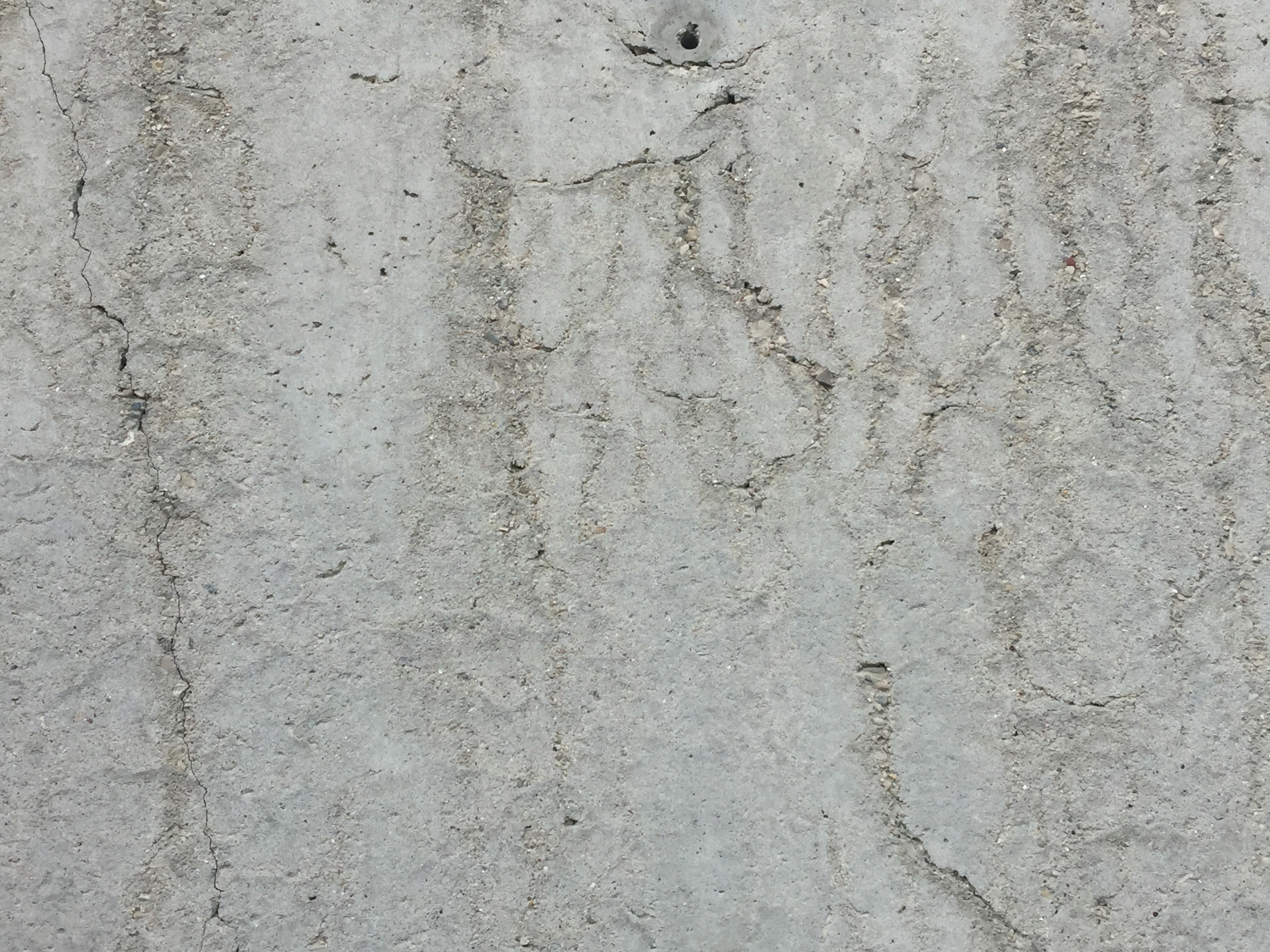
The ideal reactive release agent for your specific application is one that keeps buildup at bay and works with both your method of application (assuming it is satisfactory) and the concrete mix designs that you use. If you have dusty or greasy buildup on your forms, then the product you are using is too reactive, or you are applying the product too heavily. On the other hand, if the release agent you are using is leaving you with hard concrete buildup on your forms, then it is not reactive enough, or you are not applying it heavily enough. There is still the chance, however, that something else in your process is causing the problem.
LACK OF FORM RELEASE AGENT – If you asked one hundred wall-forming contractors the question, “Do you need to use a form release agent on your wall forms prior to each pour?” almost all would respond, “Yes,” without hesitation. However, in the rush leading up to each concrete pour, the form release agent does not always get applied on all forms or on all areas of each form. If this happens on overlaid plywood forms, especially on older ones, either overlay damage or concrete buildup will likely occur. If this happens on aluminum forms, new concrete buildup is all but guaranteed.
If there is hardened concrete buildup already on the forms, then the release agent application needs to be heavy enough to saturate the buildup. This way, the product near the surface can react with the new concrete poured against it. If the release agent does not react with the freshly poured concrete, sticking might occur, which would lead to a greater accumulation of buildup on the form surfaces.
APPLICATION OF FORM RELEASE AGENT BEFORE OR AFTER SETTING FORMS – Anyone who has applied a form release agent on wall forms knows that it is not generally a very pleasant experience. In many cases, the form release agent has a nasty smell and the wall crew responsible for erecting the forms wants to avoid getting any of it on them. The aversion to contact with the form release is not only due to the smell, but also due to skin rashes and other health risks associated with some products. And who could blame them for thinking that way?
Most wall-forming crews will tell you that the best way to reduce exposure to the form release agent is to spray-apply the product after the wall forms have been erected. All things considered, is this the best application method to use? More importantly, if the form release agent smells that bad and is also that unhealthy to be around, is that particular product the best form release agent to use? Seriously, if the form release agent you are using limits your application options, then it may be time to reconsider your form release agent options.
There is no denying that the best results are consistently obtained when the form release agent is applied before the forms are set. This method enables the applicator to apply the release agent more consistently and lightly across the entire form surface, which greatly reduces form-release-agent consumption, yields better looking walls, and, most importantly, minimizes the potential for concrete buildup.
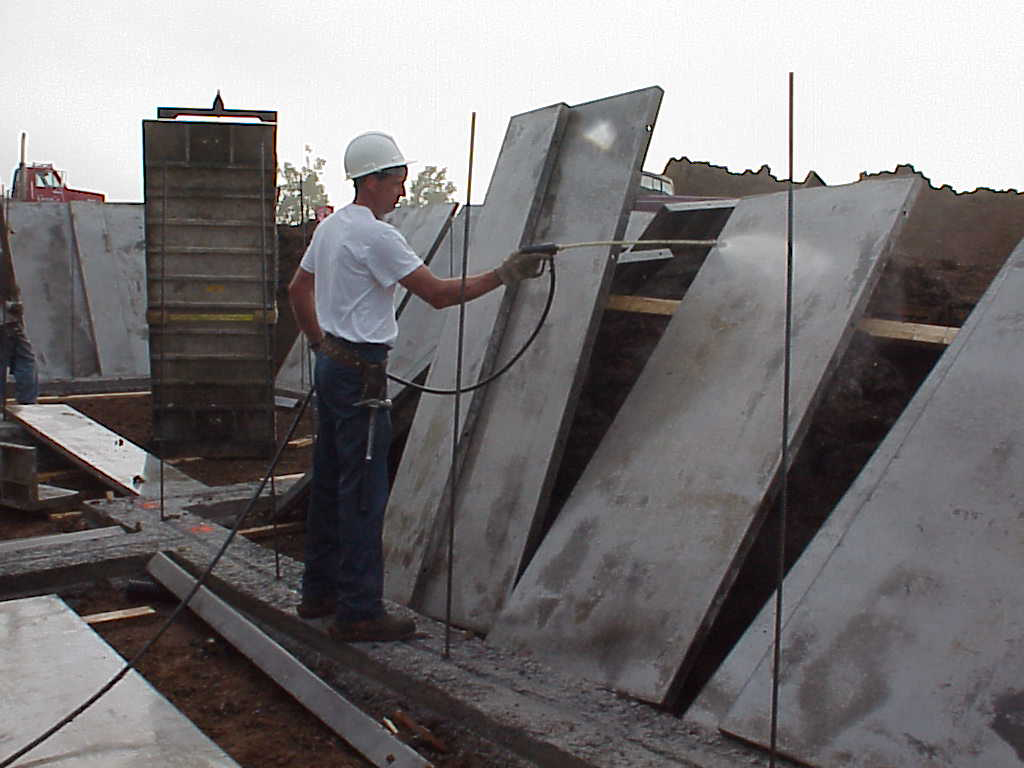
Modern form release agents contain lower VOC’s, which means more of what you apply will remain on the forms. Additionally, these lower VOC formulations have higher viscosities, which means they do not flow down the forms as much when spraying from the top after the forms are set. This is especially true during colder weather conditions. All too often, the bottom of the forms do not get fully coated when the form release agent is applied after the forms are set, and if the form release agent is missing when the concrete is placed, form-panel damage and/or buildup become the reality.
FORM SURFACE ABRASION – Form surface abrasion can occur during concrete placement or during consolidation, if internal vibrators are used. This abrasion sometimes removes the applied form release agent, damages the overlays on plywood forms, or removes the seasoning on aluminum forms. The end result is form-sticking and concrete buildup on the form surfaces. When tailgating the concrete into forms, one should use a deflection board, chute funnel or tremie hopper to direct the concrete away from the form surfaces and down the center of the wall-form cavities.
When using a pump to place the concrete, it is important to make sure the trunk on the boom is kept exactly vertical and the concrete flow is directed away from form faces. When brick ledge block-outs are used, or when the wall-form cavity is narrower than the pump trunk or chute funnel, a reducer should be used to prevent the concrete from abrading the form surfaces during placement. Alternatively, the concrete flow should be directed at the brick ledge block-outs and away from the form surfaces on the opposite side of the wall.
Concrete consolidation can be accomplished in several ways. Internal concrete vibrators present the biggest challenge because they can excite the aggregate found between the vibrator heads and the form surfaces. This interaction leads to release agent removal and form surface damage, as mentioned above. Choosing the right vibrator and using it correctly will help prevent these issues from occurring.
Ideally, the vibrator head size should be no greater than 25 percent of the wall thickness. When using the vibrator, the head should be inserted as close to the center of the wall as possible. The vibrator should be allowed to descend into the concrete under its own weight without any added force from the operator. As soon as the vibrator reaches the desired depth, it should be removed at the steady rate necessary to achieve required consolidation. This rate of removal will vary depending on the vibrator and concrete mix. Under no circumstances should the vibrator head be allowed to remain still while submerged in the concrete.
Proper storage of the vibrator is also critical. Never store the vibrator shaft in a coiled state. This can lead to curvature memory and loss of directional control of the vibrator head when submerged deeply into the wall.

CALCIUM CHLORIDE – The addition of calcium chloride accelerators should not be used, no matter the percentage, for the first six pours against newly seasoned aluminum forms. Even with fully seasoned aluminum forms, calcium chloride, particularly at percentages greater than 1.5 percent by weight of cementitious materials, can have a deleterious effect on the protective aluminum-oxide layer formed during the seasoning process. This effect can lead to form-sticking and aggressive buildup.
On the other hand, non-chloride containing accelerators can actually be beneficial for the break-in process of newly seasoned aluminum forms. They can be used at any recommended dose rate, regardless of when the seasoning was completed, because they are not reactive with the aluminum.
EARLY FORM REMOVAL – It is important to know the concrete’s approximate compressive strength at that specific time prior to stripping forms to minimize the potential for a thin film of concrete pulling off the wall and sticking to the form surfaces. Ideally, the concrete should have a minimum compressive strength of 500 psi before the forms are stripped, which is consistent with the American Concrete Institute (ACI) recommendations.
During colder weather conditions, this may mean stripping the forms 24 or more hours after the concrete is placed, which is clearly a longer time period than what is required during warmer conditions.
Temperature, cement content, cement type, chemical admixtures (such as retarders and accelerators), mineral admixtures, and elapsed time from when the concrete was batched will all be influential on the strength gain of the concrete.
Premature stripping during colder weather conditions frequently leads to concrete buildup on the form faces, which is, in many cases, incorrectly associated with poor release-agent performance or inadequate seasoning of aluminum forms.
To prevent this problem from occurring, work with your concrete supplier to develop some strength data for your concrete mix at various temperatures and at various times after the concrete was batched.