
CFA MEMBER OBITUARY: John Thomas “Jack” Easton
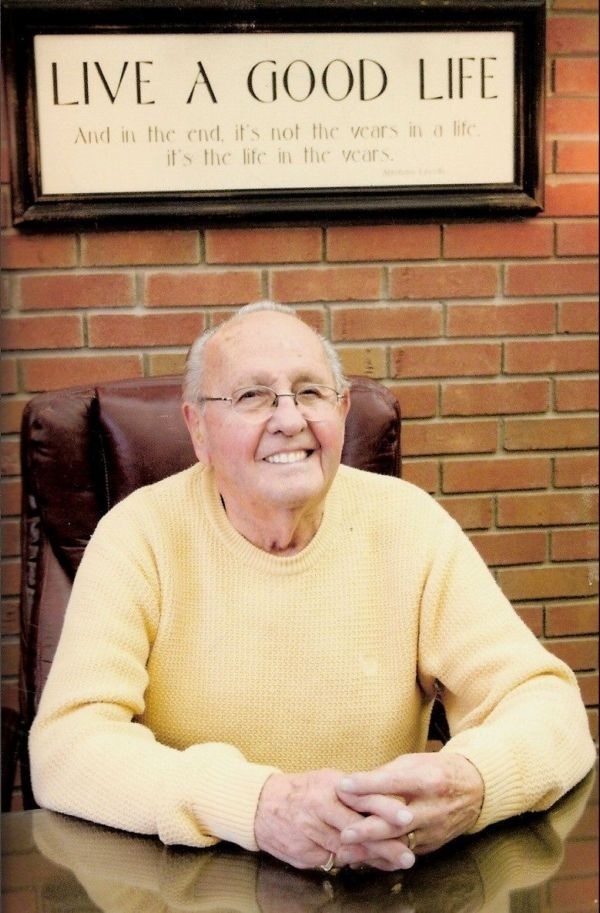 John Thomas “Jack” – Age 93, of Linden, died Tuesday, July 28, 2015. Funeral services will be held 11:00 AM Saturday, August 1, 2015 at Sharp Funeral Homes, Fenton Chapel, 1000 Silver Lake Road, Fenton. Chaplain Hank Messing officiating. Burial in Fairview Cemetery, Linden. Visitation will be held at the funeral home Thursday from 6-9 PM, Friday from 1-4 and 6-9 PM, and Saturday from 10:00 AM until the time of service. Those desiring may make contribution to the Wounded Warriors Project, Michigan Humane Society, Adopt-A-Pet, or Reverence Hospice.
Jack was born May 22, 1922 in Port Huron the son of George and Gertrude (Tebo) Easton. He was a veteran of WWII serving in the U.S. Navy. He married Audrey Behlow May 4, 1946 in Detroit and she preceded him in death February 29, 2000, he then married Georgine M. Felthaus February 10, 2001 in Livonia. He had resided in the Fenton area for the past 55 years. Jack had owned and operated Durand Equipment and Durand Forms with long time friend and business partner, Harry Harden and Jack’s latest business venture at the age of 80 was Easton Enterprises.
He is survived by his wife, Georgine; daughters, Patricia (James) Okerstrom and Vivian Price; grandchildren, Amanda, Justin, Cortney (Shawn), Brandon, and Yvonne; great grandchildren, Shelby, Joey, and Kelli (Dan); great-great granddaughter, Madelynn; brother, Marshall Price; and several nieces and nephews. He was also preceded in death by his daughter, Margine Price; son, Leroy Harden; grandson, Kevin Harden; great grandson, Adam Harden; and brothers, Louis Price and Marshall Tebo. Online tributes may be Jack Easton Obituary and Message Page.
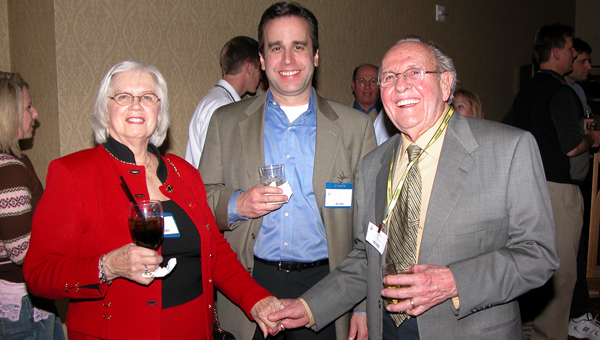
Jack and his wife, Georgine enjoying CFA friends during the Winter Meeting celebration at World of Concrete 2006.
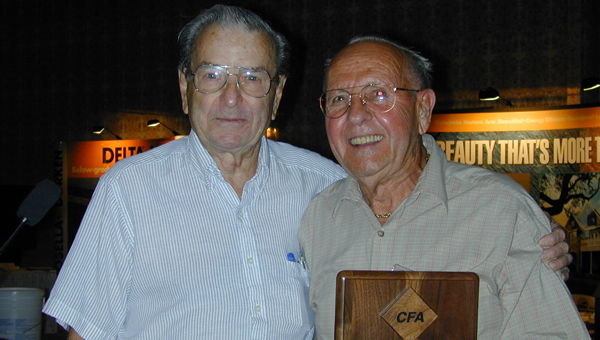
Jack Easton receiving the prestigious Robert D. Sawyer Lifetime Achievement Award during CFA Convention 2001 in Niagara Falls, ONT, Canada pictured here with Bob Sawyer
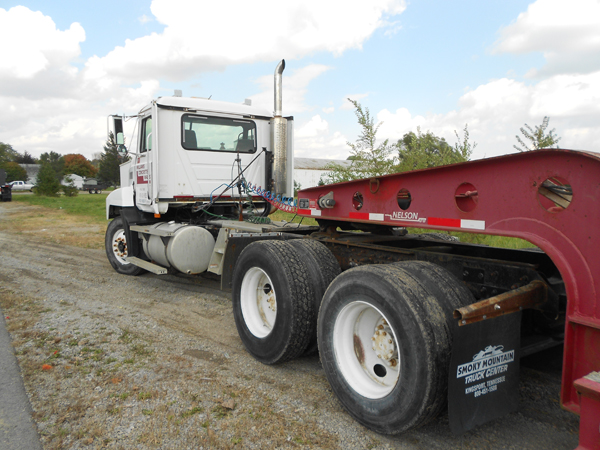
For Sale: 1999 Mack (low mileage) w/ 2004 Nelson Low-boy
This piece of equipment is being sold by a former CFA member going out of business.
For sale is a 1999 Mack CH 600 Day Cab E7 350 8Y2799 Diesel with low mileage (135,000).
Vehicle ID# IM2AA13Y8XW110337. Asking price is $22,500.
Being sold with or separate is a 2004 Nelson Low-Boy semi-trailer, model #ART-30F. It has an overall length of 43′, 8′-6″ overal width and a 21′-8″ deck length with a 32″x 7′ hydraulic folding ramp. The trailer was made in Ottawa, Ohio by Nelson Mfg. Asking price is $13,000. Trailer ID# 1N9B12V2541012866.
The trailer was used with the 1999 Mack Day Cab and they are being sold together or separately. For more information, contact Sue Williams at 419-721-4906.


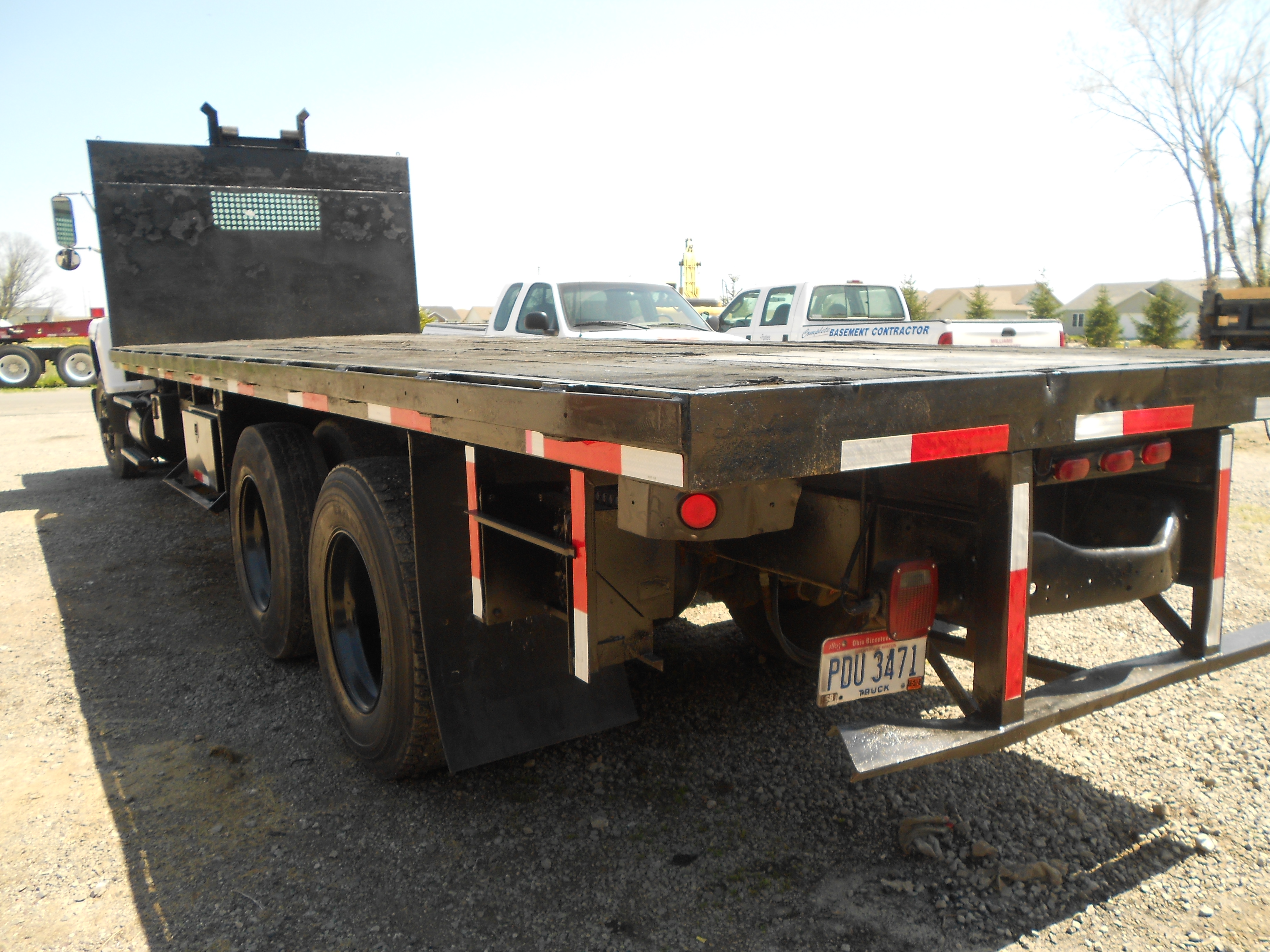
For Sale: 1995 Ford 24-ft Flat bed
This piece of equipment is being sold by a former CFA member going out of business.
This, 1995 Ford 24-ft flat bed is in good shape and features an L8000 Dual Screw Axle 8.3 Cummins Diesel. It has an 8-speed transmission and has 138,790 miles. The vehicle was used to move extra forms to the job site.
Asking price $18,000.
Contact Sue Williams at 419-721-4906 for more information. More photos can be seen below.



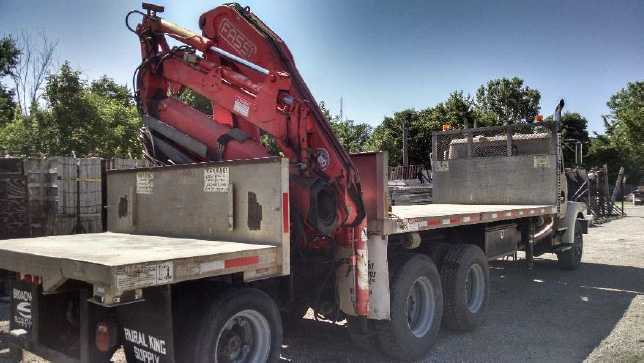
For Sale: 1994 WhiteGMC Truck Crane w/ 54-ft Fassi
This piece of equipment is being offered by a CFA member company.
This 1994 WhiteGMC truck crane has a Volvo PD123EB engine, a 9-speed Volvo transmissionVT1209 (R1700) and a 19-foot + 4-foot aluminum bed. Rear Axles: VBT4018 Rear Ends- CPEV87- 3.07 Gear Ratio.
The low mileage is very low although unable to ascertain correct count due to engine replacement. S/N G791 and VIN 4V2JCBLF9RR825774.
Remote Control Fassi Crane model # F230.23- (sticker says F240, but it was replaced at some point with the only sticker they could find). Crane has a 54-ft reach (1,900 lbs. at reach).
Contact Mike Jr. at (314) 973-2072 for more information and the asking price of $69,000. Download the attached flyer or see the images below.



Building Deep Foundations
Each year the Concrete Foundations Association (CFA) based in Mt. Vernon, Iowa holds a contest to honor the best and most difficult foundation projects of the year. Over the years, contractors occasionally submitted projects that were complicated beyond one’s ability to foresee all the problems and therefore become financial losers. So Jim Baty, the executive director of the CFA, says they changed the rules of the competition so that submissions will reflect cutting edge technology but will also be profitable. “The quality of a project should not be based solely on its economic success but rather the quality of design and craftsmanship that go into it. A project that loses money is likely to be one that doesn’t stack up to such qualities,” he adds.
As published in Concrete Contractor magazine, read the full content of this article from their website.
Employing the Next Generation – Convention Seminar
CFA Convention 2015
Williamsburg, VA July 23-25
“Bridging The Generational Gaps”
presented by Jason Ells of Custom Concrete
The next generation: who are they and how do we engage them? Baby Boomers, Generation X and Millennials; they all have their strengths, weaknesses and characteristics that set them apart. However, today’s business owners face very real frustrations and risks in looking to employ the next generation. Seemingly gone are the days of the laborer pleased to have a job and committed to honoring his/her work…or are they?
The next generation is proving to learn at an exponential rate. The have access to information, both truthful and contrived, that challenges every aspect of the task and environment. It appears that they see a current position as placeholder or a bus stop to the next opportunity. Over the course of this presentation, we will set these assumptions aside. The Millennial concept will be looked at and dissected as we share ways of engaging this generation, employing them and even learning from them.
REGISTER TODAY for the Largest Annual Gathering Dedicated to the cast-in-place concrete contractor.
TOTAL COST OF RISK: The Five Fundamentals of Insurance
HAVE YOU EVER CALCULATED THE UNEXPECTED HIDDEN SOFT COSTS THAT BECOME A PART OF YOUR TRUE INSURANCE EXPENSES?

By Christopher J. Mowery, ARM CRIS Client Service Supervisor
Arthur J. Gallagher & Co.
Everyone knows that premium, losses, and exposures contribute, but the true nitty-gritty of how a company could meaningfully impact their Total Cost of Risk lies in the hidden soft costs a contractor pays out annually in addition to pure insurance premiums. The greatest problem we see from the outside looking in is that many contractors are NOT tracking these costs and how much they impact the bottom-line!
Total Cost of Risk, TCOR for short, is a combination of:
- Hard costs or the actual costs associated with premium and losses within a deductible layer (if any)
- Soft costs or the actual costs associated with return to work programs, safety control, internal management costs, experience modification ratings, medical, replacement workers, etc. Most of the soft costs are under the radar and never mentioned to a contractor.
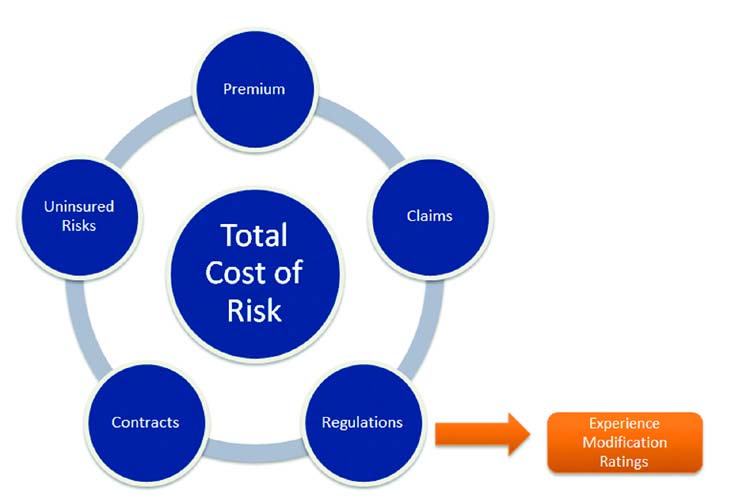
As much as 50% to 55% of a company’s total cost of risk is in the area of soft costs. These additional costs are in addition to the premium (hard costs) a company is already paying for insurance. We are working on a series of articles that are designed to make you aware of the types of hidden costs that exist as well as provide ideas on ways to eliminate or lessen these costs. A company’s total cost of risk is managed by Five Basic Fundamental Areas: Premiums, Claims, Regulations, Contracts and Uninsured Risks.
This article focuses on a subset of Regulations, specifically a company’s Experience Modification Rating (EMR). Companies are being squeezed on every project to run on very thin margins leaving zero room for mistakes and expenses which are unaccounted for. Any blip in your loss history or exposures can cause a swing with your EMR. Profits earned on jobs today could be diminished in years to come because of the soft costs associated with a company’s EMR from prior years. There is no doubt this impacts a company’s operations financially in a significant way.
Not only does an EMR indicate how safe a company is, it also contributes to the premium a company is paying for Workers’ Compensation coverage. How many jobs would it take your company to replace lost profits from a high EMR? Or how much more successful could your company be if you could bid work more competitively due to lower insurance overhead? Looking at the exhibit below and assuming a company has a 10% profit margin; it would take an extra $300,000 in jobs to pay for a 1.30 EMR. How many free jobs is your company doing a year to pay for your EMR?
Premium EMR Modified Premium
$100,000 X 0.70 = $70,000
$100,000 X 1.00 = $100,000
$100,000 X 1.30 = $130,000
SO WHAT IS NEW IN MANAGING AN EMR? THE ANSWER IS EMR MODELING AND AUDITS.
EMR modeling is a valuable tool for every contractor. Every company has their own individual EMR minimum. In today’s world of benchmarking and analytics we have the ability to evaluate each claim and tell the company how that one specific claim impacts their EMR. EMR modeling provides an analysis that is used to determine how frequency and severity impact the numbers and could also be used to calculate future EMR’s. This modeling can be a very effective tool with field staff when setting reduction goals to ensure they are reasonable and achievable.
Modeling provides us with an inside look at the calculation to see the major contributing factor driving a company’s EMR. We have noticed that frequency claims, the NCCI defines this as any claim less than $15,500 in total incurred (Paid + Reserves), can have a big impact on the numbers. Having a high frequency of small claims impacts the EMR more than one large claim. The reasoning is simple, the higher the frequency of smaller claims the more likely a severe claim will occur. EMR’s are also greatly impacted by lost time claims; monitor your lost time claims verses medical only – medical only claims have a significantly lower impact on the EMR (discounted 70%).
EMR audits further allow us to verify the factors that contribute to the calculation. Have a professional review the EMR for accuracy: verifying payroll, loss totals, and types of injuries. Also, conduct an audit on your EMR 2 to 3 months ahead of state filings (typically 6 months ahead of a company’s EMR effective date) to make sure reserves are set correctly, verify claims, and make sure as many as possible are closed can assure you have a correct calculation.
SO WHAT STEPS SHOULD YOU TAKE TO LOWER YOUR EMR?
- Track your additional annual costs passed on by your EMR.
- EMR Modeling – Determine your company’s lowest possible EMR. Set goals based on the workable EMR, which is the difference between current EMR and lowest possible EMR.
- EMR reduction must be a priority – senior management must be visible in the safety effort and must support improvement.
- Frequently communicate with employees, both formally and informally, regarding the importance of safety.
- Create a Safety Committee – Set safety goals for those with supervisory responsibility. Success in achieving safety goals should be used as one measure during performance appraisals.
- Negotiate PPO savings on medical care.
- Evaluate accident history and near-misses on a monthly basis. Identify trends in experience and take corrective action on the worst problems first.
- Investigate accidents immediately and thoroughly, take corrective action to eliminate hazards and be aware of fraud.
A vibrant and vigilant safety culture is a must. Management teams who approve and direct work activities can exert considerable influence over the operations they run, shaping the way things are done, how managers interpret safety and health policies and promote a safety and health culture among the workforce. Supporting a safety culture with evidence that it will help save money is the best way to convince upper management to get on board. Injured employees drive up company costs in the form of lost work days and compensation costs. By taking a proactive approach to safety, a company can avoid the nuisance of smaller claims and help to decrease or maintain an EMR.
Managing your claims is a must. It is imperative that when an injury occurs it is reported quickly and accurately. Employers need to be proactive on this as it has a direct impact on the overall cost of the claim.
In this day and age, a light-duty, return to work program is not just an option anymore, it is a requirement. It has been proven that light-duty programs cut the number of lost work days in half and workers who are offered light duty return to work twice as often as those who are not. It has also been proven that employees who are off work because of injury for more than 16 weeks seldom return to the workforce and subsequently companies get stuck paying hundreds of thousands of dollars each year in unnecessary costs.
From being competitive and winning new contracts, to paying for a higher EMR than a company should, the above actions should be carefully considered and where possible implemented. It is important to know that a claim stays on a company’s EMR for a period of three years. That is three years of potentially paying a higher EMR when it possibly could have been prevented. Stop doing work for free just to pay for your high EMR. Make the commitment to invest in a healthy and safe work environment today and it will pay for itself tomorrow.
Stay tuned for next month’s installment, the second fundamental of insurance: Contracts.
ABOUT THE AUTHOR
Christopher Mowery is a Client Service Supervisor for Arthur J. Gallagher & Company. He has over ten years of experience marketing and servicing Construction and Risk Management accounts. For more information about this article, Christopher can be reached at Christopher_Mowery@ajg.com. More information on Gallagher can be found at their website www.ajgrms.com.
Five Critical Mistakes That Blunt Leadership Effectiveness
SINCE 2000, ACCORDING TO NUMEROUS NATIONAL SURVEYS, LESS THAN ONE-THIRD OF WORKERS IN THE UNITED STATES ARE ENGAGED IN THEIR WORK AS MEASURED BY THEIR INVOLVEMENT, ENTHUSIASM, AND COMMITMENT TO THEIR WORK. IF YOU SIMPLY REFLECT ON YOUR MOST RECENT ENCOUNTER AS A CONSUMER AT YOUR LOCAL RETAIL STORE, RESTAURANT OR GOVERNMENT AGENCY, YOUR OWN EXPERIENCE WILL MORE THAN LIKELY VALIDATE THE REALITY OF THESE STARTLING STATISTICS.
By David Waits
Founder, Waits Consulting Group, Inc.
Leaders account for as much as 70% of the variance of employee engagement. A Gallup study of 7,272 adults in the United States revealed that one in two had left their job at some point in their career to get away from a manager in order to improve overall quality of life. People don’t leave jobs; people leave people!
Effective leadership requires not only doing the right things, but also understanding what not to do. Here are five mistakes to aggressively avoid.
Critical Mistake #1: Failing to schedule time for learning conversations
You do what you schedule. When you listen, you learn. Leaders should only be doing what no one else can do and no one can listen to your team members like you.
Schedule regular opportunities to ask clear, concise and clarifying questions to your team members and then discipline yourself to actively listen. This will provide you with vital intelligence to implement two of the main functions of a leader:
- Remove obstacles
- Provide resources
How can you know the true obstacles that are impeding success and the actual resources needed by your team if you aren’t consistently scheduling highly interactive learning conversations?
Critical Mistake #2: Failing to consistently affirm
As a leader, are you encouraging, or are you an encourager or neither?
One of the most powerful, if not the most powerful tool to embolden, motivate and energize your team is the incredible power of affirmation. Affirming is simply catching people doing things right and TELLING them about it. Don’t just think it; express it!
The effective leader is always on the lookout for opportunities to answer the soul-felt questions in the mind of their team members, “Do I matter?” and “Does what I do around here matter?” Answer those questions by being specific about your team member’s positive actions. Always tie the positive action you observed to the beneficial business outcome.
Being encouraging is something that you do, but being an encourager is something you are. If you are an encourager, then affirmations will emanate from your lips regularly.
Critical Mistake #3: Misdiagnosing
When you visit the doctor, the doctor always ask a succession of questions, and many times follows-up with a battery of tests before ever prescribing any action design to remedy an illness. Why? For the safety of the patient and for the critical business benefit of avoiding a malpractice lawsuit! The exception to this would be in an emergency situation where time is of the essence.
If you are always making decisions in business as if you live in the Emergency Room, then the health of your business is going to be in a constant state of trauma. A proper diagnosis of the “ailments” of your business is required to make the decisions necessary to have a healthy and prosperous business. This necessitates gathering appropriate and accurate information, much of which can be ascertained by avoiding Mistake #1, before randomly moving ahead with activity, which might or might not produce the desired results.
Many business owners or executives seek to bring in outside help to “treat” a problem that has been improperly, inadequately, or incorrectly diagnosed. Before assistance is formally acquired, they should answer the question: “What do you want to accomplish?” With this simple question clarified, a decision can be made on what is the fastest and the most effective way to achieve the desired outcome.
Critical Mistake #4: Wearing the wrong hat
Vision caster. Trainer. Monitor. Cheerleader. Fixer. Disciplinarian. Which hat do you wear?
All of them and more!
This dilemma is further augmented by the maturity, or immaturity as the case may be, of your team. The challenge is not only in knowing what hat you are to wear, but it’s also critical to wear the right hat at the right time.
If your team is newly formed, it’s important to be participatory in your leadership style regardless of the hat you are wearing. As your team develops and establishes appropriate parameters, your style shifts to a hands- on leader. You then can transition to a benevolent dictator as you ensure the appropriate focused action of your team. When your team matures and is highly functioning, your style shifts to free rein leadership as you equip the team to be self-sustaining.
Your style shifts. Your hats change. Your leadership flexibility is regularly challenged.
Change hats as often as the fluidity of circumstances dictates and be cognizant of the leadership style required based upon the developmental maturity of your team.
Critical Mistake #5: Not taking responsibility
There are things you cannot control. Stop wasting time and precious emotional energy on these things.
There are things you can influence. Stop being passive on the things you can influence.
There are things you can control. Stop making excuses for the things you can control. Get busy and act!
Take responsibility for your own actions, attitudes and words. Leverage your influence as a leader. Lead by example.
Avoid these five common critical mistakes and leverage your powerful positive influence as a leader.
As you do, instead of people withdrawing, disengaging or leaving, they will passionately follow you. You are the most important element of the success of your team.
Remember: your people want you to lead!
ABOUT THE AUTHOR
David Waits, founder of Waits Consulting Group, Inc., is a highly sought after consultant, speaker and author. As a proven expert in developing powerful initiatives that revolutionize culture, David helps his clients create a thriving organizational environment that facilitates rapid growth, innovative development and on-going profitability. He has worked with clients in all 50 states, including Quest Diagnostics, General Dynamics, Major League Baseball, Walmart, Walt Disney World and numerous other world-class organizations. For more information, visit www.DavidWaits.com.
OSHA New Confined Space Rule
OSHA CLAIMS NEW CONFINED SPACE RULE WILL PREVENT 780 INJURIES A YEAR
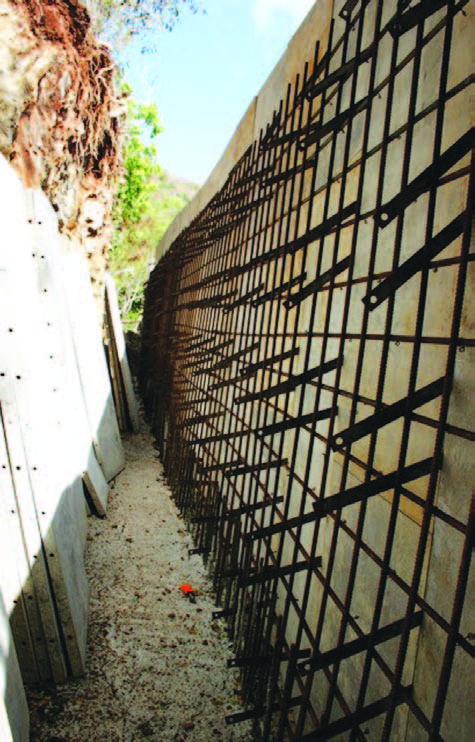 The Occupational Safety and Health Administration issued a final rule to increase protections for construction workers in confined spaces. Confined spaces are described by OSHA as spaces not designed for people yet large enough for workers to enter and perform certain jobs. They have limited or restricted means of entry or exit and are not designed for continuous occupancy. Those contractors working in the concrete foundation industry may see this as a developing change to the configuration of safety measures between the outer erected wall of formwork and the edge of an excavation. Presently, OSHA defines the minimum requirement for this distance as three (3) feet in Subpart P.
The final ruling states that “an estimated 6 fatalities and 812 injuries occur annually among employees involved in construction work in confined spaces addressed by the provisions of this rulemaking. Based on a review and analysis of the incident reports associated with the reported injuries and fatalities, OSHA expects full compliance with the final rule to prevent 96 percent of the relevant injuries and fatalities. Thus, OSHA estimates that the final rule will prevent approximately 5.2 fatalities and 780 additional injuries annually.”
“In the construction industry, entering confined spaces is often necessary, but fatalities like these don’t have to happen,” said Secretary of Labor Thomas E. Perez. “This new rule will significantly improve the safety of construction workers who enter confined spaces. In fact, we estimate that it will prevent about 780 serious injuries every year.”
The rule will provide construction workers with protections similar to those manufacturing and general industry workers have had for more than two decades, with some differences tailored to the construction industry. These include requirements to ensure that multiple employers share vital safety information and to continuously monitor hazards — a safety option made possible by technological advances after the manufacturing and general industry standards were created.
“This rule will save lives of construction workers,” said Assistant Secretary of Labor for Occupational Safety and Health Dr. David Michaels. “Unlike most general industry worksites, construction sites are continually evolving, with the number and characteristics of confined spaces changing as work progresses. This rule emphasizes training, continuous worksite evaluation and communication requirements to further protect workers’ safety and health.”
Any time OSHA issues a final rule that impacts the construction industry, the cost of construction begins to escalate and employers are both at risk for non-compliance as well as lower productivity due to changes in training, education or certification. Therefore, it is important to understand the implications and applications of such specific final rulings. In the case of this final ruling for confined space, OSHA has determined that it is not directly applicable to any excavation or trench that falls under subpart P of 1926. The final ruling on confined space states, “OSHA agrees that subpart P, and not this confined space standard, would apply to the construction of most house foundations in an excavated area until the contractor backfills the area adjacent to the foundation or otherwise covers the foundation or the other areas. “
Subpart P defines the regulations for construction work in excavations. A list of the requirements for confined space and excavation safety includes:
- When forms or other structures are installed or constructed in an excavation so as to reduce the dimension measured from the forms or structure to the side of the excavation to 15 feet or less (measured at the bottom of the excavation), the excavation is considered to be a trench.
- The bottom of the excavation, from the excavation face to the formwork or wall, must not be less than 2 feet wide.
- A stairway, ladder, ramp or other safe means of egress shall be located in trench excavations that are 4 feet or more in depth so as to require no more than 25 feet of lateral travel for employees.
- No employee shall be permitted underneath loads handled by lifting or digging equipment. Employees shall be required to stand away from any vehicle being loaded or unloaded to avoid being struck by any spillage or falling materials. Operators may remain in the cabs of vehicles being loaded or unloaded when the vehicles are equipped, in accordance with 1926.601(b)(6), to provide adequate protection for the operator during loading and unloading operations.
- Employees shall be protected from excavated or other materials or equipment that could pose a hazard by falling or rolling into excavations. Protection shall be provided by placing and keeping such materials or equipment at least 2 feet from the edge of excavations, or by the use of retaining devices that are sufficient to prevent materials or equipment from falling or rolling into excavations, or by a combination of both if necessary.
- Each employee in an excavation shall be protected from cave-ins by an adequate protective system designed in accordance with paragraph (b) or (c) of this section except when made entirely in rock; are less than 5 feet in depth and examined by a competent person to have no indication of a potential cave-in; or have a protective system present with capacity to resist all reasonably expected loads.
- All simple slope excavations 20 feet or less in depth shall have a minimum allowable slope of 3⁄4:1 for Type A soil and 1:1 in Type B soil.
- All benched excavations 20 feet or less in depth shall conform to maximum bench dimensions of 5 feet heights and 4 feet runs for Type A soil and 4 feet heights and 4 feet runs for Type B soil when cohesive.
More direction on confined space and excavations are made available in the complete 1926 subpart P online at www.osha.gov.
The final ruling on confined space does leave room for interpretation for house foundations stating, “however, depending on the particular circumstances at the worksite, once the backfill or other covering occurs, the area inside the foundation space could be a confined space subject to this final rule if it meets all of the criteria in the definition of a confined space in 1926.1201.” Therefore, the concrete foundation industry is still advised to understand the implications of this new confined space final ruling and the accompanying standard.
Compliance assistance material and additional information is also available on OSHA’s Confined Spaces.
SOURCE: OCCUPATIONAL
SAFETY & HEALTH
ADMINISTRATION MAY 4, 2015
MARKETING SPOTLIGHT: E-Marketing To Your Market
AN INTERVIEW WITH JASON ELLS ABOUT CUSTOM CONCRETE’S “THE CONCRETE POST”
By James Baty
CFA Executive Director
Perhaps one of the biggest challenges today is finding the right combination of message and vehicles to reach your customers and elevate your company above the competition. There is no doubt you’ve thought of Facebook, Twitter, Pinterest, LinkedIn, Google and many other popular social media outlets to test the water in your ability to market. How about your website? What look and message does it convey to a generation of owners quickly moving toward the label of “seekers?” These persons will use every bit of information at their disposal…from the Internet…to make their decision. Then, to most of us in today’s business world there is the never-ending barrage of email. While it might be suggested that email is overused and over-burdening to business today, it remains one of the most effective ways to achieve a wide variety of goals in one well-organized and strategic move.
I was able to connect recently with Jason Ells, Executive Director of Operations for Custom Concrete in Westfield, Indiana and garner a few minutes from his busy schedule to find out more about their e-marketing or electronic newsletter. It is titled ‘The Concrete Post’ and offers a wide variety of interests and topics conveyed to their market. A sample of their most recent edition is shown to the right.
James: Jason, that was a great-looking e-marketing piece distributed by your company recently. How long have you been producing and distributing an e-marketing piece like ‘The Concrete Post’?
Jason: We launched it in 2014, in conjunction with an updated website.
James: Rolling out a new website and a new communication vehicle at the same time had to be challenging. Did you look at the e-marketing as being purposed to drive people to the new site?
Jason: The email marketing is a small part of our overall strategy that integrates our website and social media efforts as well. The email efforts push people to our website to read our blog etc. and we have noticed a significant uptick in contacts and queries (via Google Analytic) through our website as a result.
James: It does have a great look and organized feel to it. I’m curious about your focus. Do you specifically target markets or demographics with your e-marketing content or do you produce single content to all that are subscribed to your distribution?
Jason: At this point, we are sending this e-marketing piece to both our external and internal audiences, across all verticals/industries.
James: I suspect that is challenging enough in the frenetic pace of today’s concrete industry to get one well-done piece out much less consider varying a message to the type of customer or subscriber. I’m always curious about the response that these pieces receive. How often would you say a customer or a potential customer mentions an e-marketing piece that they’ve seen from you recently?
Jason: We receive comments regularly; more importantly, we utilize a very cost effective e-marketing platform (www.MailChimp.com) that allows us to track open and click rates. The last email blast we sent out had a 38.5% open rate, well above the 22% industry standard.
James: That is certainly impressive and I would imagine it is largely related to finding the right content, the right trigger initially to get someone to interact with the piece. Personally, I found the photo contest a very creative interaction with your audience. Do you get many submittals from it?
Jason: Yes! It’s really created some engagement and friendly competition among staff.
James: Competition among staff can be very beneficial. It is easy for us to become complacent in the business roles we have. I certainly see that sort of impactful competition in the growing submittals to the CFA Projects of the Year competition (See article here). What would you say is the number one thing you’ve learned about your company in the undertaking of an e-marketing campaign?
Jason: We discovered that you have to find something that really engages them, not just pushes out information that you believe they need to know. Learning how to uncover that or really step outside of ourselves to determine what information will do that has been our biggest learning curve.
James: Ah yes, the learning curve. I believe this is the one thing that most keeps companies from getting involved in some of the technology that defines best business practices today; the reason why there are so few current or updated websites, social media engagements and even e-marketing efforts like this. Attacking the learning curve then might be suggested the biggest factor in differentiating yourself from competitors. What might be a word of advice you’d offer to companies considering e-marketing or perhaps even those opposed to spending the time implementing a campaign?
Jason: The bottom line is … well, the bottom line. We are ultimately using e-marketing as a means to generate leads and sales. A website should really act as one of your best sales people … when you think of it that way … a $5 – $10K investment and another $10K annually to maintain, update, and manage social media … versus another sales person, the ROI is exceedingly reasonable for the reach you are receiving. That said, you need to have a solid foundation of a strong website with regularly updated content.
James: This is all very impressive and I very much enjoy the content that your company brings out in each issue of ‘The Concrete Post.’ I also found the name to have a great feel. Excellent job and I look forward to future editions and seeing how this generates even greater leadership for your team.
While e-marketing can be a scary proposition, even some of the concepts that Jason describes about learning your customers and finding the right messages, it continues to be seen as a powerful tool for business today. You have to be different, you have to be branded with consistency and maintain your integrity. All of these vehicles permit ways to demonstrate the consistency in your message and integrity. The balance found in the ROI of comparing an additional personality on your sales team to vehicles that all existing sales and operation team members can participate and multiply themselves is a difficult task to undertake.
Let me encourage your company leadership to be consider what the network of the Concrete Foundations Association can do to move that forward. Professional peers like Jason find great energy in sharing strategies and conveying both success and failure to make your progress more efficient and effective. They are confident in finding the same from you in other areas. Attend CFA Convention 2015 and get to know this powerful business tool for today and tomorrow that is the Concrete Foundations Association.