Thermally Efficient Walls
Valley Forge, Pennsylvania – CertainTeed Corporation is pleased to enter the insulated concrete wall market with the patented ThermaEZE® Thermal Insulation System. ThermaEZE is an innovative technology that provides a cost-effective means for building thermally efficient above-and below-grade poured concrete walls.
ThermaEZE insulation panels, which consist of expanded polystyrene (EPS) foam, are set within the wall forms prior to pouring, and are held in place by a patented web structure that becomes embedded in the concrete. Once the concrete sets, the forms are removed, creating a wall surface that is fully insulated on the interior and/or exterior faces of the structure. The webs also provide a fastening surface for subsequent application of finish board and cladding materials. With ThermaEZE, hardly any prep work is required; the panels are simply slid into the cavity as the forms are set.
According to Steve Gross, Director of Marketing for CertainTeed Foundations, foundation heat transfer is a major factor affecting thermal interaction of buildings with their environment. “Below-grade space can represent up to 50 percent of the heat loss in a home that is heavily insulated above grade, but is poorly insulated below grade. ThermaEZE allows builders to provide in one simple step insulated walls that are increasingly required by building codes, creating long-term energy savings for the owner,” he says. When used on the interior, the ThermaEZE system replaces wood and steel studs, eliminating the need to frame. Drywall is attached directly to the ThermaEZE panels, which provide a minimum R-value of 11.5
With this entry CertainTeed now offers both wall and footing form systems. The introduction of ThermaEZE comes on the heels of the company’s highly successful launch of Form-A-Drain®, a patented three-in-one concrete footing form, foundation drainage and radon reduction system.
For more information visit their website at www.certainteed.com.
LIFELINES™ EGRESS WINDOW WELLS
Many homeowners who use their basements as furnished, livable space are unaware of the importance of a secondary escape route in the event of a fire, tornado or other life-threatening emergency. Every year people lose their lives simply because there is no way for them to get out. These are the facts that led Mar-fl ex to specially engineer Lifelines™ Egress Window Wells – to make basements safer for the families that live in them.
Lifelines are nearly six feet wide and seven feet high, allowing quick egress for adults and children, and easy entry for rescuers. The window wells also feature built-in steps and handrails so that even small children can easily climb to safety. In addition, the wells are produced from durable polyethylene, do not rust or dent, channel water away from the home and let in more natural light. They are easy to install, with no construction time difference for builders.
Increasingly, local building and fi re codes across the country are requiring emergency escape and rescue openings for basements in newly constructed homes, as well as for some existing basements. To meet these requirements, Lifelines are available in two sizes: 69.5-inch inside width by 46-inch projection by 83-inch height (larger size), and 69.5-inch inside width by 46-inch projection by 63-inch height (smaller size). Three colors are available; white, sandstone and granite.
More information about Lifelines can be obtained by visiting the Marflex web site at www.mar-flex.com, or by calling 1-800-498-1411.
SCHWING ANNOUNCES THE LONGEST BOOM ON THREE AXLES
Schwing America, Inc announces the longest concrete placing boom available on a three-axle truck – the S 41 SX truck-mounted concrete pump with placing boom. With a horizontal reach of 120 feet, vertical reach of over 134 feet and 740 degree boom rotation, the S 41 SX was designed with operators and owners in mind.
Schwing’s Super X stabilizers, the industry’s only telescoping curved front outriggers, extend out for fast, compact set up. In the retracted position, the outriggers telescope into the chassis for efficient space management and result in an overall structural height for maximum stability. The Super X design also allows for the Schwing extra-long stroke pump kits that result in even smoother operation. Outrigger controls on both sides of the chassis are a convenience feature.
The four-section Roll and Fold Boom is versatile enough for commercial and residential projects. The new Vector Control System is standard and allows two-way communication between the pump and operator. This promotes operator efficiency as they monitor the pump from the remote box while enjoying proportional boom control with twin joysticks. The Vector also displays operational data, hours of operation and diagnostic data on the controller located in a secure area on the pump.
The standard Generation III 2525H-5 pump kit is the low maintenance, long-lasting high performance concrete pump that provides long slow-stroking action. This all-hydraulic design utilizes the Schwing Big Rock Valve , promoting maximum filling efficiency of the material cylinders even with harsh mixes. Multi-port switching is a Schwing exclusive that times the switching of the Rock Valve precisely with the material cylinders for smooth operation.
For more information call 1-888-SCHWING or visit them online at www.schwing.com.
Schwing Announces Breakthrough with New Vector Control System
Schwing’s continuous commitment to advancing concrete pumping technology has produced the new Vector Control System. This breakthrough in data retrieval is the only system that allows two-way communication between the radio remote box and the concrete pump. Even higher productivity is now available on all Schwing boom pumps because the operator can retrieve important information without returning to the pump. Other features of the system include continuous operational data mapping; real-time graphical status displays and advanced diagnostics.
An LED display on the remote box informs the operator of: hydraulic pressure; PTO rpm; strokes per minute; hydraulic oil temperature; hopper grate status; local/remote or ram change mode; emergency stop and water tank low level. Audible and graphic warnings are incorporated and divided into low and high level status of operational conditions. Control functions from the remote box include: engine rpm and start/stop; pump delivery rate; end hose shut-off valve; vibrator off/auto; water pump on/off; agitator forward/reverse; pump forward/reverse and boom speed.
The Vector System utilizes twin joysticks on the remote box for pin-point accuracy. Spread Spectrum continues to be used for interference free transmission hopping 50 frequencies per second. Each radio remote has a proprietary sequence to further avoid conflicting signals and owners do not have to apply for a license.
Real time diagnostics are available at the controller located in a lockable box. Graphical displays report machine status from one location, including: emergency stop valves; remote control; boom; concrete and water pump; compressor ; truck engine information; oil cooler operation; outriggers; agitator and vibrator.
Continuous recording of operational data is also provided by the Vector, including: oil temperature, level and pressure; PTO, concrete pump, boom, slewing gear, water pump, compressor and outrigger hours. Owners and equipment personnel can use this data to more accurately schedule maintenance and extend machine life.
Several other features that provide operator convenience include a teach mode key that allows boom calibration to be performed by one person. A separate security key is inserted before boom speed settings are adjusted within certain fixed limits. Factory settings can also be easily retrieved. The expandability of the system will allow for updates in the future.
For more information, call 1-888-SCHWING or visit them online at www.schwing.com.
Concrete Construction: Using Today’s Technology to MakeYesterday’s Dreams Come True
Think of today’s technology and maybe your mind jumps to iPods or Blackberries. (Then again, perhaps you’re still trying to figure out how to attach a document to an e-mail and send it to a colleague.) Suffice it to say, we all have different levels of understanding when it comes to the technologies that have become a part of our everyday lives. Technological improvements occur every day and impact every industry, including our own. And, so it comes as no surprise that Concrete Homes Council (CHC) and Concrete Foundations Association member Poured Concrete Walls of Florida, owned by Deb and Randy Friemoth, works hand-in-hand with member Wall-Ties & Forms, Inc. to advance technologies in the concrete construction industry.
To understand how far our business has come, let’s look back to the early 20th century. In 1906, Thomas Edison, known best for inventing the electric light bulb, startled the world with plans to mass-produce low-cost concrete housing for America’s working class. After Edison built the prototype monolithically poured house, cast by Frank Lambie of the New York Steel Form Company, he gave license to anyone to turn out the design. Lambie partnered with Charles Ingersoll, of the dollar pocket watch fortune, and launched plans to build 40 homes in Union, New Jersey.
Each home was constructed in a single day by monolithically pouring the homes vertically and horizontally. The homes, which still stand, were built with fl at roofs, a cubic shape, plain frames for the windows, and virtually no ornamentation. Unfortunately the project didn’t go as well as anticipated. In short, the technologies and the vision needed to make these durable and affordable homes attractive were nonexistent. In the end, only 11 homes were actually constructed, yet Edison’s idea made history.
Fast-forward to today to see how our industry has evolved. At the Portland Cement Association’s web site you will learn how technology impacts every facet of the concrete industry from cement manufacturing processes and product standards to energy and environmental conservation. Scan the CHC web site and find out about concrete contractors who are moving forward with insulated wall, moisture control and self-leveling technologies, lightweight forming systems, and decorative applications for both interior and exterior uses. From beginning to end, new concrete construction technologies have increased our capability to create homes of unsurpassed function, form, safety and energy efficiency.
A glowing example of progress is Poured Concrete Walls of Florida, located north of Daytona Beach in Palm Coast, Florida. Owners Deb and Randy Friemoth, opened their second business after thirteen successful years owning and operating a traditional concrete foundation contracting business in Waterford, Wisconsin, Walls Are Us. The Friemoths built several solid concrete homes in the Wisconsin market and decided to expand to Florida’s east coast to capitalize on the state’s healthy housing market and to offer an alternative to concrete block construction, the predominate method of single-family home construction in that region.
When Poured Concrete Walls of Florida emerged on the region’s concrete home construction scene, they joined some of the major players in the concrete construction industry. These “big” players in the business include DiVosta (a division of Pulte Homes), EH Building Group and Mercedes Homes, all of which have poured hundreds of solid concrete walls using either tunnel or aluminum forms In their two-plus-year tenure, Poured Concrete Walls of Florida has poured hundreds of exterior walls for builders constructing concrete homes in Florida. The Friemoths have also built four solid concrete homes in the Palm Coast area. Working with forms manufacturer, Wall-Ties & Forms of Shawnee, Kansas, the Friemoths consistently utilize newly designed forms — including radius forms — to include architectural elements usually constructed of wood, concrete block and/or foam. For their latest residential project, 3 Ocean Ridge, they monolithically poured the perimeter walls and the vertical and horizontal posts and beams. The new home is two stories with 26-foot walls, pillars and column headers and features a lanai (veranda) that was poured at the same time.
Radius forms are nothing new to Carl Engelken, vice-president of Wall-Ties & Forms. “We started the production of radius forms with swimming pools and every so often, at a customer’s request, arranged to provide column forms. Because customer demand for radius forms increased, we purchased the equipment to manufacturer these forms ourselves,” says Engelken. “And, whereas five to ten years ago, we were involved with the occasional radius form, we now have a set of radius forms on our schedule every week.” Engelken adds that any shape or decorative element a homebuilder or contractor wants today is available to them and can be included in the monolithic pour. “From swimming pools, walls and ceilings to offsets around windows, we can create forms so customers can do it in one pour.”
All that Thomas Edison dreamed of many years ago—a home that offers quality, safety, satisfaction and more—is within reach. If he were alive today, Edison would have to marvel at the concrete construction’s technological advancements. Here in the 21st century, concrete homes offer value, beauty, comfort, and security in all price ranges and in designs. The famous inventor was on the right track. Now if someone could just figure out how to make good on some of his other ideas…any takers for the concrete piano?
By Wendy Shannon and Libbie Hough, Op5 Creative in Atlanta, Ga.Putzmeister Introduces New BSF 61-Meter Concrete Boom Pump
STURTEVANT, Wis. – Putzmeister America introduces the latest truck-mounted concrete boom pump model to their product range – the BSF 61-Meter. To accommodate customer reach and weight requirements, the unit is strategically positioned in size between the BSF 58-Meter and BSF 63Z-Meter Putzmeister models.
The BSF 61-Meter features a four-section roll-and-fold boom to provide a 197 2 vertical and 183 9 horizontal reach – ideal for long distance and difficult-to-reach pumping jobs. When mounted on its standard 460 hp six-axle Mack truck with tri-steer and tri-drive, the unit’s overall weight allows for added capacity in transporting pipe and hose.
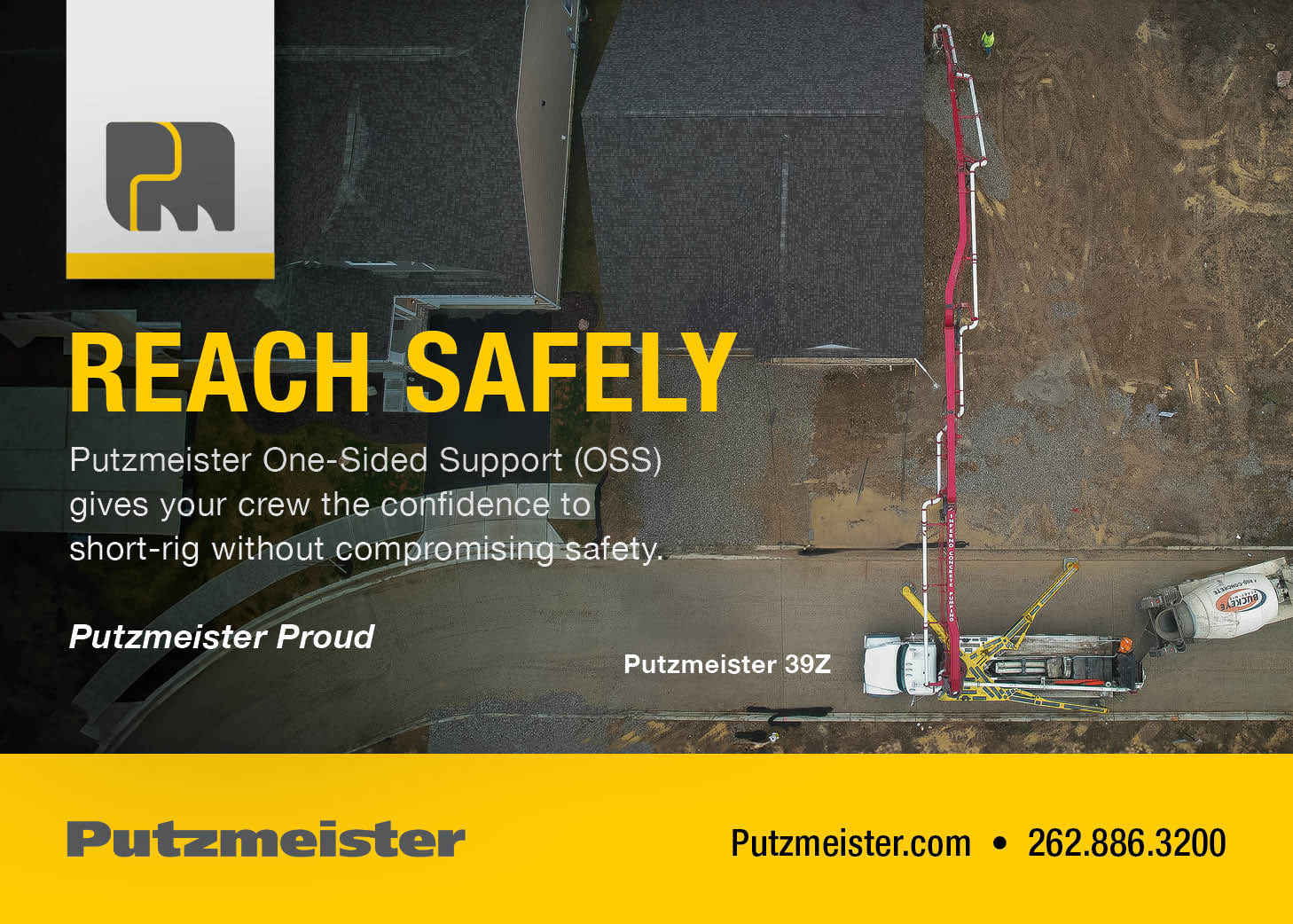
To attain the smallest outrigger footprint in its class, the new model is equipped with Putzmeister’s new OSS (One-Sided Support) outrigger system as standard. When activated, the unit can operate in a defined working envelope while only requiring a compact 22 6 (6.86m) front and 24 7 (7.49m) rear outrigger footprint. Hydraulically-operated, the front outriggers swing out and telescope, while the rear ones merely swing out for easy setup.
Equipped with Ergonic® Boom Control (EBC), the unit features minimal boom bounce, built-in safety mechanisms and easy trouble-shooting devices. OneTouchTM, a part of EBC, enables the operator to use a single joystick to automatically move all boom sections and slewing in tandem, while keeping the end hose level.
The latest model added to the Putzmeister lineup also delivers both high pressure up to 1233-psi (85 bar) and high volume. Customers have the choice of a .16H or .20H pump cell, attaining 210 yd3/hr (160m3/hr) and 260 yd3/hr (200m3/hr) outputs respectively.
Additionally, the BSF 61-Meter features exclusive 4.6” Twin-Wall™ pipe, engineered to maximize the boom pipe’s inside diameter yet still achieve a lighter weight and reduced wear. It’s a major improvement over smaller diameter pipe used on larger boom pumps, offering a smoother concrete flow for reduced hydraulic pumping pressures while attaining the same output with less abrasive wear.
Loaded with other standard features, the BSF 61-Meter includes exclusive free flow hydraulics for smooth controllable pumping; fully proportional cable and radio remote controls for precise boom positioning; auto lubrication of the unit’s boom, pedestal and hopper for simplified maintenance; and the Big Mouth S-Valve for pumping extremely harsh mixes.
Deliveries of the BSF 61-Meter began this spring. For more details, contact Putzmeister America toll-free at (800) 884-7210, (262) 886-3200 or visit the company’s web site at www.putzmeister.com to download literature.
New Jersey Pedestrian Bridge Challenges Brick-Inlay System
Collingswood, NY – When the New Jersey DOT proposed a pedestrian bridge as part of a reconstruction plan for Routes 30 and 130 near Camden, city officials were anxious for the improvements to begin. They were also happy to see that brick was the specified finish material. However, hand-set brick was not in the DOT spec; integrally-cast thin brick for cast-in-place concrete was called out, and Scott’s Rim Snap™ product fit the design nicely.
The Collingswood bridge is currently under construction by JPC Group of Philadelphia. According to project manager, John Prince, “This will be the Cadillac model in an area of town that well-deserves an upgrade.” The structure rises to a height of 24 feet over Rt. 130 with alternating ramps to accommodate wheel chairs, strollers and bicycles. “We are testing the limits of Scott’s cast-in brick system by installing the material on 14 different columns that are approximately 3 feet wide and 24 feet tall.” The Rim Snaps™ will be attached to the column forms on all 4 sides (with L-shape brick in the corners) in 8 foot tall sections. The forms will be craned up and over the rebar supports and set in place for the concrete pour. Prince has figured out how to build and lift the forms, as well as how to install the Rim Snap™ product (by using a worker small enough to fit inside the form!). The concern is how many brick may come loose during the lift and set process.
Scott’s representative, Greg Showalter, has faith in the Rim Snap™ template and its grip-hold on the brick. “The rubber gasket provides a strong suction on the brick face and with careful placement of the forms, there should be little to no brick loss.” There will be some patching necessary anyway due to the location of ties in the forms. For these areas, a Styrofoam “brick” block-out is placed over the tie, fitting into the brick pocket. Inserting the foam block-out is quick and simple as the pieces can be cut on site with a razor knife. According to Showalter, the Collingswood Bridge is one of the largest poured-in-place projects using the Rim Snaps to date with 9,000 square feet of vertically cast thin brick. “This is an ideal product for wall and foundation contractors as it allows these guys to answer the demand for brick without adding the labor of a mason.” Greg says he will report back on how well the brick held in the column form installation.
Rim Snaps™ have been used on residential and highway walls, columns and recently on a 4-story parking structure with climbing vertical forms. For more information on how Rim Snaps™ can be incorporated into your residential projects to offer alternatives to the extensive need for brick ledge and mason labor, visit Scott System’s web site at www.scottsystem.com or direct inquiries to Dana Scott at 303-373-2599 or email her at danas@scottsystem.com.
BIODEGRADABILITY DEFINED
“Biodegradability” is a word that has been inappropriately used in the past. While nearly “everything” is biodegradable over some period of time, clarification was needed on what actually constitutes “biodegradability” to the EPA.
The correct definition of “biodegradability” can be found in the ‘EPA (Environmental Protection Agency), 1998, Fate, Transport and Transportation Test Guidelines, Office of Prevention, Pesticides and Toxic Substances (OPPTS) 835.3100, Aerobic Aquatic Biodegradation. EPA 712-C-98-O and ASTM: D-5864-00, Standard Test Methods for Determining Aerobic Aquatic Biodegradation of Lubricants or Their Components.’ This reference gives everyone the guidelines to be followed when determining “biodegradability” and using the word “biodegradable” in claims as relates to various products. This includes concrete form release agents. The criteria shown in the EPA references is clear in it’s defi nition as to allowable “half-life” of materials in order to be considered biodegradable.
Hill & Griffith Company, Cincinnati, OH now offers two biodegradable concrete form release agents. Sold under the trade names GRIFCOTE® LV-50* and GRIFCOTE® Bio Gold*, these two patented concrete form release agents put at ease many of the concerns that pre-casters and poured in place concrete operations have with the environment and water run-off. Field proven in precast, pipe and poured in place operations, these biodegradable form release agents supply excellent finish and good release at reasonable cost for environmentally responsible form release agents.
GRIFCOTE® LV-50* and GRIFCOTE® Bio Gold* are EPAVOC compliant, non-DOT regulated, non-flammable or combustible, non-carcinogenic and meet the EPA requirements to be classified as biodegradable.
For additional information and samples contact Hill & Griffith at 317-887-5922, or on line at www.GRIFCOTE.com.
You Don’t Have To Be A Big Company To Do Big Work
————————– Accurate Concrete Forming David Newman, Owner 601 B Louis Ave North, Watertown, MN 55388 952-955-3911 fax 952-955-3912 davnewman3@aol.com Started in 2002, specializing in poured walls construction ————————–
When Ebert Construction needed an experienced poured wall outfit to pour their salt storage building for the City of St. Paul, they went to their local poured wall construction company with commercial experience. It happened to be Accurate Concrete Forming, a four-year old company owned by CFA-MCFA member David Newman that has hit the ground running and already branched out to commercial work.
General Contractor Ebert Construction from Corcoran, Minnesota needed a competitive bid from a reliable poured wall company for this project. David is pleased that Ebert “didn’t have to turn to a large union or big construction company, just the local poured wall guy.” For the St. Paul salt storage project, David and his men poured 20 foot columns on top of a 20 foot wall. David says “although this may not be something most residential contractors would tackle, we have the experience and equipment to handle it. We fi t in when contractors either don’t have the experience, the equipment or the time.” Accurate has done several other projects for Ebert Construction. David says ‘We work together well – we know they want a good product and we want to give them the best great poured wall we can.”
The building’s footprint for the poured walls measure 108 feet long by 130 feet wide and used 550 yards of concrete. The walls are 21 feet tall and 16 inches thick, with center walls 24” thick and the addition of a 24” column monolithically cast making the pour 40 feet to the top of the column. Accurate crews tied 54 tons of steel for the wall – all by hand. David says ‘when we bid this project, we assumed it would take us 2000 hours. Using BEP forms, a recent investment for Accurate, saved us 25% labor — we had it done in 1500 man hours.”
“I really want to thank Greg Peacock, who sold me our BEP equipment; Arie Van Wyk, Van Wyk Concrete, who lent me his ties to finish the job; and Matt McIntosh of Expert Construction for helping by loaning us some equipment to complete the St. Paul project.”
FROM RESIDENTIAL TO COMMERICAL
David started in 2002 as a residential poured wall contractor; then adding commercial work. David says, “I made the decision to expand our opportunities by moving into the commercial market, so at Accurate we do both; with approximately thirty percent of our revenue coming from commercial.”
Accurate currently employs eight people. David says he has focused on being efficient; instead of adding more employees he planned for more efficiency in their commercial projects by purchasing BEP gang forms. Already showing their value with projects like the St. Paul storage building, the BEP forms are aluminum and David thinks they are the best on the market — light and easy to use. The forms withstand a lot of head pressure and can be filled fairly quick. Because they are light-weight, his crews and are able to use a smaller crane and can move large sections of form work together. The life span and durability of the aluminum forms is also much longer compared to a wood face form.
According to David, residential poured wall contractors getting into commercial work is a smart move. David explains that residential contractors tend to run leaner, have less overhead, and stay more focused on what is getting done with individual projects. He feels that the residential contractor can be more cost effective than larger commercial companies and unions.
Adding commercial work also helps smaller companies to have more options — a case of ‘not putting all the eggs in one basket’. If the housing market is down, the commercial market may be good. Usually if one is down, the other is up.
For the Accurate crew, some of the commercial work, like this St. Paul project, also means a bonus when getting paid the prevailing wage. Although they realize they take a bigger financial risk doing commercial work, the allure of a higher profit margin for the company is an advantage that is hard to pass up.
David’s advice to small poured wall business owners out there is ‘if you can do commercial or agricultural work, your company will be stronger. The variety of projects will help make your employees better skilled workers.”
TECHNOLOGY AT ACCURATE CONCRETE
Technology has helped crews at Accurate primarily with project layout. David says ”the technology that is here (for example, the Total Station Layout) makes our job easier. The Total Station Layout on the larger building is easier than running tape measures. We also see a change in the residential market — today’s homes are bigger; where we used to truck dump, now we pump everything. People want to make the most home for their dollars.”
GETTING INVOLVED IN MCFA
David Newman started in the poured concrete business in 1992 while still in high school. After college he came back to the industry, but knew he wanted to play a bigger role. David worked for several years as a foreman for Expert Construction. This led to a partnership in a company David would eventually own, Accurate Concrete Forming. During his time as foreman for Expert Construction he became involved in the Minnesota Concrete Foundations Association (MCFA), now a local chapter of the CFA. He says “MCFA is one of the best things I’ve become involved with because most of the guys in the organization are good concrete contractors and businessmen. In the Minneapolis-St. Paul area the majority of poured wall contractors are members of both the MCFA and CFA. One of the benefits of our memberships is that we have gotten to know each other well, especially through our MCFA monthly meetings. As a result of getting to know one another, some of us members sub-out extra work to one another when needed (which can help to fill out each others schedules and make deadline dates). But most commonly, when we’re broken down we help each other out by moving equipment. ”
Historically their regional organization grew and became strong during a time when contractors were struggling with cold weather construction. At their monthly MCFA meetings, members worked through the cold weather issues with building inspectors. These regular meetings in turn helped the organization grow. Dave says “Today MCFA is the biggest regional poured wall organizations in the U.S. We realize that industry issues effect all of us. Our focus now is on what networking and technology can do for our companies.”
During the last year members from MCFA are starting to form committees – marketing, education, etc. Dave says that MCFA is slowly starting to evolve and help educate contractors in the industry.
His advice to other regions getting started are to:
• Meet regularly even if it feels like sometimes nothing is being accomplished. It is a long, slow process.
• Go to meetings when you can, but stick to it – each individual should go for networking, informational seminars and to discuss new issues and problems in the poured wall industry. Then when a problem comes up, you don’t have to ‘corral all the horses again, because most of the members attend regularly.
• Use this opportunity to get out there and MEET the other poured wall guys in your area. You will find they are a lot like you — just trying to make a living and to do good work. This group of people will become your friends and someone you will be able to turn to for advice, help if you’re broken down, or maybe some extra work help to fill your schedule. Dave says, “We do this here in my area and feel very fortunate to have each other – especially with breakdowns!”
For the new guys, membership in MCFA and CFA is also a great opportunity to learn from more experienced contractors.
Residential Foundation Contractors Find New Opportunities by Expanding into Commercial Work
It is no secret that companies grow by diversifying, provided they are loyal to building on their core strengths. As such, it is no surprise that many residential foundation contractors have begun applying their proven poured wall concrete expertise to the commercial market. By expanding into new markets, many have found they can off-set the typical high and low cycles of the economy. However, this market extension also is a win for building owners as these contractors are improving the quality of commercial foundations.
“When it comes down to it,” says Jim Baty, CFA Technical Director, “this is a near automatic decision for the residential foundation contractor. We have seen time and time again that the levels of quality that are produced in the average residential foundation exceed the quality that is provided in most commercial foundations. Therefore, the contractor that looks into this market and sub-contracts with the commercial builder can find, at times, unlimited potential for growth. Currently, commercial building is out-pacing nearly every segment of the building industry while we are beginning to observe a softening of the residential market in many regions.”
Case in point is Tim Parrish, President of Harrisonburg, Va.’s Cornerstone Foundations. Founded in 1988, Cornerstone Foundations was only the second poured wall company in their area. They quickly earned a reputation for being the company that was willing to tackle any project – big or small, complex or mundane. This zeal for work also includes bidding commercial projects.
“We were fortunate to develop a relationship with a mid-size commercial general contractor that did not have its own concrete crew,” said Parrish. “This relationship gave us an opportunity to work our way into the commercial world and its quirks with a bit of a safety net.”
Another example is Kirby Justesen of Formco Foundations in West Jordan, Utah. A member of the concrete business for 25 years, Justesen formed Formco Foundations in 1992 serving the Salt Lake City, Provo and Park City areas of Utah. Justesen moved into the commercial arena to meet the needs of the marketplace. When the Olympics came to Salt Lake City in 2002, the resort business dramatically increased in the area and contractors wanted basements for their facilities. Justesen took his firm’s experience in the residential market and applied it to the commercial market by diversifying his company to handle changes in the marketplace.
THE MARKET DIFFERENCES
Parrish alluded to the many differences between the residential and commercial markets by referring to the quirks. A majority of commercial projects for which residential contractors get involved in are either stem walls for slab-on-grade/pre-engineered metal buildings or site retaining walls. Since basements are often a necessary evil mandated by the engineer to make a building work on a particular site, the projects are typically much more complicated than a standard residential project. And, this complexity requires a new knowledge-base and approach for the contractor. For example, Parrish said their crews needed to learn to read site plans with elevations and lots of details, as well as better understand the different codes.
Commercial work typically entails a great deal more planning and coordination since more things are needed to go through the walls. “We have encountered utility inserts of all sizes including pipes that were already in place that we had to form around,” said Parrish. “Further, we have had to learn to read the mechanical and electrical plan details as well. If we had not learned this skill, we would not estimate enough labor to cover for all those types of inserts. Even when we knew what had to go into the walls, we still had to learn to work with other tradesmen that may want to install their own sleeves at their own pace.”
Another example for the additional coordination that is required on commercial projects is the start time for pours. Typically, wall pours would have to begin earlier in the day, so that the superintendent could be at the site.
“We learned that, for commercial projects, we needed to plan extra time on the job as there are typically more disruptions,” said Parrish. “Even though these are usually large job sites, we often have to stop work to relocate trucks and equipment to allow access for other trades.”
Visits by OSHA representatives also are more common for a commercial job, which increases safety awareness. While safety is paramount on any project, commercial presents more stringent regulations on safety and inspections, which can increase the time needed to complete the job. Additional disruptions can occur by asking for clarification on a detail. Oftentimes, the architect or engineer may need 24 – 48 hours to provide their answer. Justesen notes that commercial projects often require shop drawings for rebar since additional rebar is often needed for commercial projects, so proper time needs to be allotted for this.
There also are marked differences in schedules and workforce. Although commercial work is often referred to as having a “tight schedule,” Parrish said residential work is actually more time sensitive. In fact, it is common for residential contractors to be under the gun to get a wall poured that day or they lose money or the contract. In contrast, since commercial work is more complicated, it requires a slower and more methodical approach. This, however, can be frustrating to crews if they are used to performing production work. But, simply throwing larger crews at the project can backfire as superintendents are accustomed to smaller crews and they can get easily overwhelmed. A superintendent may be used to a four person crew instead of an 8-12 man crew that is typical in residential work.
According to Parrish, it is worth training existing crews rather than simply hiring other workers with experience in commercial concrete work. That is because those with residential experience tend to have greater time sensitivity, which allows for more profitable commercial work. The longer schedules can have benefits though in terms of employee morale as crews often enjoy being at the same location for a few weeks as compared to having to move around frequently for residential projects. Residential work entails a great deal of scheduling of both equipment, and manpower.
However, schedule still drives a commercial project. Justesen explains that commercial general contractors often feel intense pressure and stress to ensure the project remains on schedule. “Commercial work demands timeliness and insists that the schedule is kept to ensure that other trades can perform work when they need to,” said Justesen. “While these projects are more complex, so more time is necessary, adherence to the schedule is critical because your work is tied to the overall contract time.”
LOOKS DO MATTER
As the old adage goes, “the customer is always right.” That begs the question, who is the tougher customer – the home or business owner? According to Parrish, the commercial builder and the building owner are typically looking for a much nicer wall than in a residential situation and accuracy is essential. For example, a commercial wall that is only an inch out of plumb can have drastic impacts on the rest of the building. If an 8-foot tall wall is out of plumb, it is easy to correct, but if a 20-foot tall wall is out of plumb, the error becomes more exaggerated. Further, commercial buildings often use a pre-made steel package that has very little room for adjustment.
Justesen concurs, stating that accuracy is critical in a commercial project. “Our experience with high-tech instruments such as the Geodimeter Total Station for layout helps ensure that our jobs are as accurate as possible,” said Justesen. “Since we use these instruments for our residential projects, our crews know how to process the information in the office to get it to the field crews quickly and correctly.”
There are typically more inspections in commercial work and they expect a higher level of quality. The building owner hires a private inspector to perform a pre-pour inspection as well as test the concrete during the pour. They watch the water-cement ratio very closely and the foundation contractor usually has to submit a typical concrete mix design to the engineer before they begin the job.
While the customer preferences may be different, there also are differences in the customer profile and this is a factor that should not be overlooked. Although it depends on the size of the company involved, a written contract is typically standard protocol when working for a commercial general contractor and the terms are often quite unfavorable to the sub-contractor. Payment is often much slower and a retainage can often be held for 18 months or more. Those who have made the transition to commercial work recommend planning for this time-span and even increasing their bid to cover the length the money is held without any interest paid. Further, making changes on a commercial project is typically more complicated and a lengthier process as compared to residential work because it involves the general contractor, engineer, architect and owner.
TRANSITION FOR SUCCESS
For those interested in making the transition to commercial work, Parrish recommends you carefully perform a cost justification before diving in. Justesen agrees and notes that it is important to know that costs are going to be different than a residential project because commercial projects are not as productive. Although light commercial work is somewhat similar to residential in that the same forms can be utilized, there are distinct differences. For example, smooth-faced forms are preferred for commercial projects, though some contractors have had success with brick patterns. Further, the mix designs specified are often more difficult to work with, because some engineers will only allow certain mixes that have low slumps, larger aggregate and strict limits for hot and cold weather concrete.
“We had to educate ourselves on what it took to get a workable mix design and then we had to educate builders and engineers,” said Parrish.
Parrish also recommends that residential contractors capitalize on their strengths – speed and quality – when making the foray into the commercial market. Those who have made the transition are careful to point out that commercial work is not simply a pot of gold waiting to be found. There is a lot of effort involved for both production and management on both the front-end and once the job has begun. However, diversification does enable companies to weather economic storms.
“Being active in both the commercial and residential markets has been a good niche market for us,” said Parrish. “We have had up to 30 percent of a year’s work be commercial in nature and when residential slows down, commercial is often still busy.”
Now is the time to enter the commercial market, because commercial building owners want to maximize their space as much as possible, explains Justesen. “We have seen many owners of apartment buildings putting the parking underneath the building, which is a good utilization of basements. Basements provide cost-effective space, which is important to every owner.
”With all that is at stake in entering a new market and trying to learn how to diversify, participation in an association like the CFA can be the most important first step in the process,” says Baty. “The primary goal of the CFA for market development is networking. Providing the most efficient means and greatest opportunities to capitalize on the networking that comes with membership is paramount during the planning of each and every event as well as our online membership benefits.”
Jim Baty, Technical Director, Concrete Foundations Association jbaty@cfa.org