Bad Concrete or Bad Testing? Handling Low Cylinder Breaks in Concrete Testing
By CFA Staff
Based on the CFA Classroom resource, “When Bad Breaks Happen,” presented by Kim Basham. The 2018 presentation has been updated to include current references to codes and standards.
The integrity of any construction project relies heavily on the materials used. When compressive strength evaluation results fall short of expectations, it often triggers project delays, increased costs and liability concerns. However, low cylinder breaks are frequently misunderstood. A failing test does not automatically dictate that the concrete structure itself is fundamentally flawed.
The online Concrete Foundations Association (CFA) Classroom contains a past CFA Convention presentation where leading industry voice Kim Basham, KB Engineering LLC, presented on handling project situations where compressive tests fail to reach specified strengths. His insights provide a guide for determining whether a true problem exists and how to disprove liability for poor performance.
Concrete cylinder testing serves as the standard method for verifying that the concrete delivered to a site meets the specified mix design. However, these cylinders represent the concrete as delivered rather than the concrete as it cures in the actual structure.
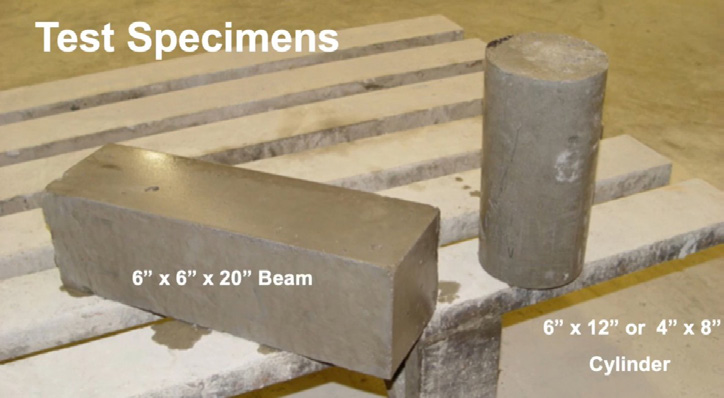
To maintain consistency, cylinders must be cast and cured according to strict ASTM-C31 standards. A standard strength test consists of the average of either two six-by-12 cylinders or three four-by-eight cylinders. Because a flaw in a larger six-by-12 cylinder has less impact on the overall result than the same flaw in a smaller four-by-eight cylinder, testing requires three of the smaller specimens to ensure an accurate average.
Furthermore, ASTM standards ensure that cylinders are created and broken consistently, but they do not interpret the results or determine ultimate pass/fail status. To ensure testing accuracy, the American Concrete Institute (ACI) 301 requires that anyone making field cylinders for acceptance must hold an ACI field grade certification level one. Cylinder strength, measured in pounds per square inch (PSI), is calculated by dividing the load at failure by the cross-sectional area. It is worth noting that only the center one-third of a cylinder is effectively tested during a break, as the material fails due to tensile forces perpendicular to the loading direction.
COMMON CAUSES OF LOW CYLINDER BREAKS
When low cylinder breaks occur, the root cause usually falls into one of two categories: bad concrete or bad testing. Far too often, testing irregularities are the actual culprit behind a low break.
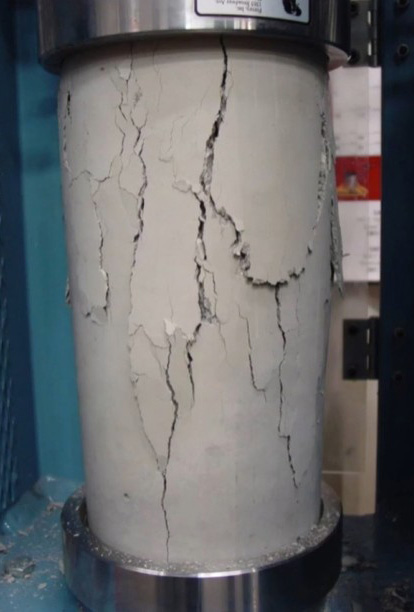
Improper sampling is a frequent issue. According to standard procedures, testers must take two samples from the middle third of the ready-mix truck load. There is a strict 15-minute time limit to collect this sample and begin making the specimens. If testers pull concrete from the very beginning or end of a load, or if they let the concrete sit too long before casting, the resulting cylinder will not accurately represent the batch.
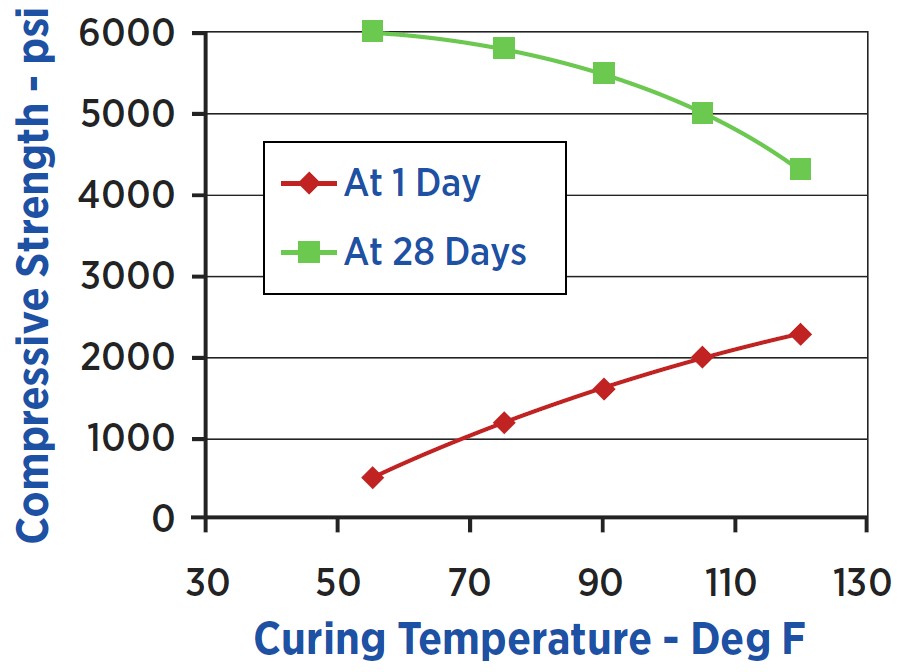
Curing conditions also play a massive role. Standard curing involves highly controlled temperatures, while field curing reflects the ambient conditions of the job site. For concrete rated at 5,000 PSI or less, standard curing requires cylinders to be kept between 60 and 80 degrees Fahrenheit for the first 48 hours. After this initial period, they must be maintained at 73.5 degrees (plus or minus three degrees) for the remainder of the 28-day cycle. Today, the testing lab is responsible for providing the initial cure box. If cylinders are left exposed to extreme heat or freezing temperatures on site, their strength will be severely compromised, leading to low breaks that do not reflect the actual structural concrete.
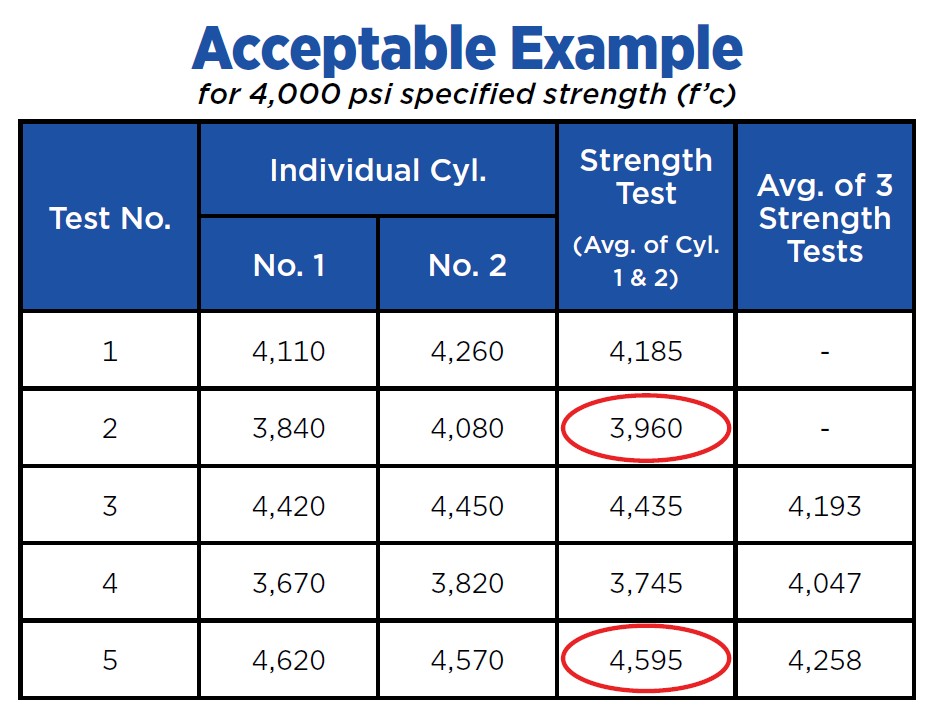
To properly evaluate concrete, professionals must understand the acceptance criteria and the natural statistical variation inherent in the material. Concrete is a heterogeneous mixture of water, cement and aggregates. Because of this, some statistical variation in test results is completely normal and expected.
Industry standards dictate that the average of any three consecutive tests must equal or exceed the specified strength. Furthermore, no single test can fall more than 500 PSI below the specified strength for concrete rated at 5,000 PSI or less. For high-strength concrete greater than 5,000 PSI, no single test can fall below the specified strength by more than 10%.
If a test result is within 500 PSI of the target but the running average drops below the specified strength, the immediate action should be adjusting plant procedures rather than rejecting the concrete outright. Understanding these statistical allowances prevents knee-jerk reactions and keeps projects on schedule while maintaining safety standards.
IN-PLACE STRENGTH EVALUATION
When standard cylinders fail to meet the acceptance criteria, the focus must shift to compressive strength evaluation of the concrete actually in the structure. Cores drilled from the hardened concrete are the definitive method for acceptance or rejection.
According to guidelines, the average strength of three cores must be at least 85% of the specified strength, with no individual core breaking at less than 75%. Cores should be taken from the same general location to ensure a consistent sample set. The core diameter should be a minimum of 3.7 inches, ideally with a length-to-diameter ratio of two. ASTM recommends waiting at least 14 days before drilling cores to allow the concrete to gain sufficient strength and to prevent damage during the drilling process.
Moisture and orientation also affect core breaks. Dry cores can break 15% to 20% higher than wet cores. Additionally, horizontal cores typically break 7% to 9% lower than vertical cores due to the orientation of bleed water channels trapped under aggregate particles during the initial pour. For non-destructive testing, equipment like the Windsor probe offers a more reliable assessment than a standard rebound hammer. Acoustic tests can also provide estimates, where a sound transmission from various non-destructive testing (NDT) methods of 16,000 feet per second roughly correlates to a strength of 4,000 PSI.
FACTORS AFFECTING CONCRETE STRENGTH
Several environmental and mechanical factors influence the ultimate strength of your concrete. The water-cement ratio is arguably the most critical variable. Adding just one gallon of water over the mix design can lower the concrete’s strength by approximately 200 PSI.
Curing temperatures dramatically alter strength development. A poorly cured slab can exhibit a 35% difference in strength compared to a properly cured specimen. You can expect about a 15% strength difference between standard laboratory-cured specimens and field-cured specimens left exposed to ambient site conditions.
Stress history and micro-cracking also play a vital role in in-place strength. If a core is taken from an area where the concrete has already been subjected to structural stress, shrinkage or temperature fluctuations, micro-cracking will have occurred. This internal damage will artificially lower the core’s tested strength, misrepresenting the material’s initial quality. Important variables to verify include water content, air content, unit weight and the concrete placing techniques used on the day of the pour.
RECOMMENDATIONS
Effective project leaders do not just react to problems. They anticipate them and use structured frameworks to find solutions. If you are faced with low cylinder breaks, follow this checklist to identify the root cause and protect your project.
- Verify the low strength report. Check the math on the break report. Ensure the compressive strength was calculated correctly by dividing the load by the exact cross-sectional area.
- Review the batch tickets. Look closely for any instances of water additions on site. Note whether the water was added all at once or gradually, as this impacts the mix integrity.
- Investigate curing conditions. Confirm that the initial cure box was utilized and that temperatures were maintained between 60 and 80 degrees for the first 48 hours.
- Examine testing procedures. Verify that the testing technician held the proper ACI field grade certification and that samples were pulled from the middle third of the load within the 15-minute time limit.
- Evaluate structural capacity. If any strength value falls below the specified strength by 500 PSI, work with the structural engineer to investigate and ensure the structural load capacity is not jeopardized.
- Plan for coring carefully. If cores are required, wait 14 days, select appropriate locations free from high stress and account for moisture content before breaking.
Navigating concrete strength issues requires a strategic approach grounded in industry standards. Low cylinder breaks are stressful, but they are manageable when you understand the mechanics of concrete cylinder testing, statistical variation and in-place evaluation methods. By focusing on proper testing protocols, monitoring curing conditions and utilizing a systematic checklist when issues arise, you can protect your project’s timeline and budget while ensuring complete structural safety.
Continuous learning is the best defense against liability and project delays. To gain a deeper understanding of these concepts and hear real-world examples of overcoming material challenges, view Basham’s full presentation in the CFA Classroom. In the CFA Classroom you can also find additional learning modules including the ACI Residential Concrete Foundation Technician Certification training course. Equipping yourself and your team with this knowledge will empower you to handle future structural challenges with absolute confidence.
As with any concrete mixture, it is essential to conduct trial batches to confirm the specific properties of the concrete. Final results can be affected by various factors, such as temperature, humidity and the specific components used in the mixture. We recommend consulting a local concrete foundation professional for guidance.
Please note that no information provided herein should be interpreted as a warranty or guarantee, whether expressed or implied. This includes, but is not limited to, any implied warranty of fitness for a particular purpose.
REFERENCES
ACI Committee 214. “ACI 214R-11: Guide for Evaluation of Strength Test Results of Concrete,” American Concrete Institute, Farmington Hills, Mich. 2011.
ACI Committee 214. “ACI 214.4R-21: Guide for Obtaining Cores and Interpreting Compressive Strength Results.” American Concrete Institute. Farmington Hills, Mich. 2010.
ACI Committee 228. “ACI 228.1R-19: In-Place Methods to Estimate Concrete Strength,” American Concrete Institute. Farmington Hills, Mich. 2003.
ACI Committee 228. “ACI 228.2R-13: Nondestructive Test Methods for Evaluating Concrete in Structures.” American Concrete Institute. Farmington Hills, Mich. 2013.
ACI Committee 318. “ACI 318-25: Building Code Requirements for Structural Concrete.” American Concrete Institute. Farmington Hills, Mich. 2014.
Bungey, J. H. Testing of Concrete in Structures. 2nd Ed. Surrey University Press. New York, N.Y. 1989. The Concrete Society. “Technical Report #32 Analysis of Hardened Concrete: A Guide to Tests, Procedures and Interpretation of Results.” 2nd ed. Sandhurst, Berkshire, UK. 2014.
Malhotra, V. M., and Carino, N. J. Handbook on Nondestructive Testing of Concrete. 2nd ed. CRC Press. Boca Raton, Fla. 2003.