Adapting to New Materials and Industry Demands in the Concrete Industry
By CFA Staff
In the concrete construction sector, each project often has at least one challenge that requires a lot of creativity and research to solve. In addition, the standards for materials, tools and methods are constantly changing. Sustainability targets, new performance expectations and operational constraints require a more adaptive mindset for planning and delivery. Understanding and responding to these factors is no longer optional for project success; it has become a driving force behind every material decision.
This article is the first in a series that examines how the industry is responding to ongoing changes and details practical, strategic planning approaches for concrete construction projects, using insights from the UC Davis webinar series, “Addressing Barriers in Innovative Concrete Implementation.”
CHALLENGES IN MATERIAL INNOVATION
The expectation to reduce embodied carbon exists alongside established objectives for structural safety and long-term durability. Some teams are optimizing concrete mixes to achieve efficient use of supplementary cementitious materials (SCMs), while others are evaluating design alternatives to meet these performance and sustainability mandates. There is a balance to maintain; reducing emissions cannot lead to compromised strength or reliability. For many projects, this means careful alignment of material selection with project-specific goals, context and available resources.
Vertical construction, including commercial high-rise buildings, often involves tight schedules. Adopting new materials can pose a risk; contractors may hesitate if they believe it could cause delays or disrupt established timelines. In contrast, horizontal construction—such as highway pavements—is frequently influenced by legislative requirements for lower carbon emissions. Recognizing these sector-specific pressures is essential for developing practical strategies. By selecting technology and materials that fit each project sector, teams can support key delivery requirements and achieve project goals more effectively.
The industry faces reported shortages of traditional SCMs such as fly ash and slag. Nationally, supplies sometimes seem stable, but in practice, regional limitations force producers to seek and evaluate alternative sources. This ongoing dynamic means that relying solely on standard materials is less viable, making diversification part of the normal planning process.
This shift brings variability in material properties. Imported cements and natural pozzolans might produce inconsistent test results—projects sometimes encounter unexpected water absorption or shrinkage. Teams must find solutions that safeguard durability and address carbon reduction targets. Selecting and validating new materials is not a static exercise, but a dynamic process with multiple moving parts. Effective planning often means revisiting assumptions as data is gathered from field and lab work.
To this effect, new alternative materials are now being considered across the industry. These include natural pozzolans, remediated fly ash, calcined clay and low-carbon cements. Each alternative brings its own set of characteristics and testing requirements. Sometimes, trial results prompt immediate changes. At other times, collaboration is required to resolve issues as they emerge. This process is rarely linear; verification often involves a cycle of assessment, feedback and adaptation that continues throughout a project’s duration.
LOGISTICAL HURDLES IN ADOPTING NEW MATERIALS
Replacing one material with another is not a straightforward task. It is a multi-stage process that calls for advanced planning and careful allocation of resources. Some teams spend as much as six months on testing—spanning mortar trials, concrete lab tests, plant-scale evaluations and project mock-ups—all to confirm field performance. For every step, project managers must adapt and match their process to new constraints.
Storage space at concrete plants is limited, and finding room for new materials often becomes a logistical puzzle. Some teams use super sacks, large, flexible polypropylene containers, to accommodate these additions. However, super sacks bring their own set of challenges. Loading processes can become more complicated, and incorrect sequencing sometimes leads to balling in mixing trucks.
Air quality permits may also restrict opportunities for material testing, making compliance costly and bringing added complexity to the process. On job sites, contractors regularly encounter technical hurdles. Shrinkage issues appear without warning, while pumping finer pozzolans can become problematic when filters shrink. By proactively identifying these challenges, project managers are better equipped to build contingencies into their plans and control project costs.
Structured communication is a key factor in managing logistical challenges. When suppliers, producers, engineers, contractors and owners engage in open dialogue, it becomes possible to identify and resolve issues related to material performance more quickly. Without collaboration, projects risk delays or higher costs. Sometimes a single conversation can clarify a technical issue or uncover a practical solution that saves both time and resources. Consider how a project team can avoid unnecessary setbacks by simply sharing a test result or discussing an unexpected field observation early in the process. Through routine communication and a willingness to adapt, teams can better coordinate their approach and minimize risks as the project moves forward.
The current environment for concrete materials presents measurable challenges and process adjustments. Navigating SCM shortages and logistical requirements requires the use of tested materials, documented communication and appropriate technology for project execution. Projects that demonstrate consistent planning, data sharing and integration of available digital tools are positioned to meet specified workflow objectives.
The next article in this series will address specific strategies for overcoming barriers in innovative concrete implementation.
The concepts of this article were taken from a presentation by UC Davis. As with any concrete mixture, it is essential to conduct trial batches to confirm the specific properties of the concrete. Final results can be affected by various factors, such as temperature, humidity, and the specific components used in the mixture. We recommend consulting a local concrete foundation professional for guidance.
Please note that no information provided herein should be interpreted as a warranty or guarantee, whether expressed or implied. This includes, but is not limited to, any implied warranty of fitness for a particular purpose.
Case Study
WALLS TO NOWHERE COQUITLAM, BRITISH COLUMBIA, CANADA
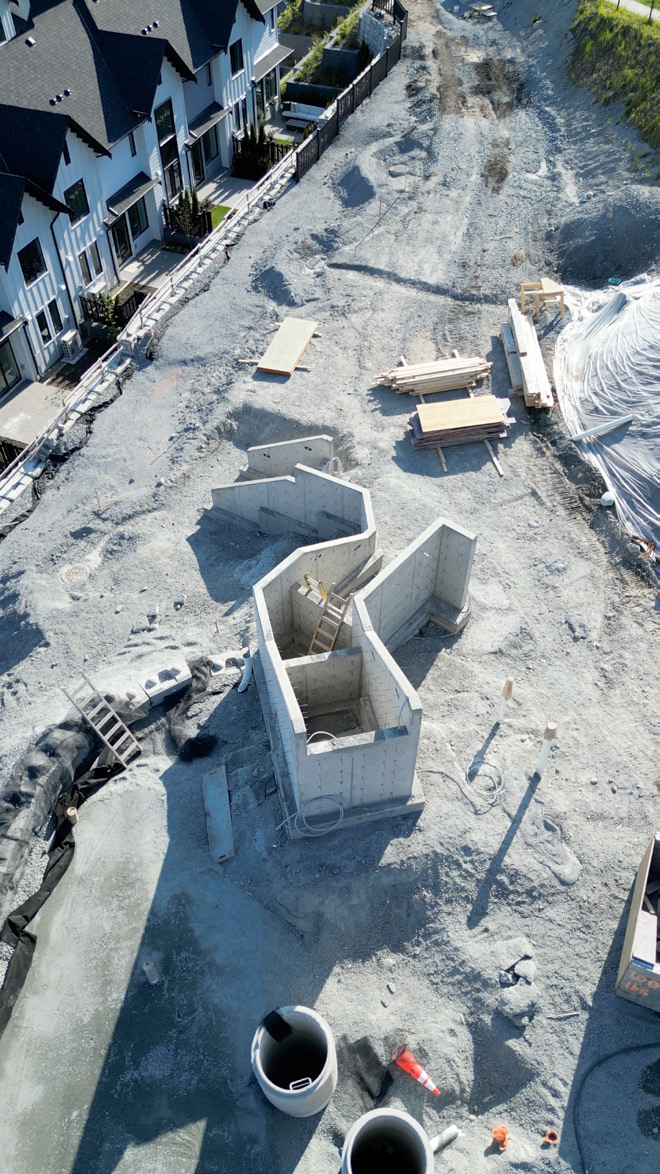
The Walls to Nowhere project in Coquitlam, British Columbia, required layout and forming for several odd-angle corners including two 53-degree, one 58-degree and one 45-degree angle. Warped plywood affected the ability to connect bevels at these corners.
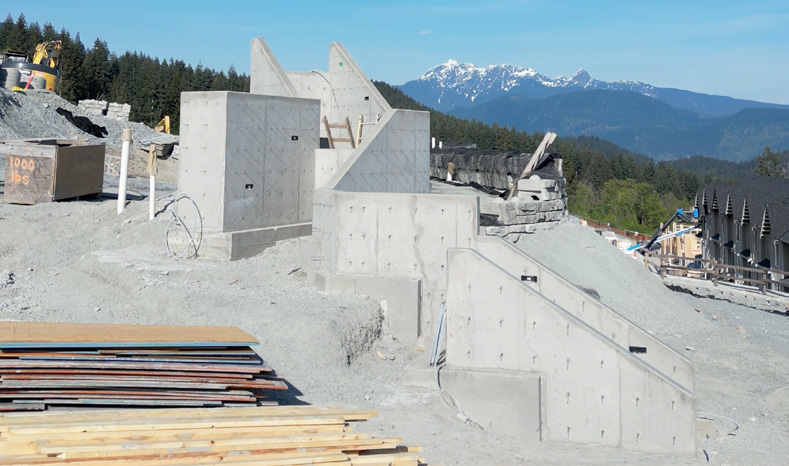
The team addressed these challenges by beveling the plywood at each odd angle and using chamfer strips for 90-degree edges. To manage warped plywood, mitered walers were applied to close gaps. The project team used AutoCAD and BricsCAD for 3D modeling of the footings, walls and form panels. A Leica Robotic Total Station was used for layout and installation accuracy. These techniques enabled precise formwork, reduced on-site adjustments and contributed to a faster project timeline with fewer errors. This project was named a 2025 CFA Project of the Year for its innovative solutions to challenges and the group’s seamless teamwork.