Interpreting Nominal Concrete Wall Thickness
Compiled by CFA Staff
In the world of residential concrete construction, one topic that comes up frequently is the interpretation of “nominal” versus “actual” concrete wall thickness.
The conversation that often starts with a frustrated contractor and a skeptical building inspector. In most cases, the dispute usually centers on a fraction of an inch and whether standard forming systems meet code requirements.
Why does this keep happening, and more important, how can contractors arm themselves with the right code references to resolve these disputes quickly?
The scenario is almost always the same. A foundation contractor is placing walls for a residential project using a standard forming system set for a wall thickness of 7 5/8 inches. This is standard industry practice for what is widely known as an “8-inch wall.”
However, problems arise when a building inspector challenges this measurement. The inspector might argue that the local or state code does not explicitly define “nominal” thickness or permit a 7 5/8-inch wall to substitute for an 8-inch requirement. In some cases, inspectors even question the structural integrity, suggesting that the engineering behind a 7 5/8-inch wall cannot withstand the same soil pressure as a full 8-inch unreinforced wall.
For contractors who have been pouring these walls for decades, this reaction can feel like a sudden change in the rules of the game. They are left thinking of ways to provide evidence and proof that this is an industry standard.
The root of this confusion often lies in the lack of transparency and consistency within building codes. Historically, the consolidation of three separate model codes into the International Residential Code (IRC) resulted in a loss of some foundational data and base equations. When states adopt these codes, often with their own modifications, definitions can become murky.
However, the answer exists if you know where to look. A recent inquiry from Wisconsin highlights this issue perfectly. The Wisconsin Uniform Dwelling Code (UDC) is a typical state adoption of the IRC. While it simplifies many things, it can lack the granular detail found in more specialized documents.
Fortunately, the Wisconsin UDC (specifically section SPS 32.01) references ACI 332, the Residential Code Requirements for Structural Concrete. This is the gold standard for residential concrete foundations, providing the level of detail that general building codes often omit.
ACI 332-16 clears up the confusion immediately in section 8.2.1.2, stating that the “minimum uniform wall thickness is 7 1/2 inches.” Furthermore, the prescriptive tables in ACI 332 are based on “specified minimum actual wall thickness” of 7 1/2, 9 1/2 and 11 1/2 inches. This distinction is critical. Since its inception, ACI 332 has prescribed minimums in terms of actual thickness to avoid the very market confusion caused by the term “nominal.”
The IRC also supports this interpretation, though you must dig a bit deeper. Section R404.1.3.1 of the IRC mandates that concrete walls must comply with the shapes and dimensions required by Table R608.3.
When you look at the footnotes for that table, the definition of “nominal” appears:
“Nominal wall thickness. The actual as-built thickness of a flat wall shall not be more than 1/2 inch less or more than 1/4 inch more than the nominal dimension indicated.”
This confirms that a nominal 8-inch wall can actually be 7 1/2 inches thick and still meet the code. Since standard aluminum forming systems typically produce a 7 5/8-inch wall, they fall comfortably within this allowable tolerance.
Understanding these references is about more than just winning an argument; it is about keeping projects on schedule and maintaining credible relationships with code officials. When a state code like the Wisconsin UDC simplified its tables, it inadvertently removed the nuance required for specific site conditions. For instance, the Wisconsin table for concrete foundation walls is overly simplified for consolidated soil conditions and doesn’t explicitly detail reinforcement requirements for varying conditions.
By referencing the more comprehensive tables in the 2015 IRC (Tables R404.1.2(1) through (8)) or the ten distinct tables in ACI 332, contractors can demonstrate that their wall systems are not only compliant but are often engineered to higher standards than the simplified state code implies.
Because this question is so pervasive, relying solely on ad-hoc explanations or individual code searches is inefficient. The industry needs a unified, authoritative voice to settle the “nominal vs. actual” debate once and for all.
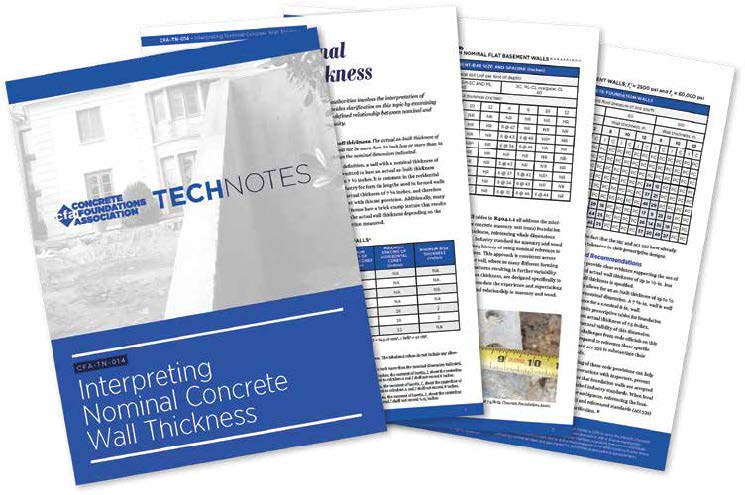
To address this, the Concrete Foundations Association (CFA) produced a new Technical Note dedicated to this specific topic. You can check out CFA-TN-014: Interpreting Nominal Wall Thickness on the CFA website or by scanning the QR code on page 19 of this issue. This resource consolidates the relevant code sections from the IRC, ACI 332 and state-specific examples into a single, easy-to-reference document. The goal of this Technical Note is to provide members with a “field-ready” tool. When an inspector questions a 7 5/8-inch wall, a contractor can simply present this document, which clearly outlines the code path validating the system. This initiative underscores the value of the CFA, taking complex technical hurdles and transforming them into practical solutions that keep your business moving forward.
As with any concrete mixture, it is essential to conduct trial batches to confirm the specific properties of the concrete. Final results can be affected by various factors, such as temperature, humidity and the specific components used in the mixture. We recommend consulting a local concrete foundation professional for guidance.
Please note that no information provided herein should be interpreted as a warranty or guarantee, whether expressed or implied. This includes, but is not limited to, any implied warranty of fitness for a particular purpose.