CFA Tech Note 014: Interpreting Nominal Concrete Wall Thickness
Introduction
A frequent point of discussion between contractors, designers and code authorities involves the interpretation of “nominal” versus “actual” concrete wall thickness. This technical note provides clarification on this topic by examining relevant building codes and industry standards. Understanding the code-defined relationship between nominal and actual dimensions is essential for ensuring compliance and project continuity.
Analysis of Code Requirements
The International Residential Code (IRC) and ACI 332, Residential Code Requirements for Structural Concrete can be used to answer the question of whether a nominal 8-in. wall thickness, which is an actual wall thickness of 7 1/2-in., meets the code requirement for an actual 8-inch wall. State and local jurisdictions, such as the Wisconsin Uniform Dwelling Code (UDC), frequently adopt or reference these documents.
International Residential Code (IRC)
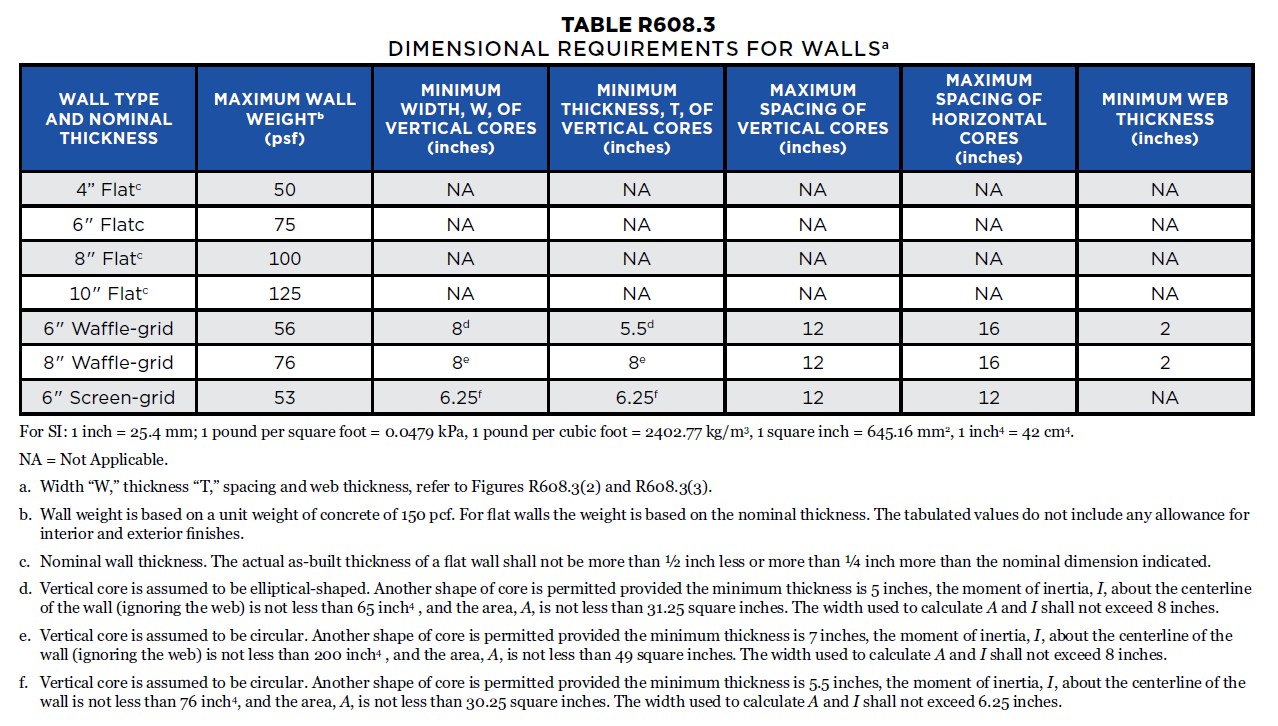
The IRC provides a clear definition for the allowable tolerance of nominal wall thickness. Section R404.1.3.1 directs users to Table R608.3 for concrete cross-sectional dimensions. Sub-note “c” within this table states: Nominal wall thickness. The actual as-built thickness of a flat wall shall not be more than 1/2 inch less or more than 1/4 inch more than the nominal dimension indicated.
Based on this definition, a wall with a nominal thickness of 8 inches is permitted to have an actual as-built thickness of not less than 7 1/2 inches. It is common in the residential foundation industry for form tie lengths used in formed walls to result in an actual thickness of 7 5/8 inches, and therefore is fully compliant with this IRC provision. Additionally, many foundation wall forms have a brick stamp texture that results in variability to the actual wall thickness depending on the specific cross section measured.
IRC Wall Reinforcement Tables
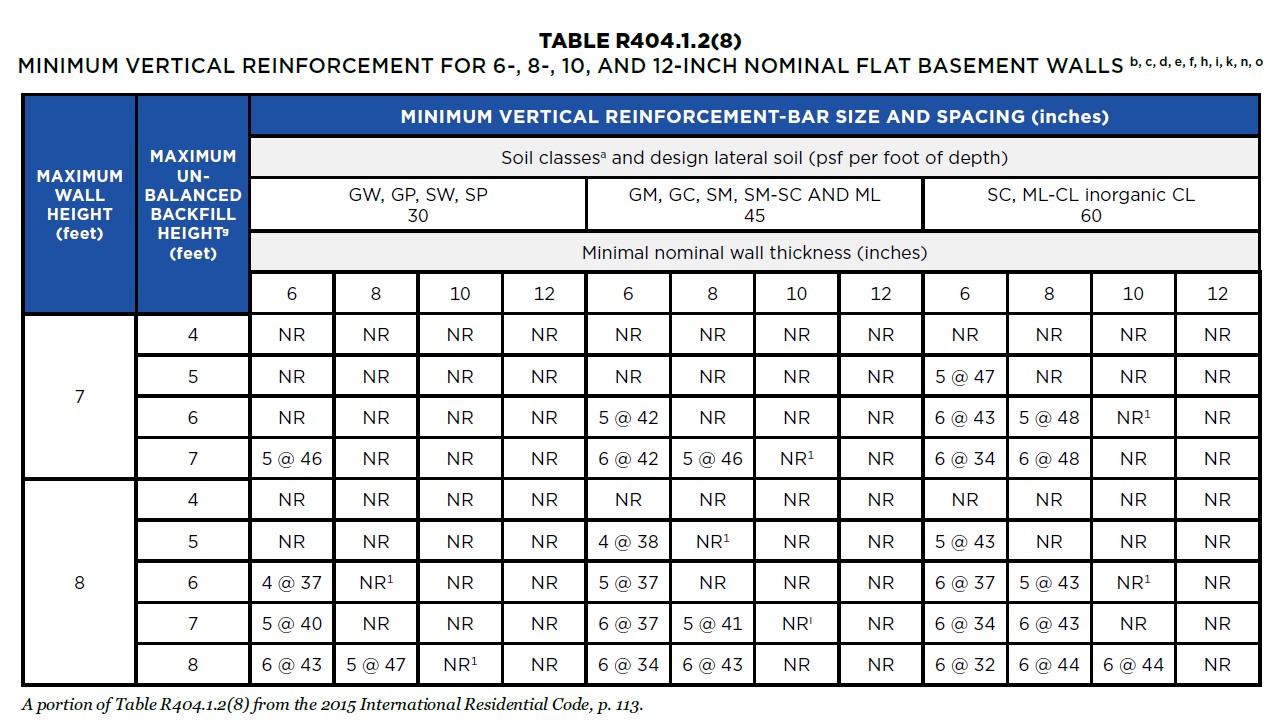
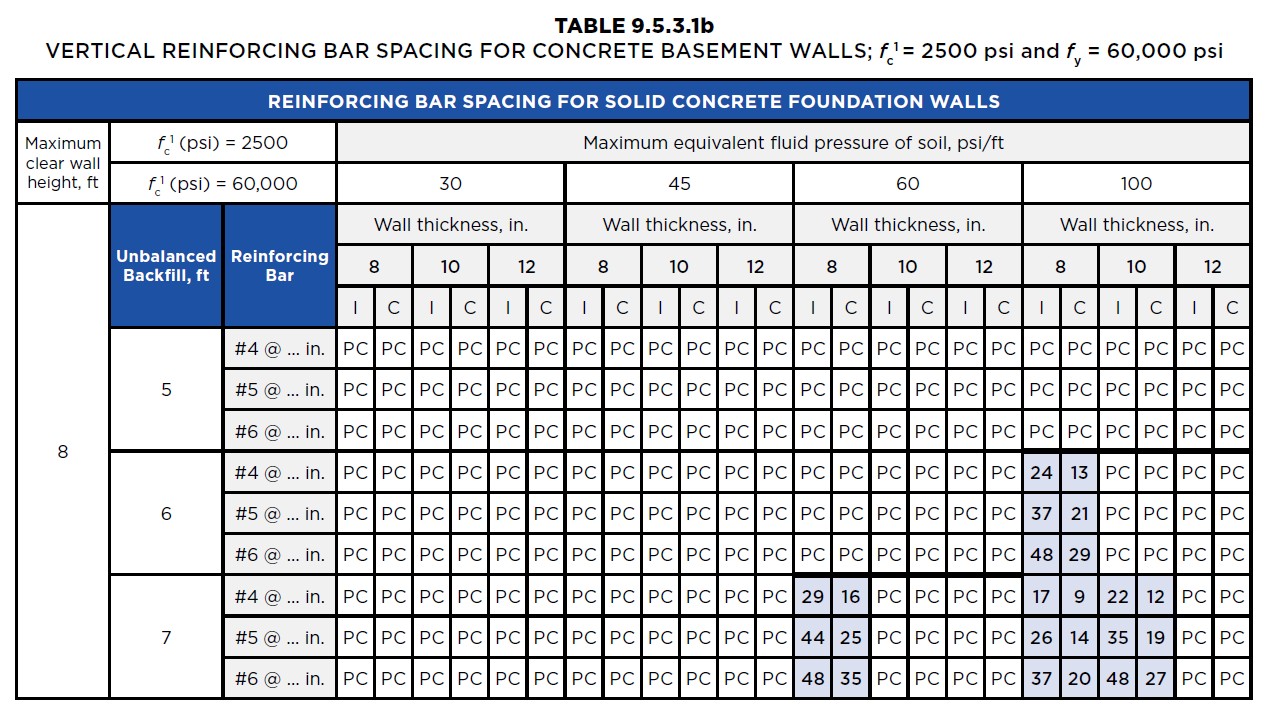
Above is a portion of Table R404.1.2(8) from the current International Residential Code, one of seven tables in chapter 4 for foundations pertaining to concrete walls and reinforcement requirements. Four of these tables address the construction of flat concrete walls, built with either insulated concrete forms (ICFs) or removable concrete forms. These tables all use the term “nominal” in the title and provide footnotes that reference the acceptable dimensional tolerance as identified in Table R608.3. This table demonstrates the approach to wall construction using a variety of wall thickness and reinforcement pattern solutions. The sub-note “i” from this table states: See Table R608.3 for tolerance from nominal thickness permitted for flat walls.
The preceding wall tables in R404.1.1 all address the minimum standards for concrete masonry unit (cmu) foundation walls of nominal thickness, referencing whole dimensions from 6 to 12 inches. Industry standard for masonry and wood dimensions have a long history of using nominal reference to infer actual dimensions. This approach is consistent across building standards as well, where so many different forming systems, many with patterns resulting in further variability of the wall cross section thickness, are designed specifically to interact with or accommodate the experience and expectations of this nominal vs. actual relationship to masonry and wood.
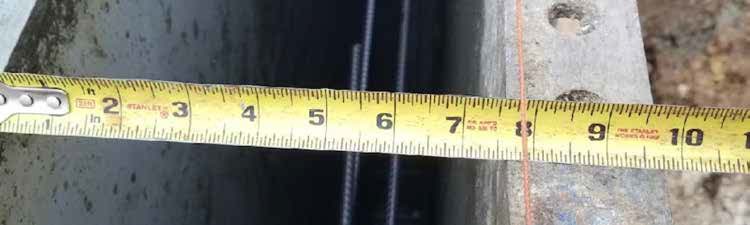
Fig. 1: Concrete wall forms set for residential foundation showing a nominal 8-in. wall thickness with an actual thickness set at 7 5/8-in. Concrete Foundations Assoc.
Structural Concrete
ACI 332 is established as an accepted alternative in the IRC and is often referenced or chosen directly by state codes, like the Wisconsin UDC. It offers more detailed prescriptive requirements for residential concrete walls. The standard provides tables for plain and reinforced concrete walls based on specific, actual minimum thicknesses.
- ACI 332-20, Section 9.3.1.2 establishes that the minimum uniform wall thickness shall be 7 1/2 inches.
- ACI 332-20, Tables 9.5.3.1 (a) thru (j) are prescriptive tables based on a “Specified minimum actual wall thickness” of 7 1/2 in., 9 1/2 in. and 11 1/2 in. but refer to them in the table as 8 in., 10 in. and 12 in.
The ACI 332 standard directly validates the structural adequacy of a 7 1/2-inch actual wall thickness for applications where a nominal 8-inch wall is specified. The performance values and prescriptive tables within ACI 332 are engineered with this minimum actual thickness in mind, confirming that a 7 5/8-in. wall performs as intended under the specified design conditions.
The UDC permits a “nominal” wall thickness and, by referencing ACI 332, implicitly accepts the engineering basis for a minimum 7 1/2-inch actual thickness. The inspector’s concern that a 7 5/8-in. wall does not meet the structural requirements of an 8-in. wall is addressed by the fact that the IRC and ACI 332 have already accounted for this tolerance in their prescriptive designs.
Conclusion and Recommendations
The building codes provide clear evidence supporting the use of an industry standard actual wall thickness of up to 1/2-in. less where a nominal wall thickness is specified.
- The IRC explicitly allows for an as-built thickness of up to 1/2 inch less than the nominal dimension. A 7 5/8-in. wall is well within this tolerance for a nominal 8-in. wall.
- ACI 332 establishes its prescriptive tables for foundation walls on a minimum actual thickness of 7 1/2 inches, confirming the structural validity of this dimension.
- Contractors facing challenges from code officials on this matter should be prepared to reference these specific sections of the IRC and ACI 332 to substantiate their construction methods.
A thorough understanding of these code provisions can help facilitate productive conversations with inspectors, prevent project delays, and ensure that foundation walls are accepted as compliant with established industry standards. When local codes appear simplified or ambiguous, referencing the foundational model codes (IRC) and referenced standards (ACI 332) provides the necessary clarification.
Learn more about this and all our tech notes on the CFA website. Want to put your knowledge to the test? Learn more about certification and where to find the ACI and IRC codes at cfaconcretepros.org/certification.
As with any concrete mixture, it is essential to conduct trial batches to confirm the specific properties of the concrete. Final results can be affected by various factors, such as temperature, humidity and the specific components used in the mixture. We recommend consulting a local concrete foundation professional for guidance.
Please note that no information provided herein should be interpreted as a warranty or guarantee, whether expressed or implied. This includes, but is not limited to, any implied warranty of fitness for a particular purpose.
CFA Downloadable Tech Notes
CFA offers a variety of technical notes ready for download on the CFA website. These are the technical notes currently available: