2025 Projects of the Year: The Category Winners
The 26th annual Concrete Foundations Association (CFA) competition invited members to showcase their most outstanding projects, competing for recognition as some of the most celebrated achievements in the industry’s history. The entries, a collection of 24 unique and intricate submissions, spanned 11 categories, ultimately resulting in 14 projects being honored this year.
While the projects themselves are the centerpiece of this program, the accompanying statistics highlight the Association’s leadership and the remarkable milestones achieved. Representing 13 U.S. states and one Canadian province, the entries came from locations as diverse as Utah and California in the West, Connecticut and Rhode Island in the East, British Columbia in the North, and Texas and Georgia in the South. A total of 15 members contributed to this year’s submissions, demonstrating the widespread participation and commitment of CFA members. The projects varied significantly in scale, with the largest covering 14,760 square feet of building area and the smallest just 111 square feet. One particularly impressive project utilized nearly 1,130 cubic yards of concrete and 186,186 pounds of steel reinforcement. Altogether, the competition saw the use of 8,590 cubic yards of concrete and 889,161 pounds of steel reinforcement, along with numerous other essential materials, underscoring the scale and complexity of the work submitted.
For many CFA members, this awards program serves as a vital platform for marketing their companies and showcasing their expertise. Longtime participants include Herbert Construction Company of Marietta, Ga., SCW Footings and Foundations of Salt Lake City, Utah, Custom Concrete of Westfield, Ind., Talpey Construction, LLC of Old Saybrook, Conn., and Ekedal Concrete, Inc. of Irvine, Ca. These companies, among others, recognize the value of the CFA in promoting the exceptional quality of their work and gaining industry recognition.
“It’s incredible to witness the growth of the Projects of the Year awards program over the years,” said James Baty, executive director of the CFA. “In 2020, we celebrated six winners and now, just five years later, we’re recognizing fourteen projects. This growth reflects the enthusiasm of our members to share the innovative and unique work they’re doing.”
Baty also emphasized the high standards set by CFA members, saying, “Each year, I’m inspired by how our members continue to raise the bar for quality and technological advancements in the cast-in-place industry. These awards are a testament to their innovation, craftsmanship and creativity, which are on full display in every project submitted.”
Grand Project of the Year: Single Family 5,001 to 10,000 Sq. Ft.
Mills Foundations
Parsons Residence – Stonebridge Subdivision
Branson West, Missouri

This single-family home serves as a prime example of advanced construction methods and innovative problem-solving to overcome challenging site conditions. The project under-scores the importance of meticulous planning and technical precision in residential builds.
Spanning 5,300 square feet, the poured wall system was custom-engineered to accommodate a dramatic 35-foot elevation difference on the property. To ensure structural stability and seamless integration, the foundation incorporated 32 continuous footing steps.
The team constructed structural and retaining walls reaching up to 20 feet in height. These elements required 197.25 cubic yards of concrete and 6,000 pounds of reinforcing steel, emphasizing the scale and complexity of the project.
To stabilize the site, approximately 200 linear feet of retaining walls were built, balancing both structural integrity and functional design. Additionally, 141 linear feet of stacked forms were employed to construct walls up to 20 feet high, addressing the steep elevation changes. A three-level elevator shaft was also embedded into the poured wall system, showcasing the team’s ability to coordinate intricate structural elements with precision.
The construction process faced challenges from high-temperature conditions. To ensure the concrete remained workable and structurally sound, a retarder and super plasticizer were added to the mix. This adjustment extended the finishing time while preserving the quality of the concrete.
Efficient on-site operations were achieved through streamlined material deliveries and close collaboration between subcontractors.
This project offered several key insights. The stepped foundation provided a practical solution for extreme elevation changes, while heat-resistant concrete, achieved through mix modifications, successfully addressed environmental constraints. Furthermore, integrating structural components like retaining walls and the elevator shaft optimized both functionality and design, resulting in a highly efficient and durable build.

Single Family Foundation <2,000 Sq. Ft.
Uni-Foundations Inc.
Lake Holiday Project
Cross Junction, Virginia
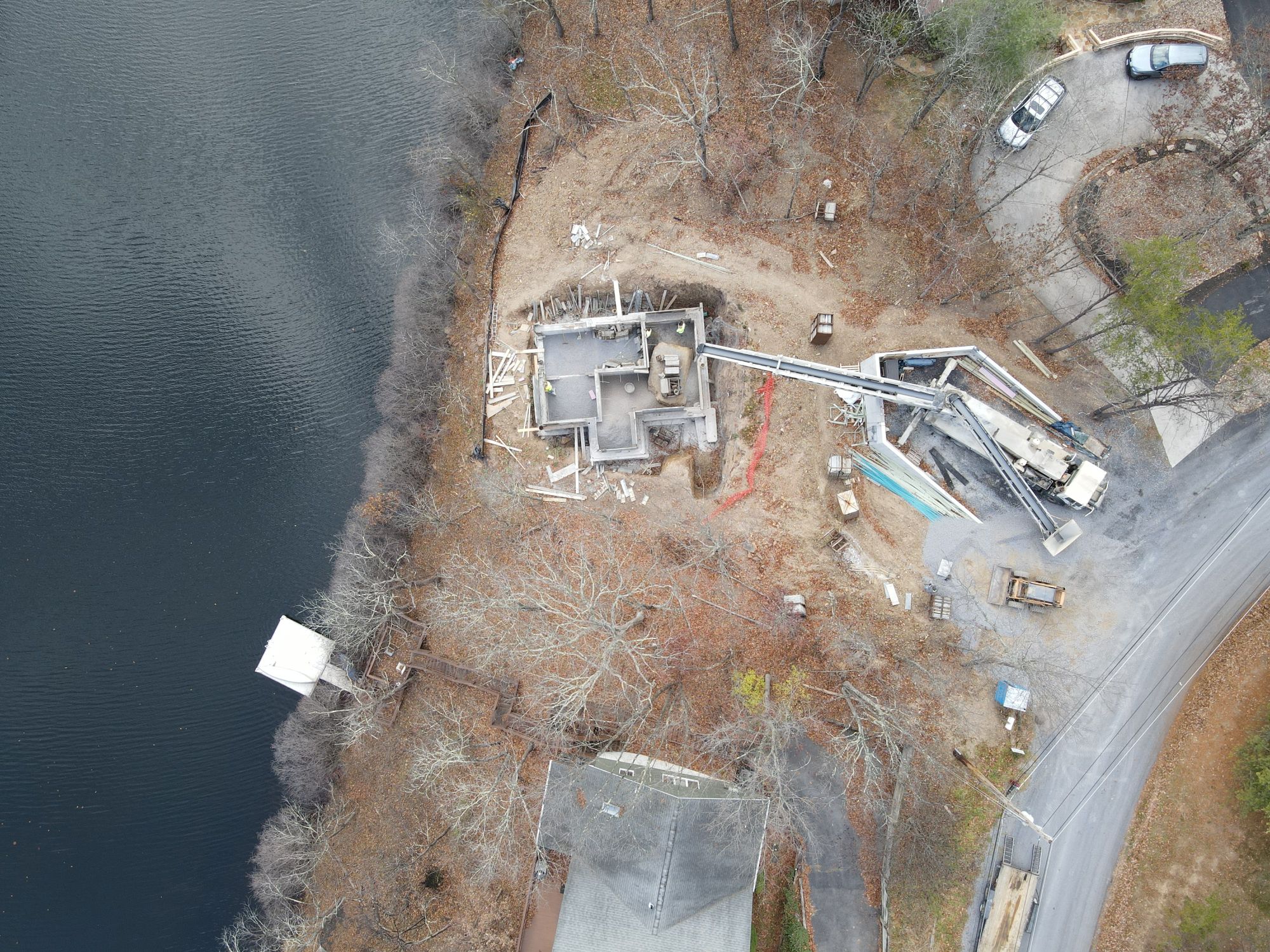
The project involved constructing a compact residence on a steeply sloped site, necessitating innovative approaches due to significant elevation changes. The foundation included footings with a 12-inch thickness. Exterior footings measured 36 inches wide, while interior footings were 24 inches wide. A total of ten stepped footings ranged from one to five feet in height. Fiberglass reinforcement, specified per the homeowner’s request, was utilized throughout, eliminating the need for traditional steel reinforcement.
The walls varied significantly in height and thickness to adapt to the terrain. Heights ranged from 32 feet at the tallest exterior sections to 25 feet, with interior walls spanning from nine feet to a minimum of three feet. The wall thicknesses were between ten and 24 inches, showcasing precision in structural adaptation. The total volume for wall concrete was approximately 130 cubic yards.
Of notable complexity was the parking area retaining wall, which supports a walking bridge providing the sole access to the residence. This feature required meticulous planning and placement, adding 80 cubic yards of additional concrete. Limited site access demanded manual transport of formwork and materials, supplemented by crane use where feasible. This project achieved engineering excellence by addressing unique challenges and delivering a high-quality result tailored to the site’s demanding conditions.

Single Family Foundation 2,000-5000 Sq. Ft.
MJ Lorenz Concrete
Christmas Lake Curve
Shorewood, Minnesota
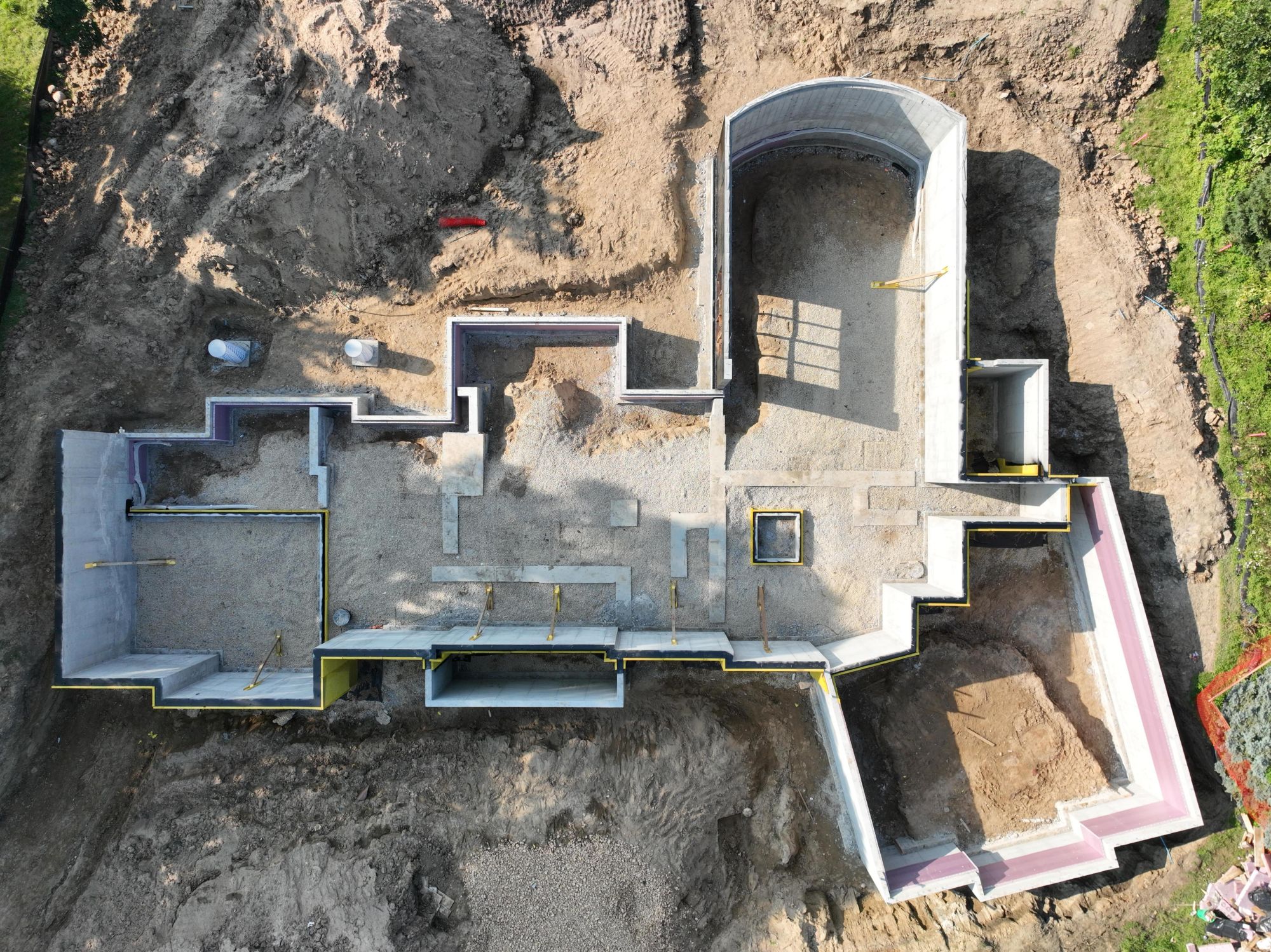
This residential project consisted of constructing a cast-in-place concrete foundation that required 207 cubic yards of concrete and 8,000 pounds of reinforcing steel. The footings, measuring 20 inches to 24 inches wide and ten inches thick, included two #4 continuous rebar and structural bulkheads to manage multiple elevation changes. Forming techniques for the curved wall footing utilized short board sections for precise shaping.
The walls, with varying heights of 4 feet, 10 feet 9 inches, 11 feet 9 inches, 13 feet, and 14 feet 7 inches, featured thicknesses of 8 feet, 10 feet, and 14 feet. A curved wall with a pre-cast bearing ledge and an exterior brick ledge presented unique challenges. Insulation foam was cut and mitered to create seamless ledges, and one-sided wall ties were implemented due to intricate detailing. Total Station technology was employed for precise layout of the curved wall and framing lines post-pour.
Despite the complexities, the entire wall assembly was achieved in a single pour, meeting both safety and scheduling targets. This meticulous approach ensured alignment with the general contractor’s timeline. The project demonstrated proficiency in handling complex geometries, implementing advanced layout techniques and coordinating detailed reinforcement and formwork solutions to deliver a high-quality structure ready for framing.

Single Family Foundation 10,000-15,000 Sq. Ft.
Herbert Construction Co.
Lake Rabun Hose
Lakemont, Georgia

This construction project features a residential property with intricate technical demands, successfully addressed through precise planning and innovative techniques. The total project spanned 14,760 square feet, utilizing 1,130 cubic yards of concrete and a reinforced steel framework weighing approximately 186,186 pounds, categorized by #4, 5, 6, 7 and 8 rebar sizes. Wall heights reached up to 35 feet, with varying thicknesses and complex configurations, including radius and sloped designs.
Eighty-eight distinct footing details were incorporated, including 34 step footings totaling nearly 62 linear feet, with precise elevation control. The project required 23 concrete pours and included multiple top-of-wall elevations, creating structural intricacies demanding continual adjustment.
Custom innovations included Hancock-style brackets, facilitating the second and third wall lifts, and enhanced by integrated OSHA-compliant scaffolding. The steep site necessitated phased construction and precise logistics. Each phase featured waterstop integration at key joints to ensure durability and water resistance.
Challenges included managing plan modifications during construction, fostering close collaboration among architects, engineers, and subcontractors. Computer-aided design (CAD) drawings supported detailed planning, while specialized materials, such as an acrylic fortifier at control joints, enhanced durability. Despite tight conditions and remote access, the team executed the project with technical precision, achieving an outstanding residential structure that exemplifies high-quality craftsmanship.

Non-Foundation Structural Element
SDP Concrete Ltd.
Walls to Nowhere
Coquitlam, British Columbia, Canada

The project involved constructing cast-in-place concrete walls with a total volume of 32 cubic yards, featuring 15 cubic yards allocated to footings and 17 cubic yards for walls. The footings were designed with precision, featuring dimensions of 2 feet by 10 inches. Additional complexity was introduced by double-stacking two-by-ten wooden planks in some areas and stacking a two-by-four atop a two-by-ten in others. Steps ranged from five feet to 8 feet 7 inches wide and 32 inches high.
Wall structures were designed at eight-inch thickness with heights under ten feet. Unique features included five rake walls extending 12inches above future stair nosings and angles such as 53-, 58- and 45-degreecorners. State-of-the-art formwork techniques were employed, including beveled plywood for seamless joints and chamfer strips for clean, visible edges. Ensuring an architectural finish, walls were formed using new paper-faced plywood, snap ties, and 2x lumber.
Key processes involved CAD-based 3D modeling for precise layouts, robotic total stations for accurate positioning and collaboration with GPS-enabled excavation tools. Despite challenges including warped plywood, the team achieved tight deadlines within 13 days, demonstrating exceptional foresight, craftsmanship and efficient resource use. This project displays meticulous attention to detail, ensuring both technical precision and aesthetic excellence.

Above-Grade Concrete Home
Origin Concrete, Inc.
Summer Residence
Malabar, Florida
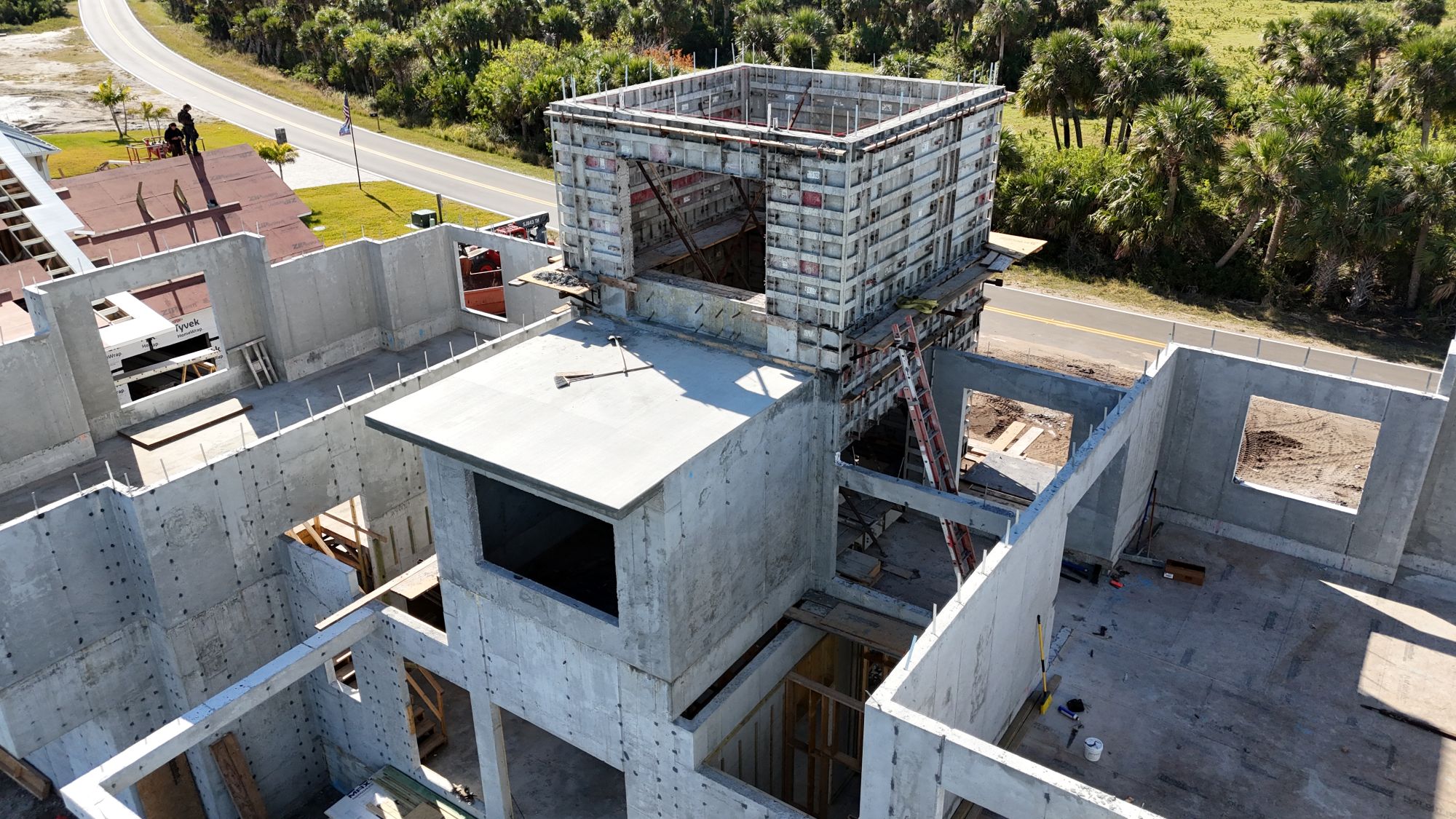
This residential project spans 9,496 square feet and utilizes 438.5 cubic yards of concrete, reinforced with 47,000 pounds of steel. The wall structures are notably complex, with heights ranging from four to 41 feet and thicknesses of six, eight and 12 inches. The construction integrates six cantilevered wall areas and a cantilevered deck positioned 32 feet above ground level. Additional features include radius site walls, cantilevered beams and numerous precision openings requiring tight tolerances.
The project utilized advanced materials and systems to achieve its objectives. All forming was executed using custom-engineered formwork systems. Reinforcement was tied with automated rebar-tying tools to enhance efficiency and consistency.
The concrete incorporated micro-reinforcement for improved strength and durability, and pumping was facilitated by high-capacity equipment. Control joints were completed using specialized waterproofing products to ensure longevity and performance under varying conditions.
Exceptional planning and collaboration were key to addressing technical challenges, with input provided at the design stage to refine structural solutions. This residence exemplifies resilience and architectural versatility, demonstrating the potential of concrete to realize highly intricate designs. By leveraging innovative materials and techniques, the project offers a durable, disaster-resistant housing solution that meets both functional and aesthetic criteria.

Above-Grade Commercial Concrete Project
Fox Blocks
White Shield Old Scouts Veterans’ Memorial Center
White Shield, North Dakota

The project features a 12-sided dodecagon structure spanning 10,900 square feet of insulated concrete form (ICF) walls, emphasizing precision and innovation. This design required exact angular measurements for all 12 corners, ensuring structural integrity and achieving a geometry inspired by traditional construction techniques.
The ICF system provided continuous double-layer insulation, integrated fastening strips and a reversible interlock system. These features minimized thermal bridging while enhancing structural performance. Glued laminated timber (glulam) embed plates were incorporated within the walls to anchor the roof structure. The roof’s structural system included a central compression ring and a custom geo-dome skylight, ensuring efficient load distribution and maximizing natural light.
Specialized earth berms along the exterior served as additional insulation, while improving the building’s energy performance and visually integrating it with its surroundings. These design choices enabled a 35-percent reduction in Energy Use Intensity as well as optimized thermal efficiency for harsh climates.
Construction was completed in 25 days for the ICF walls, saving approximately 40 days compared to traditional methods and reducing costs by $120,000 during extreme winter conditions. The project demonstrates the adaptability and efficiency of advanced formwork systems, achieving sustainability and durability while meeting cultural and technical complexities with innovative solutions.

The Rest of the Best
Along with the category winners, seven additional projects received high enough evaluation scores to be named award recipients this year. Six amazing projects by SCW Footings & Foundations of Salt Lake City, Utah, were deemed exceptional: Nocek Residence, Fox Mountain Retreat, Marshall Pavilion, Hyde Residence, Velvaere Lot 27 and Cutler Residence. Fox Blocks, Omaha, Neb., also had the highly rated Texas Ranch House. The fun of CFA awards season doesn’t stop here; in the winter issue of Concrete Facts, we will be covering the “rest of the best” of the project award winners.