Design and Construction of GFRP Reinforced Residential Concrete

Bent Bars Ready for Shipment
By Danielle Kleinhaus, Mateenbar Composite Reinforcements
Greetings fellow CFA members! Is your crew tired of hauling steel rebar around your job sites? Are you sick of looking at rusty rebar and rust stains on your concrete? With this article, I want to introduce you to a construction innovation that you can apply to your business today. Fiberglass, or glass fiber reinforced polymer (GFRP), rebar is now code-approved and available for use in residential construction. Lighter weight, easy to cut and with a higher tensile strength than comparable steel products – GFRP rebar is a proven advancement in concrete reinforcement, ready for your next project. Let’s take a closer look at what’s changed and how it can cut labor time, resist corrosion and help you deliver better results.
Mateenbar Composite Reinforcements is a proud CFA member. With a legacy of over 30 years in fiberglass rebar innovation, we continue to serve the residential market, supporting homebuilders of all sizes with proven reinforcement solutions. Following the 2024 acquisition of Owens Corning’s fiberglass rebar facility in Concord, North Carolina, Mateenbar has carried forward the manufacturing expertise behind Pinkbar+, now refined and reintroduced as Greenbar2X.
We look forward to connecting with you at CFACON25 in South Dakota in July, where we are serving as Educational Sponsor. Be sure to visit our booth to learn more about these advancements and how they can be applied in residential construction.
GFRP Reinforcing Bars for Concrete Construction
ASTM A615 “Standard Specification for Deformed and Plain Carbon-Steel Bars for Concrete Reinforcement” outlines the material specification requirements for the most common type of steel reinforcement, while ASTM D7957 “Standard Specification for Solid Round Glass Fiber Reinforced Polymer Bars for Concrete Reinforcement” outlines physical, mechanical and durability properties for GFRP reinforcing bars. GFRP reinforcing bars are manufactured using a pultrusion process where strands of glass fiber are pulled through a vinyl ester resin bath and then through a die to mold the glass and resin material into bars that cure to solid form. This precision manufacturing ensures consistent performance, which is critical for structural reliability. While GFRP rebar was initially introduced through experimental applications over 30 years ago, the past decade has seen significant advancement driven by evolving material specifications, structural codes and design guides. These developments within the structural design community have enabled broader adoption across the industry.
Unlike steel reinforcing bars, GFRP reinforcing bars do not exhibit any yielding under load. GFRP reinforcing bars have a higher tensile strength but a lower tensile modulus. Additionally, they are lighter in weight (i.e., they weigh roughly one-third of the weight of steel bars), and the materials are non-ferrous, so there is no corrosion. As with any construction material it is critical to always require GFRP that meets or exceeds the relevant ASTM standards and specifications. Unfortunately, not all products on the market are fully compliant, so verifying adherence to ASTM D7957 is essential to ensure structural integrity and long-term performance.
Construction tolerances are generally specified according to ACI 117 “Specifications for Tolerances for Concrete Construction and Materials” making them the same as for steel reinforcing bars. The lighter weight makes the GFRP bars easier to handle. It is easier to cut, only requiring a small hand saw, and placing and tying follows with the same bar supports and ties as steel. Depending on your placing drawings, the GFRP bars may need to be tied or supported slightly more often based on their lighter weight (i.e. the bars can exhibit a tendency to float in freshly placed concrete) and flexibility (i.e., longer bars will have a tendency to deflect more under their own weight making supports more critical for clear cover). These practical differences in weight, handling and corrosion resistance are exactly what help crews reduce labor time, avoid rust-related issues and deliver cleaner, longer-lasting results.
Since the resin used in the bars cures during the manufacturing process, GFRP bars are not able to be bent in the field. Put another way, any bent shapes need to be formed in the bar in the manufacturing facility (like steel, prior to delivery at the job site in most markets). Because of this process the bends are exact, which we see as an advantage. The bars are formed around the necessary pins and cured in place meaning tolerances, shape and dimensions are exact and more importantly the same time after time. The manufacturing facility serves as mill and fabricator, in a sense, providing both bent and straight bars for the project. In some cases, for longer-legged bends, the bar will need to be supplied in two pieces and then lapped in the field. Lap lengths are generally longer than steel bars but like steel vary based on the design parameters of concrete strength, bar diameter, and so on. Calculations should be made for your specific design.
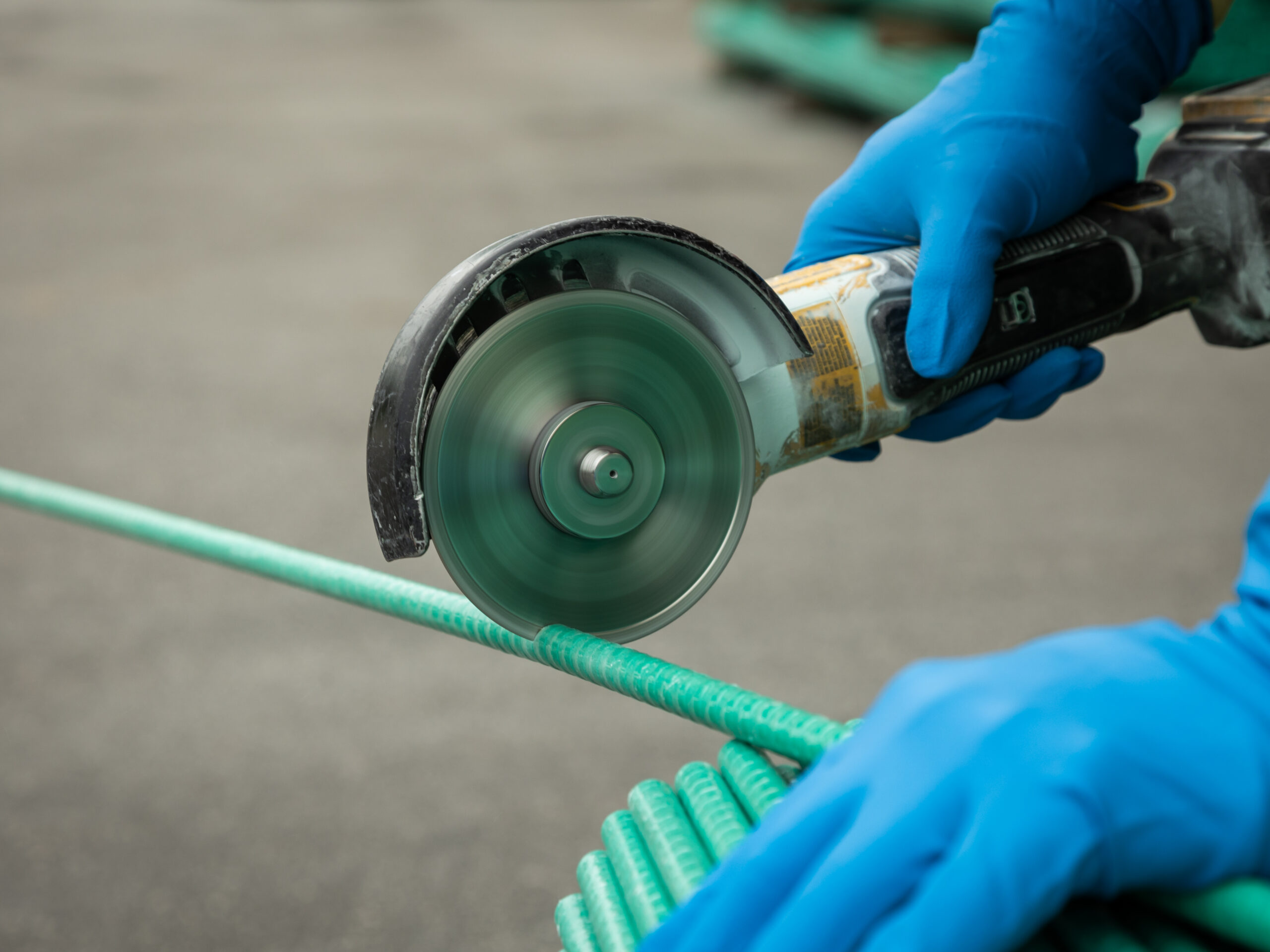
Cutting GFRP with Simple Handtools
Today’s design codes — including ACI, IBC and the IRC — now speak GFRP. And the industry is listening.
Evolution of Design Codes for GFRP Reinforced Concrete Residential Walls
Generally speaking, ACI 332 “Code Requirements for Residential Concrete” covers the design and construction of residential concrete and is referenced and incorporated into the IRC (International Residential Code). ACI 318 “Building Code Requirements for Structural Concrete” is referenced and incorporated into the IBC (International Building Code) to cover building design apart from residential construction. When adopted by a jurisdiction, these Codes become part of the general building code and govern acceptable engineering design and practice.
One of the benefits of ACI 332 (compared to ACI 318) is that it simplifies the design process for several common residential structure configurations namely “one- and two-family dwellings, multiple single-family dwellings, townhouses and…cast-in-place footings, foundation walls and slabs-on-ground.” It offers prescriptive tables that detail the steel reinforcement needed according to the provisions of ACI 318 for a number of design parameters including wall height, concrete strength, wall thickness and maximum earth pressure of the soil. For these prescriptive conditions only, the need for a set of calculations sealed by a licensed design professional is eliminated.
When GFRP reinforcing bars were an emerging technology, the International Code Council Evaluation Services (ICC-ES) developed acceptance criteria for their use in concrete construction. Prior to the publication of ACI 440.11-22 code (more on that in a moment), fiberglass reinforcing would have been permitted under ICC Acceptance Criteria 454 “Fiber–reinforced Polymer (FRP) Bars for Internal Reinforcement of Concrete Members” which allows fiberglass reinforcing materials to meet certain requirements and then be an allowable alternative design to steel reinforcement. That was one path to use that required a full engineering design. Then, with the publication of ACI 440.11 “Building Code Requirements for Structural Concrete Reinforced with Glass Fiber-Reinforced Polymer (GFRP) Bars” in 2022, which was also referenced and incorporated into the IBC, GFRP reinforcing bars are allowed to be used more broadly via another path that requires a full engineering design.

Concrete Pour
Recognizing the ease of the ACI 332 prescriptive tables and related to the topic of GFRP reinforcement, NEx – An ACI Center of Excellence for Nonmetallic Building Materials recently published a comparable document for prescriptive residential design using GFRP reinforcement. MNL 6 “Recommended Practice Guidelines for FRP Bars in Pre-Engineered Projects” currently provides guidance connecting the principles outlined in ACI 440.11 to ACI 332. These tables outline reinforcement requirements in a similar format to ACI 332 for GFRP reinforcement meeting the ASTM D7957 material specification. For conditions not covered by these design parameters, of course, a licensed design professional could apply the strength and serviceability requirements in ACI 440.11.
Mateenbar took this one step further for ease of design and use by industry. Our ICC Equivalency Report 5548 “Fiber–Reinforced Polymer (FRP) Bars for Internal Reinforcement of Concrete Members” specifies allowable reinforcement with Mateenbar products for certain residential applications, the same as MNL 6 does in prescriptive tables, but specifically for Greenbar2X and Mateenbar60. The analysis behind the report takes full advantage of the Mateenbar properties, over and above the ASTM specifications.
Suffice it to say, the tools are in place today to use GFRP reinforcing bars without engineering calculations within the design parameters listed in our ICC Equivalency Report and MNL 6, but full design flexibility is also allowed with engineering calculations for structures outside of those limits according to ACI 440.11-22 under the IBC and IRC.
What’s more, ACI 332 committee members have approved revisions to ACI 332 such that GFRP will be included as an “approved material” in accordance with ASTM D7957 and ACI 440.11. This next edition of ACI 332 is scheduled to be published in 2026 and will be inclusive of GFRP reinforcing bars throughout. However, there will likely not be any prescriptive wall tables for GFRP within the code. As a side note, this is similar to the approval for fiber-reinforced concrete (FRC), which is also included in ACI 332 but without specific tables. This is an exciting development for the industry because it will enable GFRP to be used in all residential markets in the US immediately upon publication since ACI 332 is referenced by the IRC.
With industry-recognized standards now firmly in place—supported by ACI, ICC-ES, NEx and other leading organizations—the use of GFRP is no longer emerging, it is established. Contractors seeking to deliver longer-lasting, corrosion-resistant foundations now have the technical backing to do so with confidence. GFRP is ready for use today and worth considering for your next project.
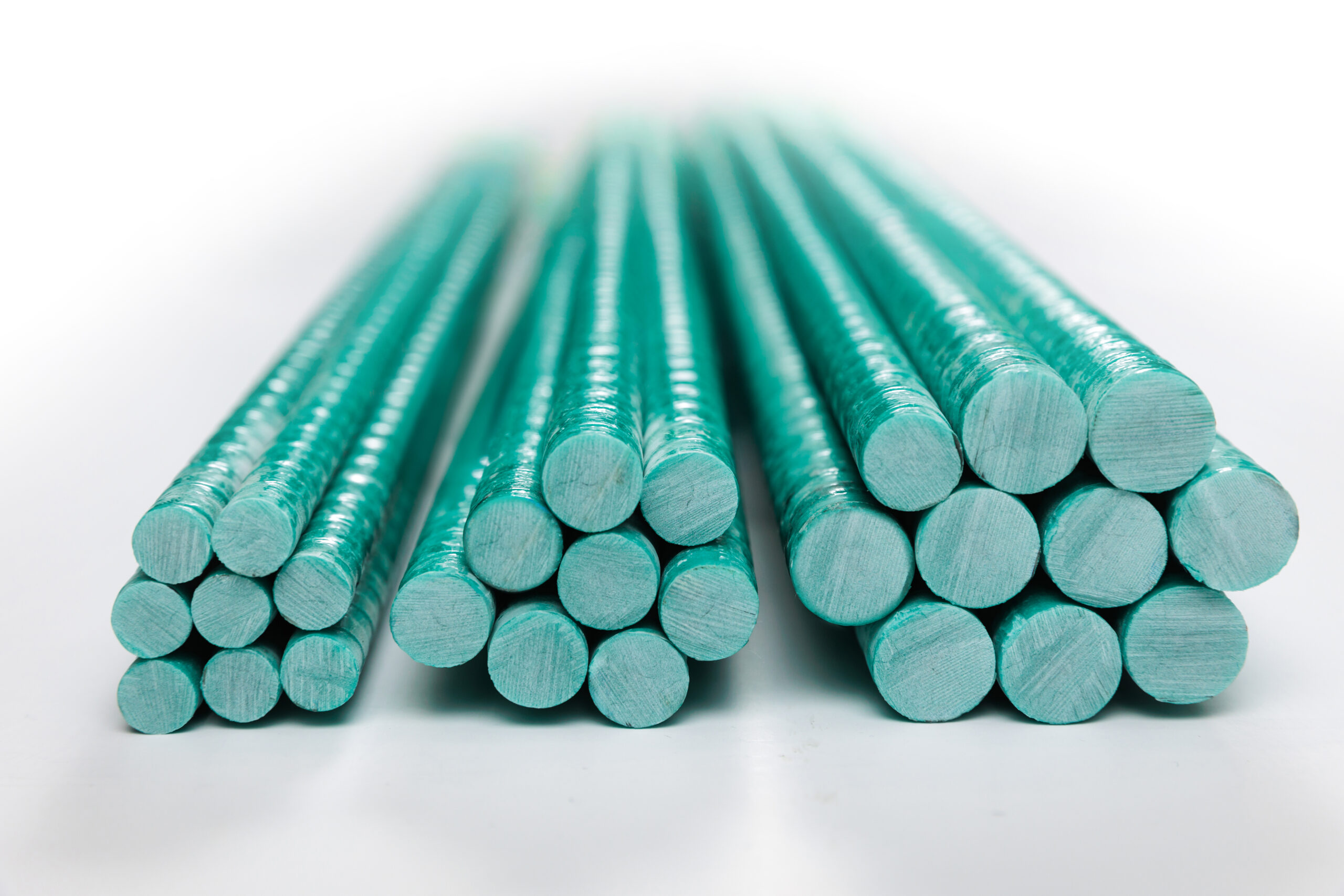
Greenbar2X in Sizes #3, #4, and #5
About Mateenbar Composite Reinforcements, LLC
Mateenbar Composite Reinforcements, LLC produces two product lines of GFRP reinforcing bars – Greenbar2X™ and Mateenbar60™. Greenbar2X™ is perfect for residential projects like foundations, driveways, pool decks, patios, sidewalks and more. In addition, this flatwork product is ideal for light industrial projects like single-story buildings and vertical applications 10ft high or less. Greenbar2X™ is a lacquered, buffed and helically ground rib design, optimized for superior bond strength with concrete. The lacquer provides an additional barrier to the glass fibers in the bar (in addition to work gloves which would always be recommended practice on a construction site), as well as additional UV protection for the product. A distinctive green color enhances visibility and worker safety on construction sites. So, whether you’re forming walls, pouring footings or laying slabs, Greenbar2X™ delivers proven performance, a lighter lift and the durability to outlast steel where it matters most – on your jobsite.
Designed for heavy industrial projects and larger structural applications, Mateenbar60™ is a dependable choice for bridges, multi-story buildings and other demanding infrastructure projects. For both products, the innovative form factor (i.e., the surface preparation that enables the bond to the surrounding concrete) ensures a long shelf life without deterioration and makes for easy handling. As highlighted previously, prefabricated bends are available by order to accompany both products, offering added versatility for customized project needs and making it easier to meet specific design requirements.
Mateenbar® products can be found wherever you currently purchase your construction materials and reinforcing bars. Greenbar2X™ and Mateenbar60™ are sold nationally in “big box stores” including Lowe’s and Home Depot, both in-store and online, a rare achievement in the reinforcement space. The products are also distributed by leading national and regional partners serving infrastructure, commercial and industrial sectors across the US. All products are backed by expert support and inventory across multiple regions to meet demand for large scale, time-sensitive projects.
A Note about Price Stability and Tariffs
The price of the component materials of GFRP reinforcement is relatively stable, unlike steel whose pricing can vary considerably over time based on scrap prices and demand, seasonal variability and other market forces. Advances in manufacturing technology have also resulted in efficiencies that have and will continue to ultimately lower the unit price for GFRP. Our manufacturing plant, located in Concord, North Carolina (just outside of Charlotte), is fully Build America, Buy America (BABA) compliant. While BABA compliance is not currently mandated for residential construction, we view it as both a responsibility and a point of pride. At Mateenbar®, we believe in reinforcing the important things in life — from connecting communities and supporting contractors, to being responsible contributors to the places we live and work. Our commitment to domestic manufacturing ensures that every product we make strengthens not just structures, but the long-term resilience of American infrastructure and the people who depend on it, like you!
GFRP Reinforcing Bars
– lightweight, competitive price point and non-corrosive –
an appealing alternative for your next project!
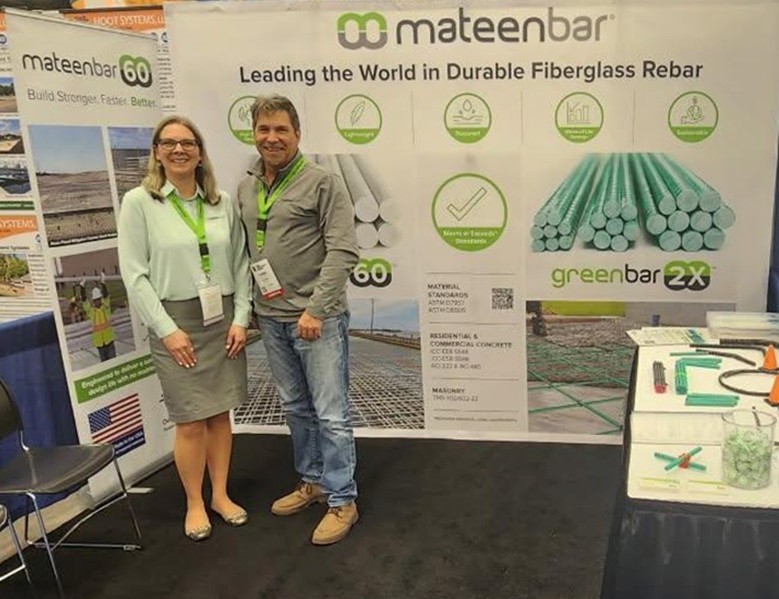
Danielle Kleinhans and Torre LoDolce at The Precast Show, February 2025
About the author: Danielle Kleinhans is Director of Engineering and Business Development for Mateenbar Composite Reinforcements, LLC located near Charlotte, North Carolina. In this role, she is tasked with educating the design and construction community about GFRP reinforcing use in concrete nationwide. She has over 20 years of experience in structural engineering and association management. Prior to joining Mateenbar®, she worked for the Concrete Reinforcing Steel Institute (CRSI), where she most recently served as President and CEO. Before that, she worked at CTLGroup focusing on forensic engineering and at Modjeski and Masters as a structural bridge design engineer. She earned a bachelor’s degree in civil engineering from the University of Alaska-Fairbanks, and a master’s degree and PhD in civil engineering from the University of Missouri-Rolla. She serves on numerous industry committees related to reinforced concrete construction, is a licensed professional engineer and a fellow of the American Concrete Institute.